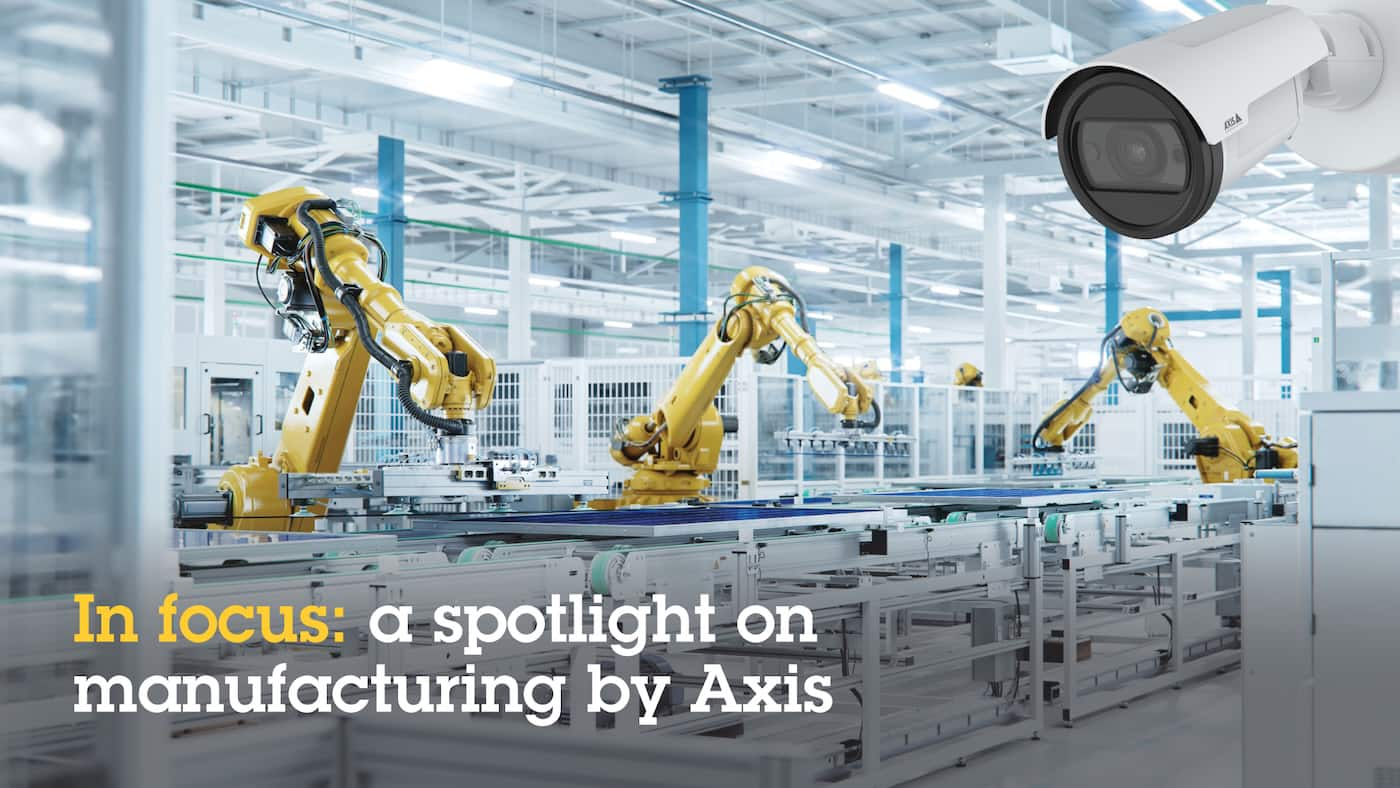
Axis Communications has identified a shift in how UK manufacturers use camera networks, with visual intelligence moving beyond site protection and into everyday operational decision-making.
Research commissioned by the company found that 39% of UK manufacturing decision-makers expect operational efficiency and productivity to deliver the greatest future value from security systems, ahead of security and incident prevention at 33%. Rising costs were cited by 57% of respondents as the strongest pressure on their businesses, increasing interest in tools that can improve visibility across production, safety, logistics, and maintenance.
Network cameras have traditionally been specified around perimeter security, access control, evidence capture, and incident response. As factories connect more equipment and collect more operational data, the same infrastructure is increasingly being used to monitor bottlenecks, unsafe behaviour, material flow, equipment use, loading bay activity, and the condition of critical areas where machine data alone gives an incomplete picture.
A camera mounted above a production line can still support security and safety, but it can also show where operators repeatedly intervene, where materials are queuing, and where a process is being slowed by layout, handling, or communication problems. Visual data from yards, warehouses, and loading bays can strengthen both security and planning by giving teams a more accurate view of movements that affect dispatch, turnaround, and production continuity.
Manufacturers have spent years investing in sensors, PLC data, manufacturing execution systems, and dashboards, yet many factory operations still include manual work, older equipment, mixed processes, and physical flows that do not appear clearly in machine telemetry. Visual intelligence can help close that gap when it is connected to analytics, alerts, maintenance routines, health and safety processes, and production management rather than left as a passive video feed.
The expansion of camera use also demands careful governance. Video infrastructure carries cybersecurity, privacy, retention, and access control requirements, especially when footage is combined with analytics or integrated with wider factory systems. Digitalisation can improve productivity, but unsecured devices and poorly managed data routes can create operational risk. That same discipline is already shaping operational technology projects, where legacy controls and production continuity have become central concerns as factories connect older systems to modern networks.
Camera networks also sit at the edge of the factory, where real-time decisions often need to be made. Processing visual data locally can reduce latency, limit bandwidth requirements, and support faster alerts. That becomes relevant where the system is being used to identify unsafe conditions, detect unauthorised access, flag process abnormalities, or support quality checks during production rather than after the event.
Energy and maintenance pressures strengthen the case for more practical use of existing infrastructure. Many manufacturers already have cameras installed but are not using them as part of wider operational improvement work. Adding analytics, improving integration, and defining clear workflows can extract more value from installed assets without waiting for a complete digital factory rebuild.
The strongest deployments will be those built around defined use cases rather than broad technology adoption. A system designed to reduce forklift near-misses will need different camera positions, alert thresholds, and response procedures from one designed to monitor packaging quality or identify stoppages on a line. The technology becomes useful when the visual information leads to action that operators, engineers, supervisors, or maintenance teams can trust.
Visual intelligence is likely to become a more normal layer of industrial information architecture, sitting alongside machine data, safety systems, environmental monitoring, and production software. Camera networks will still protect sites, but in factories under cost, labour, and throughput pressure, their larger role may be to make physical operations visible enough to improve.