Armstrong Industrial has expanded its gas heating range with individual boilers that can operate as standalone units or be combined into larger modular systems and packaged boiler houses. The approach allows capacity to be installed in smaller increments, giving industrial and commercial facilities a route to increase heating output, introduce redundancy or stage boiler operation without committing to a full multi-unit plant before the demand exists.
Armstrong’s current condensing technology is specified at gross efficiencies of up to 98.2% under the conditions required for condensation, with fully modulating burners offering a 6:1 turndown ratio. Turndown determines how far the burner can reduce its output while remaining in continuous operation, so a wider range allows the boiler to follow falling heat demand for longer before cycling becomes necessary.
That behaviour is important in facilities where the thermal load changes across production shifts, seasons or individual processes. A system sized for maximum demand can spend much of its operating life below that peak, and repeatedly switching a boiler on and off is a different operating regime from continuously modulating at reduced output. Armstrong’s modular architecture adds another level of control because several smaller boilers can be sequenced together, allowing capacity to be brought online progressively as demand rises.
Dividing output across multiple units can also provide resilience, although the amount available during a failure depends on how much spare capacity was designed into the system. A plant running every boiler near maximum load has little redundancy simply because several units are present; a correctly sized modular arrangement can instead allow one boiler to be taken offline while the remaining units continue serving an acceptable proportion of the process load.
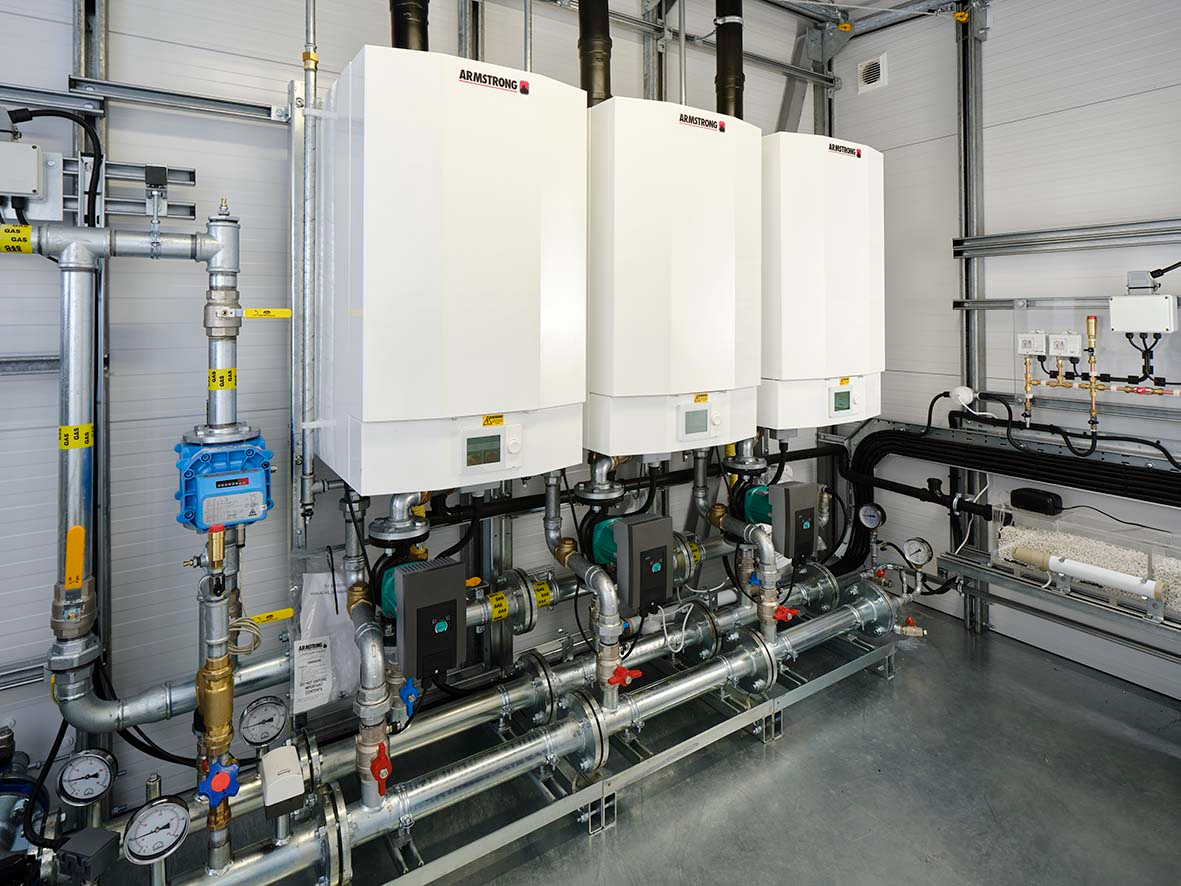
Armstrong can package boilers with pumps, valves, pressurisation equipment, controls and electrical systems inside fabricated plant rooms assembled away from the final site. Moving more mechanical and electrical integration into a factory reduces the amount of fabrication required around an operating facility, while pre-assembly allows pipework, equipment arrangement and control interfaces to be checked before the system arrives for final connection.
Off-site assembly does not eliminate commissioning because gas, electricity, flues, process pipework and building controls still have to be connected and tested at the destination. It does, however, change where much of the labour occurs, which can be valuable during brownfield upgrades where a production shutdown is expensive and the available installation window is short.
System efficiency remains dependent on the wider hydraulic design. Armstrong’s 98.2% figure applies under condensing conditions, which require sufficiently low return-water temperatures for latent heat in the flue gas to be recovered, while pumps and valves determine how water is circulated through the heating circuit. A high-efficiency boiler operating in an unsuitable system will not spend its working life at the headline efficiency simply because that number appears on the specification sheet.
Controls therefore become as important as the boiler hardware once several units are connected. Intelligent sequencing can decide which boilers operate, how heavily each is loaded and when another unit should start, while remote monitoring and diagnostics give maintenance teams access to operating information without attending the plant for every inspection. Armstrong also supports remote reset capability where the fault and operating condition allow it.
The company already applies packaged heating systems in industrial environments, including gas infrastructure where boiler output has to track changing process conditions. The expanded individual-boiler range takes the same system architecture into a broader group of applications covering manufacturing, chemicals, pharmaceuticals, water treatment, food and beverage, and oil and gas, where hot water or process heating remains a critical utility rather than a background building service.
The engineering case is ultimately about matching capacity more closely to the load profile. A facility can begin with individual boilers, combine them into a sequenced system and add capacity later where the surrounding gas, electrical, hydraulic and control infrastructure has been designed to accept it; the technology does not remove those constraints, but it gives operators more increments in which to plan around them.