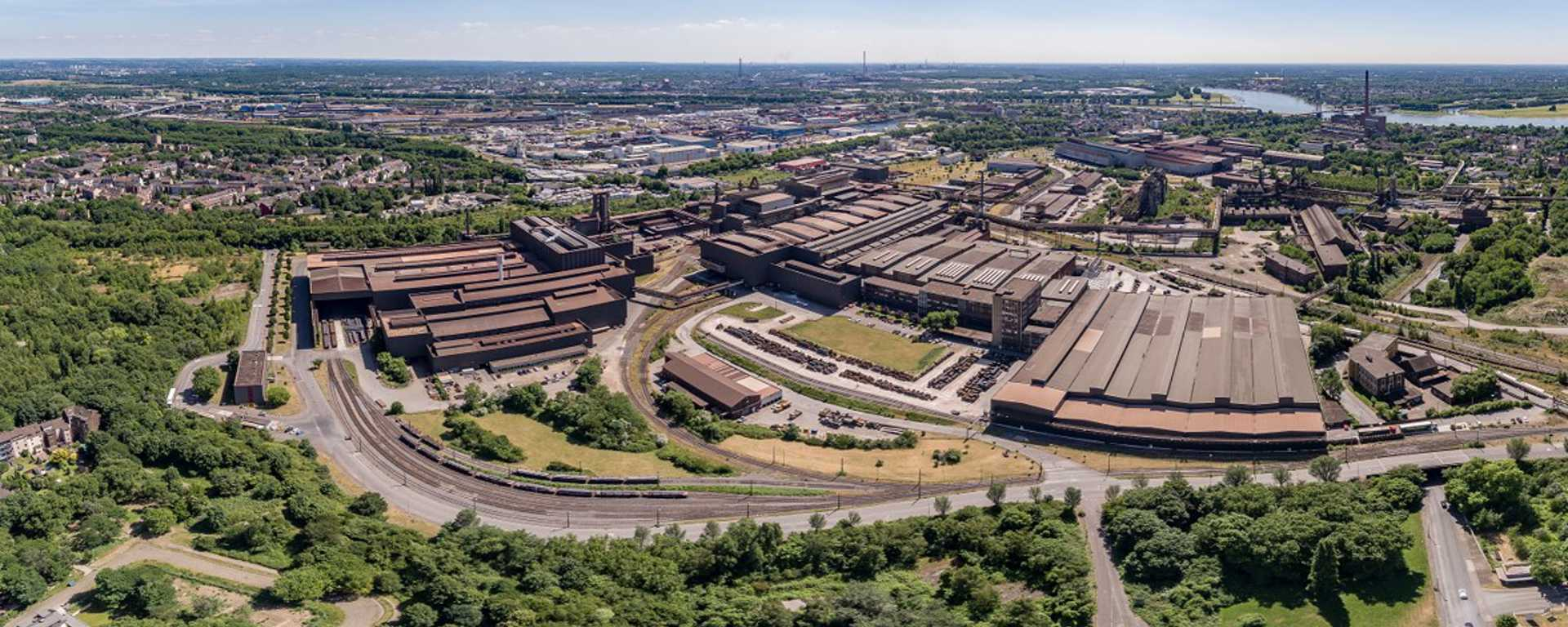
ArcelorMittal plans to close steelmaking and billet rolling at its Duisburg operation after the site’s hot-metal supply agreement expires in September 2027, restructuring the plant around wire-rod production supplied with semi-finished billets from elsewhere.
The proposal remains subject to approval by the ArcelorMittal Duisburg supervisory board. If it proceeds, the steel shop and billet rolling mill would leave the production route, while the wire-rod mill would continue operating with billets supplied by other ArcelorMittal sites and external European producers.
The change follows ArcelorMittal’s December 2024 decision to terminate its hot-metal supply contract with thyssenkrupp Steel from September 2027. The company said the proposed renewal involved a significant cost increase and that subsequent work on alternative hot-metal supplies and possible steelmaking decarbonisation routes had not produced an economically viable option.
Duisburg would consequently remain an operating steel-processing site, but with a substantially shorter manufacturing chain. The plant currently contains two oxygen converters, secondary-metallurgy equipment, vacuum treatment, bloom and billet casting, a billet rolling mill, inspection and conditioning equipment, and wire-rod production.
Removing the upstream stages would make billet availability one of the site’s most important external production dependencies. Semi-finished steel has to arrive with the required chemistry, metallurgical cleanliness, dimensions, surface condition, and process history if the downstream mill is to maintain the properties customers expect from finished wire rod.
The Duisburg mill supplies grades used in automotive, mechanical-engineering, energy, and other industrial applications, including cold-heading steels, spring grades, bearing steels, and specialist wire rod. Finished wire-rod dimensions extend from 5.5mm to 25mm, with much of the material destined for further drawing, forming, or component manufacture.
ArcelorMittal has identified its Hamburg operation as one potential billet source. Hamburg uses a direct-reduction and electric-arc-furnace route and combines billet casting with wire-rod production, giving the group an internal source of semi-finished material produced through a different process from Duisburg’s existing oxygen-steelmaking route.
The company says Hamburg billets could also offer Duisburg a lower-carbon supply option. Other ArcelorMittal plants and external European producers are expected to provide the remaining material, creating a more distributed feedstock model rather than replacing one hot-metal supplier with another.
That flexibility comes with an operational trade-off. A steel shop feeding an adjacent rolling mill can adjust production schedules around downstream requirements; a plant dependent on externally produced billets has to manage transport, inventory, supplier scheduling, specification consistency, and disruption across a wider network.
The restructuring will also alter material flows elsewhere in ArcelorMittal’s European long-products business. Duisburg currently supplies much of the semi-finished material consumed at the group’s Gandrange operation in France. Once Duisburg stops producing billets, Gandrange is expected to source material from several other ArcelorMittal sites and external suppliers.
ArcelorMittal has linked the proposal to wider pressure across the European bars and rods sector, citing low capacity utilisation, declining local demand, restricted export opportunities, and high energy costs. Those pressures are particularly difficult for primary steelmaking because furnaces, converters, casting equipment, gas systems, and utilities carry substantial fixed costs even when volumes fall.
The decision also illustrates the economic difficulty surrounding European steel decarbonisation. Lower-emission production routes can involve direct reduction, electric furnaces, renewable electricity, hydrogen-compatible infrastructure, and extensive changes to raw-material supply. The technology is only one part of the decision; utilisation, energy prices, capital requirements, policy support, and customer demand determine whether the conversion can support a viable operating model.
Duisburg’s proposed route instead retains the downstream process where ArcelorMittal believes there is a sustainable business while moving primary steelmaking elsewhere. The site would effectively change from a steelmaking-and-rolling operation into a processor whose most important incoming raw material is already cast into billets.
The workforce implications have not yet been finalised. ArcelorMittal plans to begin social dialogue connected with a redundancy programme during September 2026, with the eventual employment impact dependent on consultation and the operating structure approved for the remaining plant.
There is still around a year before hot-metal supply ends. During that period, ArcelorMittal will need to qualify alternative billet sources, establish logistics, maintain customer specifications, and make the transition without interrupting wire-rod deliveries.
The critical measure after September 2027 will therefore be continuity rather than nominal capacity. Duisburg may continue rolling specialist steel, but it will be doing so with a production system whose upstream risk has moved from inside the plant to a network of billet suppliers across Europe.