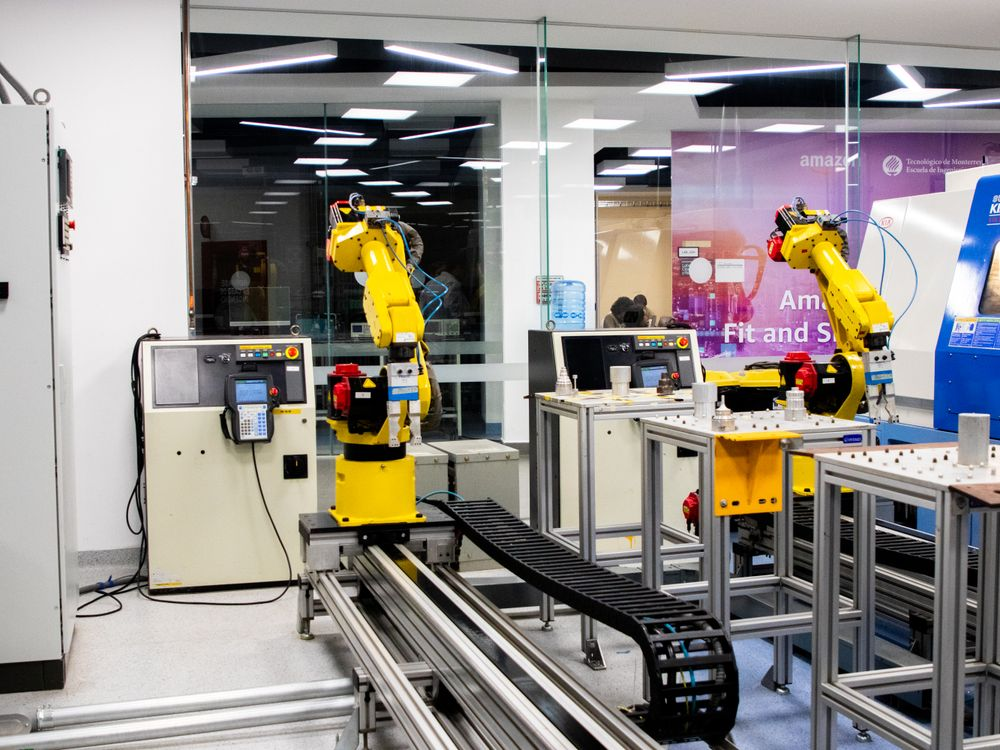
Advanced Manufacturing Innovation Centre has formally opened its Factory of the Future at Global Point in Newtownabbey, completing an almost £100m Belfast Region City Deal investment intended to give manufacturers access to robotics, automation, advanced materials, digital twins, artificial intelligence, metrology and machining without requiring each business to reproduce the same infrastructure in-house. The ceremony on 6 October marks the formal opening rather than the start of operations, because the 10,500 sq m facility has already been working with companies since April 2026.
Led by Queen’s University Belfast alongside Ulster University and Antrim and Newtownabbey Borough Council, AMIC has been built around a familiar problem in manufacturing technology adoption: a process may work in research or under supplier demonstration conditions without yet being sufficiently understood to justify capital expenditure on a live production line. By giving companies access to engineering teams, manufacturing equipment and measurement capability in one location, the centre is designed to move more of that proving work outside the customer’s operating factory, where mistakes are generally more disruptive and considerably more expensive.
The technologies gathered inside the facility are useful partly because they interact. A robotic process cannot be judged only on whether an arm reaches the required position; component presentation, fixtures, sensing, guarding, cycle time and downstream inspection all affect whether automation produces repeatable parts. Digital twins depend in turn on reliable physical data, while advanced metrology provides the measurements needed to determine whether a supposedly improved process is actually holding tolerance. Housing those capabilities together makes it possible to test a production system rather than a collection of isolated technologies.
Project 4WARD provides an early example of that approach. The £9.5m programme brings AMIC together with Hyster-Yale, Terex, 4DNI, Nugent Trailers and Datum Tool Design to develop welding automation, an area where apparently simple robotisation can be undermined by changing joint geometry, component variation, heat input, fixture accuracy and the sequence in which assemblies are built. Automating the torch movement is only one part of the problem; the line also has to present the work consistently, control the process and provide enough inspection evidence to show that the resulting welds are acceptable.
Manufacturers using AMIC can therefore test how a proposed system behaves before it is committed to their own floor space, labour model and production schedule. That is particularly relevant to smaller businesses, where buying a robot cell, high-end metrology system or specialist machining platform purely to discover whether a process is viable can be difficult to justify. Shared facilities reduce that initial capital barrier, although the commercial decision still remains with the manufacturer once a process has been demonstrated and the likely integration cost becomes clearer.
The Factory of the Future is also being used for work on energy efficiency, renewable energy, circularity and resource consumption, which puts environmental performance into the same engineering environment as productivity. Reducing process energy or material waste is useful only if output, quality and reliability remain acceptable, so the centre can measure those variables together rather than treating decarbonisation as a separate corporate exercise. The same principle applies to digitalisation: additional data has little value unless it improves a decision about production, maintenance, quality or resource use.
Queen’s expects AMIC to support up to 1,500 jobs across Northern Ireland, contribute £1.3bn to the economy and help train 300 apprentices by 2050. Those figures are long-term projections rather than guaranteed outcomes, and a building full of advanced equipment does not in itself create the claimed productivity gain. The more useful measure will be the volume of industry work moving through the centre, the proportion that progresses into commercial deployment and whether businesses return with second and third projects after the first technology trial.
Skills form part of the same equation because new equipment changes the work required around it. A manufacturer that introduces automated welding, digital twins or higher-end metrology still needs people who can maintain the system, interpret its data and change the process when production conditions move outside the original assumptions. AMIC’s apprenticeship and industry programmes are intended to develop that capability alongside the hardware, reducing the risk of investment arriving faster than the engineering knowledge needed to operate it effectively.
The centre’s first six months of operation mean that the formal opening comes after the more consequential transition from construction project to working industrial facility. Laboratories, an engineering hall, metrology capability and specialist manufacturing equipment are now being used by businesses rather than waiting behind a ribbon-cutting date, while programmes such as 4WARD provide an early test of whether shared innovation infrastructure can move from demonstration into factory deployment.
Almost £100m has bought Northern Ireland a substantial manufacturing technology base; the return will depend on what leaves the building. Equipment trials that end as presentations will add little, whereas processes that survive engineering validation, reach production and continue to perform under commercial conditions would give AMIC the industrial role its scale suggests.