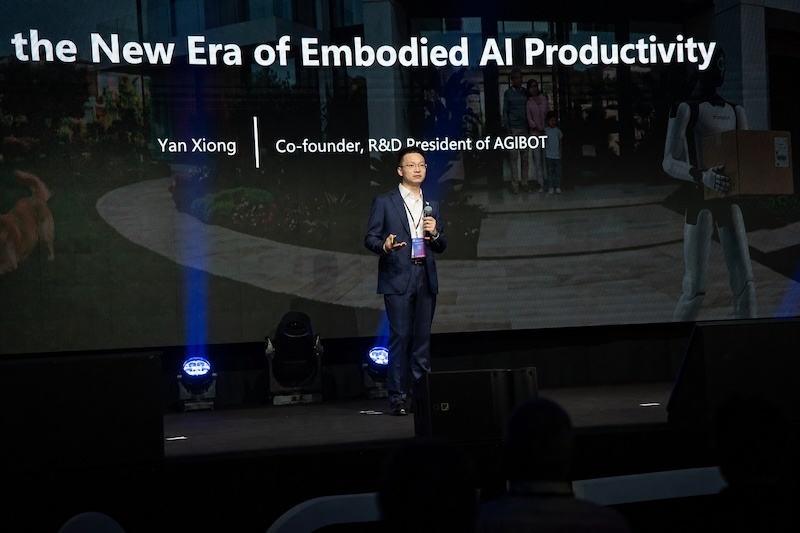
AGIBOT has introduced its A3 humanoid robot to the European market and outlined a UK Robot-as-a-Service model designed to move humanoid systems into commercial trials and early deployment.
The company presented the A3 during its UK APC2026 partner conference in London, where it set out local support plans, rental options, and wider ambitions for embodied AI. In the UK, humanoid robots will be available to rent from £1,999 per day, while quadruped systems will be available from £899 per day, with operational support included.
The A3 platform weighs 55kg and uses a lightweight structure reinforced with magnesium alloy and titanium alloy. AGIBOT states that the robot has a dual-battery system, up to 10 hours of nominal battery life, and 10-second battery swapping. Those features put attention on serviceability and endurance, two areas that will define whether humanoid robots can operate in real environments rather than remain confined to demonstrations.
The company is targeting use cases across education, logistics, commercial services, facilities, and industrial environments. A rental model lowers the initial barrier for organisations that want to assess humanoid robotics without committing to ownership before task fit, safety procedures, supervision, and operating cost are understood.
Humanoid robotics is entering a more practical phase. The commercial question is no longer whether a robot can walk, carry, gesture, or respond to commands in a controlled setting. The test is whether it can complete routine tasks safely, repeatedly, and economically in spaces that were designed for people rather than machines. That includes handling interruptions, unclear routes, changing objects, mixed human traffic, and equipment that was not built for robotic interaction.
The attraction of humanoid systems is clear in brownfield environments. Factories, warehouses, laboratories, hospitals, campuses, and commercial sites already contain doors, stairs, shelves, trolleys, handles, tools, and workspaces designed around human movement. A robot that can operate in those settings could reduce the need for expensive redesigns. In practice, however, the human form creates demanding requirements around balance, sensing, actuation, collision avoidance, battery life, maintenance, and safety validation.
AGIBOT’s rental model may help expose those requirements earlier in the buying cycle. Trials can generate data on energy use, downtime, operator interaction, task duration, payload limits, navigation, supervision, software updates, and maintenance. That information is more useful than speculative adoption forecasts because it shows where humanoid systems fit, where they do not, and which tasks need redesign before automation makes sense.
Safety will carry much of the engineering burden. Humanoid robots are expected to work near people, often in less structured spaces than conventional robot cells. Site risk assessments must cover speed, reach, stopping behaviour, obstacle detection, human proximity, emergency procedures, software failure, manual intervention, and responsibility during supervised or semi-autonomous operation.
Perception technology will be one of the enabling layers. Robots operating near people need reliable awareness of objects at different heights, unpredictable human movement, and partially occluded spaces. New safety-certified sensing systems, such as three-dimensional detection for robot and mobile automation applications, show how machine safety is evolving to match more flexible robot behaviour.
The UK market is likely to test humanoid robotics carefully. Labour availability, service continuity, and productivity pressures create interest, but industrial buyers will still judge systems by uptime, integration effort, maintainability, safety, and measurable return. A humanoid may be impressive, but a conventional AMR, cobot, fixed automation cell, or process redesign may still be the better engineering answer for many tasks.
AGIBOT’s European debut gives the UK a structured route to explore the technology without treating early adoption as a capital equipment gamble. Commercial deployment will depend less on spectacle than on disciplined trials, clear operating procedures, reliable local support, and proof that humanoid systems can solve work that existing automation handles poorly.