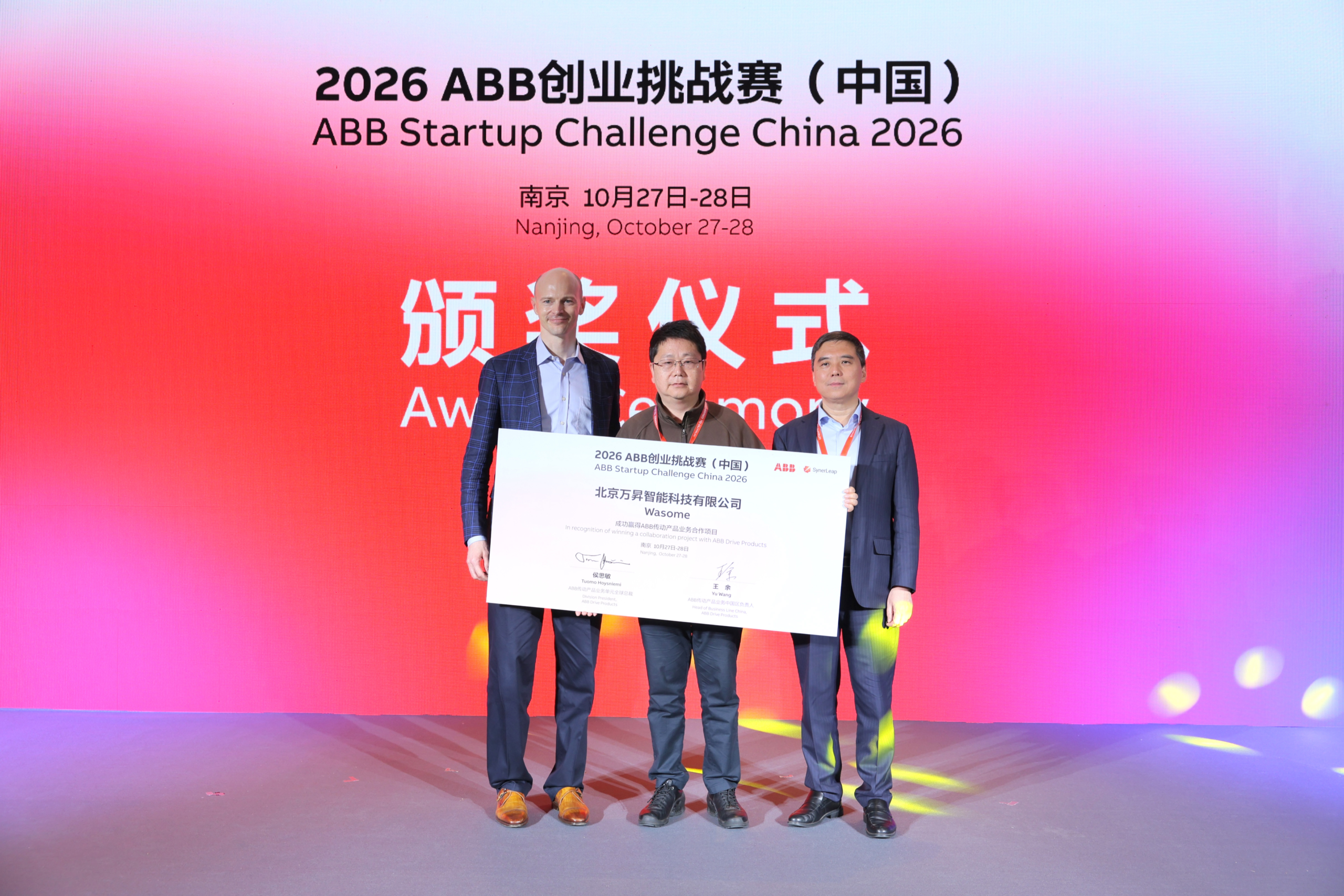
ABB has selected Chinese startup Wasome as the winner of its Startup Challenge China 2026, establishing a collaboration to develop AI assistance for industrial automation engineering. ABB’s Drive Products division will work with the company through the SynerLeap innovation platform on software intended to support programming, commissioning, fault investigation and maintenance of automation systems.
Seven finalists presented their technologies in Nanjing, and Wasome will receive a CNY 200,000 project award alongside SynerLeap support. The event was the seventh edition of the ABB Startup Challenge and its first in China. ABB specialists will now work with the winning company on a potential market-ready solution for customers and partners; the competition award itself is not a product launch.
Programming and commissioning an industrial machine involves several interdependent systems. A controller has to coordinate drives, sensors, safety interlocks, communications and equipment sequences, while engineers configure the components and test their behaviour under the machine’s operating conditions. Changes to one device can affect others through control logic, network messages or process timing.
The number of settings and diagnostic messages increases that engineering workload. A variable-speed drive may expose extensive motor and application parameters, while a programmable logic controller needs verified routines for starting, stopping and responding to abnormal conditions. A fault code can originate in a drive, wiring, sensor or mechanical load, so diagnosis requires measurements and system context as well as a lookup in product documentation.
ABB and Wasome intend to explore how an AI assistant could guide engineers through documentation, configurations and troubleshooting procedures. The intended scope includes day-to-day programming and commissioning rather than a general-purpose question-and-answer service. Details of the final product, supported hardware and user interface will be determined through joint development.
Recommendations produced by such software would still need checking against the actual installation. A proposed motor parameter must match the drive and machine load; a suggested controller change may affect interlocks, communications and operation during a fault. Engineering teams need to validate any changes before applying them to running machinery, particularly where safety-related functions are involved.
Relevant engineering information is often spread across drive manuals, PLC project files, wiring diagrams, commissioning records and maintenance histories. An assistant intended to help with a specific installation would need to account for the versions and settings actually in service, rather than returning a procedure suitable for a different machine. Engineering teams would also need a clear method of checking any recommendation before acting on a live control system.
Troubleshooting can require engineers to move between machine-level observations and several layers of documentation. A drive trip, for example, may call for checking supply conditions, motor cabling, application limits and the control signals commanding the drive. A guided search could shorten time spent locating relevant instructions, while measurements and equipment condition would still determine the diagnosis.
Original equipment manufacturers encounter the same issue when adapting a standard machine design to several customers. Control sequences and equipment selections may be reusable, but electrical arrangements, mechanical loading and local site standards change between installations. A useful engineering assistant would have to distinguish standard configuration steps from those requiring project-specific review.
ABB’s Drive Products division supplies motor-control and variable-speed drive technology across industrial applications. Configuration and commissioning influence how such equipment interacts with a plant’s process and can affect machine availability and power consumption. The proposed AI collaboration is therefore being developed around a defined engineering workflow, with any integration into existing ABB tools and services still to be established.
ABB engineers will work with Wasome on a solution suitable for possible introduction to the company’s customers and partners. SynerLeap will provide development support and access to ABB specialists, while the CNY 200,000 award supports the startup’s work. Commercial availability and any customer trials will depend on the development work.
ABB has also expressed interest in exploring collaboration with other finalists from the Nanjing challenge. The wider programme gives startups an opportunity to test product concepts with industrial specialists, but the practical scope of each collaboration depends on the engineering tasks and equipment selected for development.
Tuomo Hoysniemi, division president of ABB Drive Products, said: “We see enormous potential in partnering with these startups to co-develop solutions that address customer needs and can scale locally and globally.” His remarks accompanied ABB’s decision to hold the challenge in China and extend its search for partners in automation engineering.
The engineering validation required for a future AI-assisted tool extends from the accuracy of its technical references to the treatment of equipment-specific constraints. Suggested parameter or programme changes will have to be checked against the installed system before implementation; incomplete records, conflicting document versions and changes to machine configuration can all affect the usefulness of a recommendation.
The first deliverable from the ABB–Wasome partnership will be joint development work to establish which engineering tasks the software can support and how it fits customer processes. The eventual product scope, testing arrangements and any market launch remain decisions for that programme.