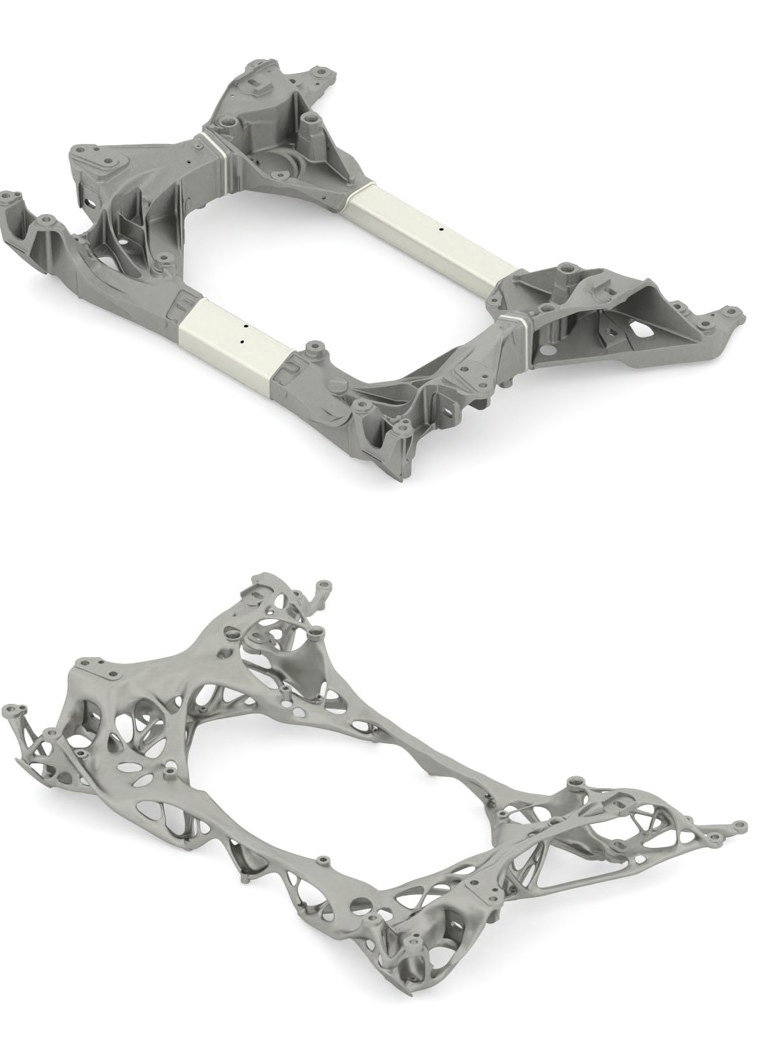
Coventry foundry Sarginsons Industries has produced a cast aluminium front subframe prototype for the £5.8m PIVOT automotive research programme, moving a previously optimised design into a physical component. Its manufacture used inorganic sand core printing, and the consortium is preparing rig tests to compare actual structural performance with the simulation results used during development.
The front subframe was designed to be 17% lighter than the component it would replace. A separate rear subframe design has a calculated 35% mass reduction and has reached design freeze, but it has not been reported as a completed physical prototype. Both figures come from the consortium’s earlier virtual design work rather than measured weight savings from validated production parts.
PIVOT stands for Performance Integrated Vehicle Optimisation Technology. Led by Sarginsons, the programme brings together Aston Martin, Altair, Brunel University of London and metals recycling company Gescrap, with Siemens design tools also featuring in the work. The Advanced Propulsion Centre records a total project value of £5.8m and £2.9m of funding from the Department for Business and Trade through the APC. Its objective is to improve the design and production of lighter aluminium castings using more detailed performance data.
A large structural casting does not necessarily have uniform properties throughout its geometry. Differences in section thickness and local solidification conditions can influence the metal’s microstructure and mechanical response. Designs based on a single conservative property value may therefore require more material than a simulation using credible local property data would indicate. The PIVOT approach attempts to account for those variations before the component is cast.
Sarginsons has developed a database from more than 20 years of material testing and microstructural analysis. The consortium uses that information alongside design optimisation software to assess where material can be removed while retaining required performance under the selected load cases. Manufacturing constraints still have to be represented: a lightweight geometry that cannot be filled or solidified reliably would not provide a viable route to a finished vehicle component.
Topology optimisation can identify regions that contribute less to a selected load case and propose ways of concentrating material where it is more useful. Yet vehicle subframes must tolerate multiple loads and failure modes rather than a single static force. Stiffness, durability, crash behaviour, connections and manufacturability all constrain the design. The project’s use of local material properties is intended to make the simulation less dependent on blanket safety assumptions.
The prototype was produced using inorganic sand core printing, a process that creates core geometry directly from digital data. In a casting, the cores occupy spaces that must remain hollow or inaccessible to conventional tooling, and are removed after the metal solidifies. The printed route can permit more complex internal passages and shapes, but dimensional accuracy, core handling and the quality of the final casting still need to be demonstrated in the physical process.
Casting the design establishes that the geometry can be made using the selected production method. It does not yet validate crash performance, long-term fatigue resistance or repeatability at automotive production volumes. Those questions require physical testing because porosity, local microstructure, dimensions and surface condition can differ between a simulated part and the component delivered from the foundry.
The new front subframe will undergo physical rig testing to examine structural response and durability. Engineers can compare measured deflection, failure behaviour and response to repeated loading with the model’s predictions, then adjust the design or material assumptions where necessary. The consortium has not yet reported completed rig-test results, so the next milestone is an independent check on the performance forecast rather than a new verified mass reduction.
For the rear structure, design freeze means the team has selected the geometry to take into the next manufacturing phase. It should not be conflated with the manufacture of the front prototype. The rear design’s 35% calculated mass saving belongs to that separate component; the newly produced front subframe corresponds to the earlier 17% target.
The programme is also examining the use of recycled, lower-carbon aluminium to reduce the material footprint of structural castings. A lighter part can reduce mass carried by a vehicle, but a full assessment of its environmental performance also requires information about alloy inputs, casting yield, heat-treatment energy and production scrap. No completed lifecycle assessment or series-production yield figures accompanied the prototype disclosure.
Physical testing will determine how closely Sarginsons’ casting data and optimisation approach predict the behaviour of the front subframe. If those results support the design, the consortium can move towards vehicle demonstrator work and further process development. The new achievement is the production of a complex structural casting; the claimed mass savings and durability remain subject to validation.