AP&T has secured an order from US precision metal manufacturer EMT Metals for an integrated servo press line to produce large heat exchanger plates. The installation is intended to establish domestic production capability for plates used in thermal management equipment, including systems serving data centres and electrical infrastructure. AP&T describes it as a particularly large US heat exchanger plate forming project, although the supplier has not published the press force, planned annual output or the value of the order.
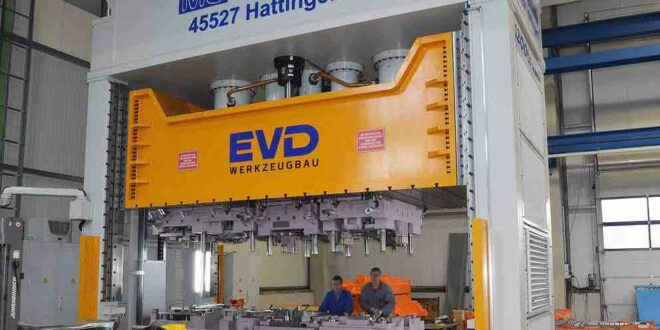
EMT Metals has ordered a complete production system rather than a single standalone press. The core of the installation is a large servo press configured to form precision plates, supported by the other stages required to create a repeatable industrial production process. AP&T expects the line to enter operation in late 2026 or early 2027. That is a commissioning expectation, not confirmation that the equipment is already operating or delivering qualified production parts to customers.
Heat exchanger plates create defined channels through which separate fluids can transfer thermal energy without direct mixing. The plate geometry, material selection, surface finish and manufacturing consistency influence pressure drop, heat transfer area and the ability of a completed assembly to seal reliably. Large formed plates must therefore retain the intended geometry across a significant surface area while being produced at rates suitable for equipment manufacturers. Tool design and press control are central to making that repeatability possible.
A servo press allows the speed and position of the slide to be controlled during a forming cycle, rather than following the essentially fixed motion of a conventional mechanical drive. Its profile can be adjusted through demanding stages of a stroke to suit the material and the features being formed. That level of control is relevant when deep or closely spaced corrugations must be reproduced consistently across a large metal plate. Tool condition, feeding accuracy, material properties and process validation will still determine production quality; AP&T has not published EMT-specific figures for reject rates, cycle time or energy consumption.
Large plate formats increase the demand on tool alignment, force distribution and material handling. Even modest differences in formed geometry can affect the contact and sealing surfaces used when plates are assembled into a heat exchanger. A line intended for series production therefore needs to coordinate press operation with feeding, downstream handling and inspection as well as the tooling itself. AP&T has described a complete manufacturing system, but the public information does not identify every module or the target plate dimensions for this order.
EMT Metals was founded in 1946 and manufactures precision components for original equipment manufacturers in demanding sectors. Its existing capabilities include progressive stamping, CNC machining, sheet metal fabrication and assembly. The company says it produces more than 1,100 mission-critical stock keeping units annually across its facilities. The heat exchanger plate investment expands that metal forming background into a product segment where large plate formats and production consistency are central commercial requirements.
The project moved quickly from initial discussions at a Chicago industry conference to a signed equipment agreement in less than two months, according to AP&T. EMT chief executive Mark D. Izzo had previously inspected AP&T installations in Europe, giving the buyer experience of the supplier’s existing heat exchanger plate equipment. Delivery speed was an important factor in the selection. Neither company has disclosed the precise installation site or the expected annual quantity of plates, so the eventual scale of customer supply cannot yet be calculated.
AP&T has supplied heat exchanger plate production lines since the 1980s. It describes the EMT order as its first US installation of this class of equipment, extending experience gained at facilities elsewhere. EMT expects the machinery to help supply North American original equipment manufacturers with large precision plates that might otherwise need to be sourced from more distant production centres. The companies have not quantified the amount of imported plate capacity the installation could replace.
Large data centres use liquid cooling systems and heat exchangers to transfer heat away from densely packed computing equipment, while electrical installations use thermal management to control operating temperatures in other equipment. Plate geometry, pressure ratings and fluid compatibility differ between applications, so EMT’s ability to form large plates consistently will influence the range of equipment manufacturers it can supply. The order does not name any customer contracts or specify which finished heat exchanger designs will use the new production capacity.
AP&T expects the line to be running in late 2026 or early 2027. EMT must first install and commission the machinery, establish stable forming conditions and qualify parts against the requirements of individual equipment makers. Plate dimensions, forming repeatability, line throughput and the range of accepted materials will determine the kinds of thermal management systems that can be supplied. The order establishes a planned manufacturing capability; its contribution to domestic supply will become measurable once customer-qualified production begins.