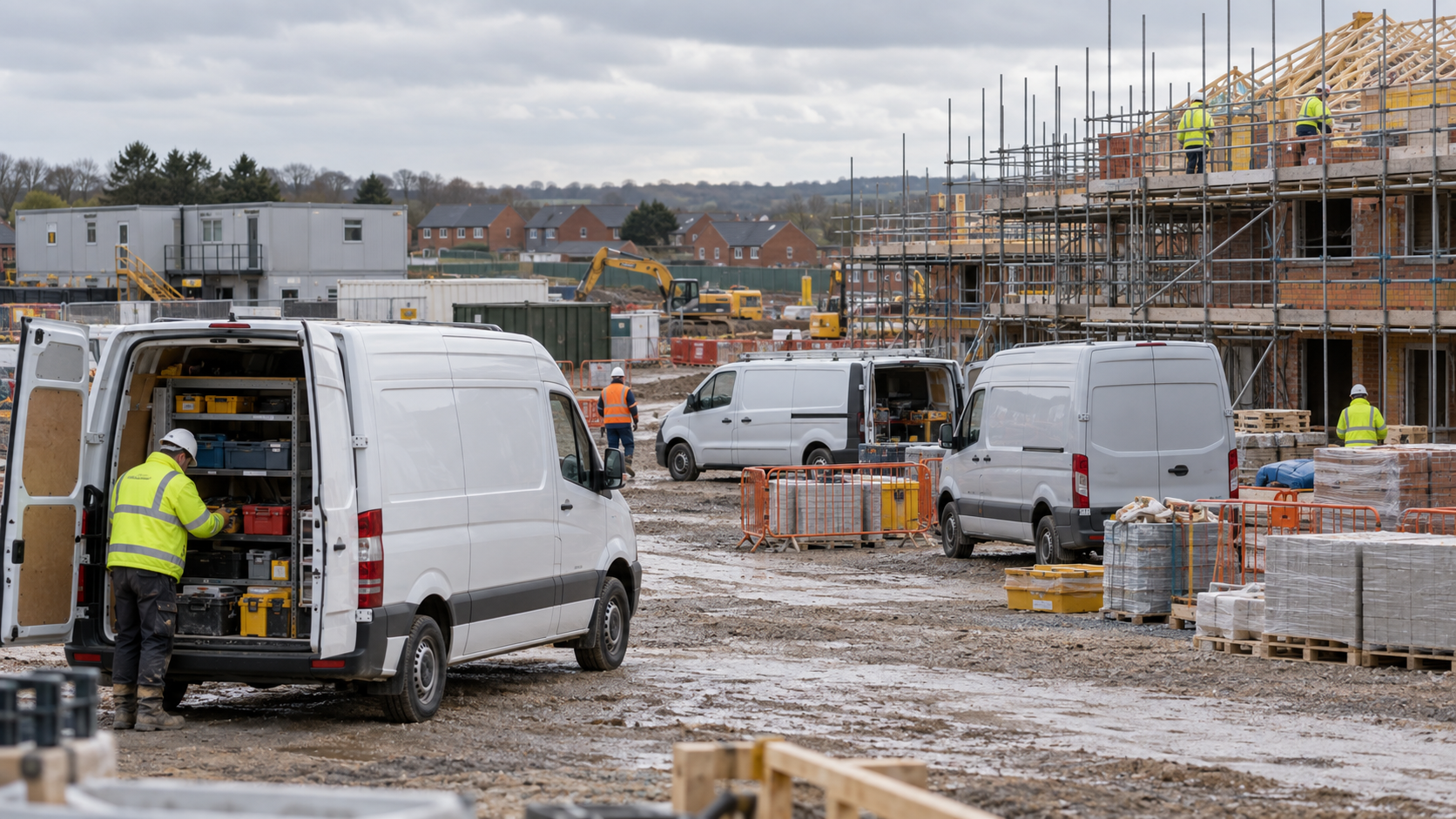
Glenigan has sharply reduced its UK construction forecast for 2026, projecting a 13% fall in underlying project starts before an 11% recovery in 2027 and further growth of 7% in 2028.
The revised assessment marks a substantial deterioration from the company’s June forecast, which anticipated a decline of only 1% during 2026. Higher energy prices, inflation, borrowing costs and delayed investment decisions are cited as factors weakening the current pipeline. The new figures concern the value of underlying projects, generally those valued below £100 million, rather than a simple measure of construction employment, total output or every major scheme.
Glenigan’s Winter 2026 Construction Industry Forecast anticipates that publicly funded projects and capital programmes in utilities, transport, education and healthcare will support the recovery. Private sector development is expected to recover more slowly, with the timing affected by project viability and financing conditions.
Project starts measure work moving into the construction phase, whereas construction output also reflects spending on schemes already under way. A decline in starts can reduce the future pipeline for contractors, engineering consultancies and materials suppliers without immediately reducing the value of construction work currently being delivered by the same proportion.
In the industrial sector, Glenigan anticipates a 14% reduction in project starts during 2026. Investors have deferred proposed developments as financing costs and demand uncertainty make schemes harder to justify. Such postponements affect the pipeline for factory buildings, structural materials, mechanical and electrical installations, site equipment and associated engineering services. The contraction concerns new industrial construction projects, leaving activity at existing manufacturing plants outside that particular measure.
Private housing is expected to fare worse, with starts forecast to fall by 24% in 2026. Glenigan attributes weakness to financing constraints, higher development costs and slower demand. A gradual recovery is expected from the middle of 2027, but the forecast indicates that the sector may remain below its 2025 activity level at the end of 2028.
Residential and commercial project viability depends on borrowing costs, construction input prices and anticipated returns. Developers have to assess expected sales or rental income against land, materials, labour, regulatory and financing costs. If that balance becomes less favourable, developments may be redesigned, deferred or abandoned. Glenigan’s forecast captures those changing conditions across the pipeline, without establishing the outlook for every individual development.
Civil engineering offers a more positive medium-term picture, although starts are still expected to fall by 9% during 2026. Glenigan forecasts increases of 11% in 2027 and 10% in 2028 as infrastructure programmes move into construction. Electricity network improvements, renewable generation and water projects form part of that projected workload.
The water sector’s AMP8 investment cycle is an important part of the expected utilities demand. Water and wastewater asset programmes require civil works, pumping and treatment equipment, electrical installations, instrumentation and commissioning. Electricity network reinforcement similarly creates demand for substations, cables, transformers, control systems and construction services, though individual schemes remain dependent on approvals and delivery timetables.
Public building programmes are also expected to gather pace. Glenigan forecasts education starts growing by 9% during 2027 and healthcare starts by 11%, following anticipated growth of just 1% in each sector during 2026. School rebuilding and hospital investment programmes will only add to the value of recorded starts as funded projects progress through procurement and begin on site.
Office construction presents a different pattern. Starts are expected to remain broadly level in 2026 before rising by 11% in 2027 and 8% in 2028. Glenigan identifies demand for higher-quality sustainable space, refurbishment and data centre projects as supporting factors. Regional demand, project funding and the availability of suitable sites will continue to affect individual developments.
Glenigan’s Summer 2026 forecast had already projected 11% growth in 2027, so the latest revision is not the first prediction of a recovery next year. The principal changes are a much deeper expected contraction during 2026 and a higher projected rate for 2028, previously 4%. The larger starting decline means that percentage growth in 2027 must also be considered against a lower activity base.
The company’s methodology combines project-level pipeline information with sector analysis, historical trends and macroeconomic assumptions. The projections can change as new projects are approved, postponed or cancelled, and as public spending and private financing conditions develop. The projections remain sensitive to future changes in the project pipeline and economic assumptions.
Demand for construction materials and industrial equipment is likely to remain uneven across these sectors. Factory and housing developments face a weaker near-term pipeline, while water, electricity and public infrastructure programmes are projected to generate more new construction from 2027. Actual starts and supplier orders will show whether those planned programmes advance on the forecast timetable.