Siemens has detailed an automated component testing system developed with Bosch that produces vibration models for virtual engineering assessments, reporting a reduction of up to 93% in frequency-response measurement time compared with conventional testing methods.
The system combines a self-measuring fixture with Simcenter test equipment and software, bringing excitation, data acquisition and model extraction into a repeatable workflow. It is intended for the characterisation of components such as motors, pumps, compressors, steering assemblies and actuators before their integration into larger machines or vehicles.
The companies’ collaboration builds on Bosch’s patented predictiveVIA technology. Siemens introduced the AutoCMX component model extraction approach in its Simcenter Testlab 2606 technical material during September; the latest announcement describes the jointly developed industrialised implementation and its claimed measurement performance.
Noise, vibration and harshness testing examines how a component behaves dynamically and how that behaviour changes when it is connected to a surrounding structure. A motor may produce forces at its mountings that travel through a machine frame or vehicle body, creating vibration or audible noise away from the source.
Predicting those effects requires more than measuring the sound emitted by a standalone component. Engineers need information about the component’s excitation forces and the dynamic response of its interfaces so that the interaction with different structures can be represented mathematically.
Frequency-response functions describe how a system responds to controlled excitation over a range of frequencies. They form part of the evidence used to characterise structural behaviour and to calculate what may happen when a component is attached to another assembly.
Obtaining these measurements manually can be labour-intensive. Engineers may need to reposition instruments, apply excitation in different directions and process multiple sets of results, with the final model sensitive to the consistency of the experimental arrangement.
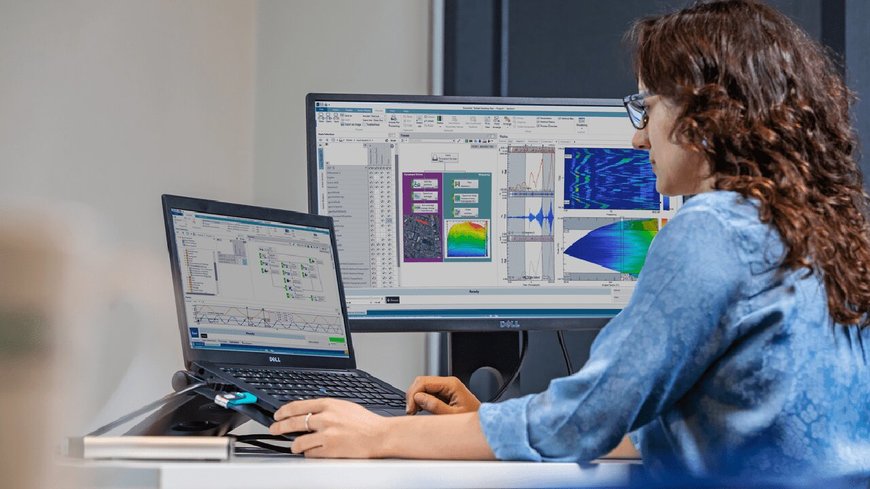
The new fixture keeps shakers and accelerometers permanently mounted on rigid virtual-point adapters. It connects through an amplifier and control system to a Simcenter SCADAS data acquisition frontend and a computer running Simcenter Testlab.
Because the instruments remain on the fixture, component changes do not require sensors to be installed repeatedly on the part under test. An operator can remove one specimen, secure another compatible unit and run the same sequence, making repeated testing more practical across component variants.
The measurement procedure uses sequential excitation to obtain the required frequency-response information. Software then processes those measurements and the operating responses to estimate the forces at the component interfaces, allowing the resulting data to be used in a model of a complete system.
A central technique is blocked-force characterisation under ISO 20270. The blocked force is intended to describe the excitation generated by the source in a form that can be used with different receiving structures, provided the component and interfaces remain within the appropriate modelling conditions.
The resulting models support component-based transfer path analysis and virtual assembly. In these approaches, information measured from individual components is combined with representations of the structures to which they will be mounted, allowing predicted vibration or noise to be assessed before full physical prototypes are available.
Siemens reports a reduction of 93% in frequency-response measurement time. Its detailed technical account describes one electric power steering test in which automated acquisition took 16 minutes, compared with roughly four hours using a manual roving-hammer approach or four hours 48 minutes using a roving shaker.
These figures refer to particular measurement methods under the reported test conditions, not a reduction of 93% in a complete product development or certification programme. Equipment preparation, interpretation, model validation and final system testing remain necessary.
The technical case study also describes testing a baseline steering assembly, a refined production unit and a deliberately defective component. Siemens states that the method distinguished differences between the units and produced predictions that agreed closely with subsequent vehicle measurements.
The company has described repeatability and accuracy in strongly positive terms, but a universal numerical accuracy claim cannot be established from the available public evidence. The draft therefore confines numerical performance claims to the reported measurement-time comparison and attributes other results to the supplier.
Consistent test conditions are particularly useful when several suppliers or laboratories contribute data to one engineering programme. Differences between fixtures, sensor placement and excitation methods can otherwise be difficult to separate from genuine differences between manufactured components.
Automated characterisation does not remove those sources of uncertainty entirely. Fixture rigidity, suitable boundary conditions, measurement quality and the validity of the mathematical assumptions still influence how well a component model represents its installed behaviour.
Sam Mahalingam, executive vice president and head of simulation software at Siemens, said the system would help customers “turn a complex, expert-driven process into a scalable engineering capability”. The supplier positions the workflow as a way to reduce manual measurement effort while retaining engineering oversight of model use and validation.
Bosch and Siemens are targeting applications in which multiple components or design variants must be compared before final assemblies exist. The reported measurements indicate a shorter testing workflow, with subsequent engineering value dependent on how consistently the models can be integrated and checked against physical operating conditions.