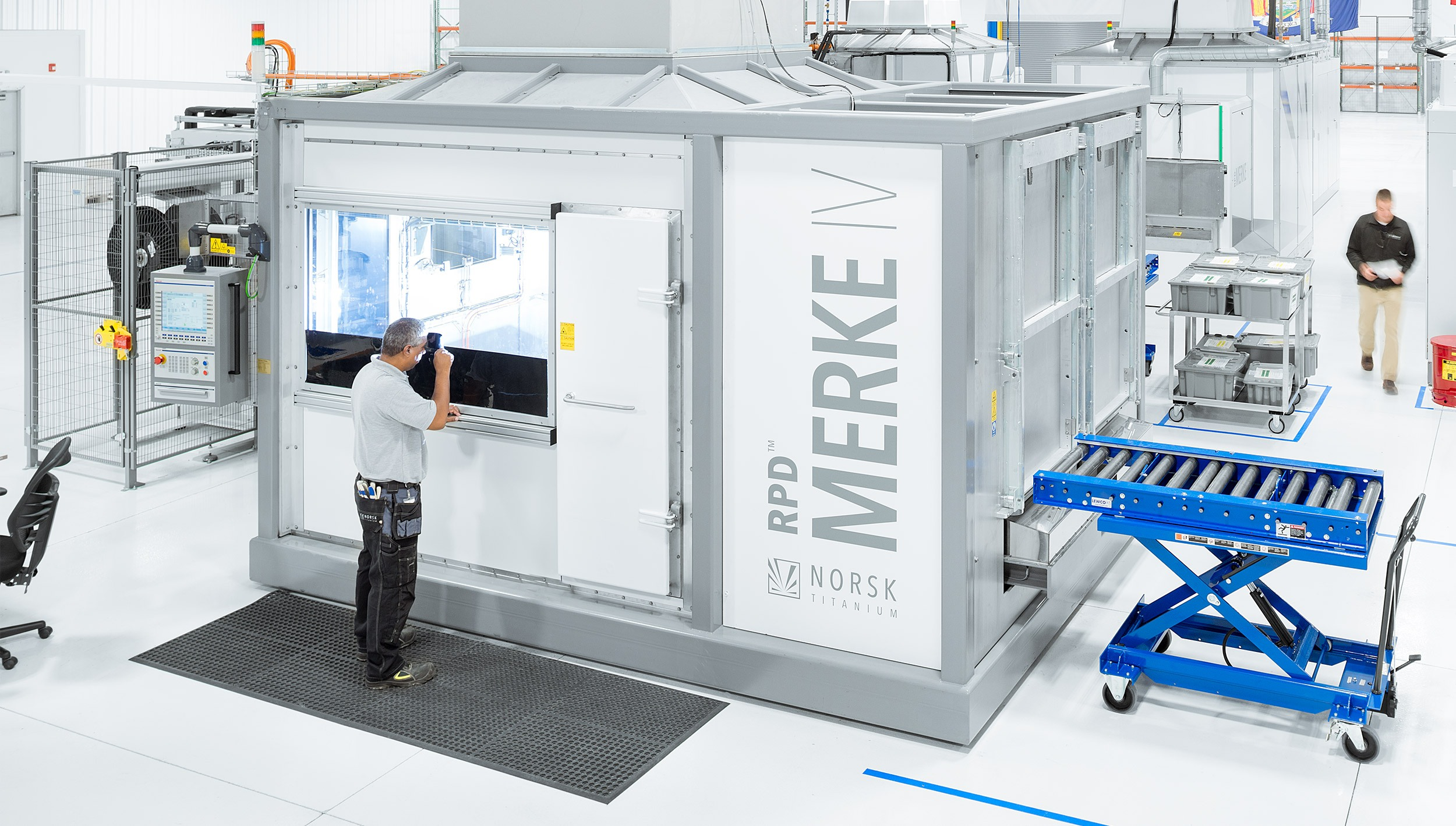
Norsk Titanium has installed its first Rapid Plasma Deposition machine at Airbus’s Varel factory in Germany, moving a programme to qualify additively manufactured structural titanium components into the aircraft manufacturer’s own production environment.
The Merke IV machine completed site acceptance testing in September 2026. Its installation follows a cooperation and research agreement with Airbus covering industrial process validation and the development of a framework for wider use of the technology across aircraft manufacturing programmes.
Norsk Titanium also reported increased serial deliveries to Airbus and Dutch precision engineering supplier Hittech during the third quarter. The company is trying to expand recurring production while continuing customer-funded engineering and qualification work across aerospace, defence and industrial applications.
Rapid Plasma Deposition, or RPD, is a wire-fed directed energy deposition process. A plasma heat source melts titanium wire and deposits the material layer by layer, producing a preform that can subsequently be machined to meet the dimensional and surface requirements of the finished component.
This differs from conventional manufacturing routes that machine some parts from relatively large solid billets or forgings. Depositing material nearer the required final geometry can reduce the amount removed during machining, although the saving depends on the component shape, permitted material allowance and the alternative manufacturing method.
Titanium is used in aerospace because its combination of strength, weight and corrosion resistance suits demanding structural and mechanical applications. The material is also costly to produce and process, which makes material utilisation an important consideration in component manufacturing.
A deposited part cannot be introduced into aircraft production solely because its shape and material use are attractive. The manufacturing route must demonstrate suitable mechanical properties, structural integrity, consistency and traceability under the conditions relevant to each component.
Layer deposition introduces process variables involving heat input, wire feed, travel speed and the thermal history of the growing part. Those conditions influence the resulting material and must be controlled so that production remains reproducible between components, machines and manufacturing runs.
The Varel installation enables Airbus to operate the equipment within its own factory rather than depending exclusively on parts delivered by Norsk Titanium. Under the supplier’s RPD Ecosystem model, the customer operates the machine while Norsk Titanium retains control of the core process technology, software and qualification framework.
A customer-operated installation allows production engineering and qualification activity to be conducted closer to the manufacturing processes that ultimately use the parts. It also raises practical requirements for operator training, equipment maintenance, inspection and the documentation needed for industrial production.
Airbus and Norsk Titanium are working towards a broader process-level qualification framework rather than repeating every part of the assessment separately for each new geometry. Any such approach will still need to establish which materials, processes and component applications are covered by validated conditions.
The supplier’s latest operating update confirms that serial deliveries to Airbus increased during the quarter and that discussions continued over a third production order under the companies’ 2024 master supply agreement. Discussions have not been reported as a confirmed additional production contract.
Deliveries to Hittech also increased, providing a separate industrial application for RPD-produced titanium components. Hittech uses the supplied parts in equipment associated with semiconductor manufacturing, where component accuracy and material characteristics differ from the requirements of aircraft structures.
Elsewhere in the aerospace business, Norsk Titanium continued deliveries to Boeing, Leonardo and other customers while developing applications with Safran Landing Systems. The company also received a Rolls-Royce development component order, which is distinct from the newly installed Airbus machine and has already been the subject of separate coverage.
The combination of machine placement, process qualification and serial production creates several possible revenue streams. Norsk Titanium has identified future machine sales or leasing, technology licensing and supporting services as potential elements of its business model, but has not announced a completed commercial rollout beyond the first Airbus installation.
Revenue and other income reached US$2.1 million in the third quarter, compared with US$0.7 million a year earlier. The equivalent total for the first nine months increased from US$2.8 million in 2025 to US$5 million in 2026, indicating growth from a comparatively small base.
Serial production accounted for US$0.6 million of third-quarter revenue, while development programmes and associated services contributed US$1.2 million. The company forecasts full-year revenue and other income of approximately US$8 million, a projection rather than a confirmed annual result.
Cash consumption remains a consideration as the manufacturing business expands. Average monthly cash burn in the quarter was US$2.2 million and the cash balance at the end of September was US$27.2 million, after financing completed during the summer.
In defence, the company has begun work under an existing US$4.2 million development contract for submarine applications and is finalising a separate qualification order with an American defence contractor. It has identified potential future sales under that programme, contingent on successful qualification and further orders.
Norsk Titanium is targeting breakeven in 2028 as volumes increase and manufacturing utilisation improves. For Airbus, the immediate milestone is more specific: the equipment has passed site acceptance, but further industrial validation will determine the range of structural parts that can enter regular production through the RPD process.