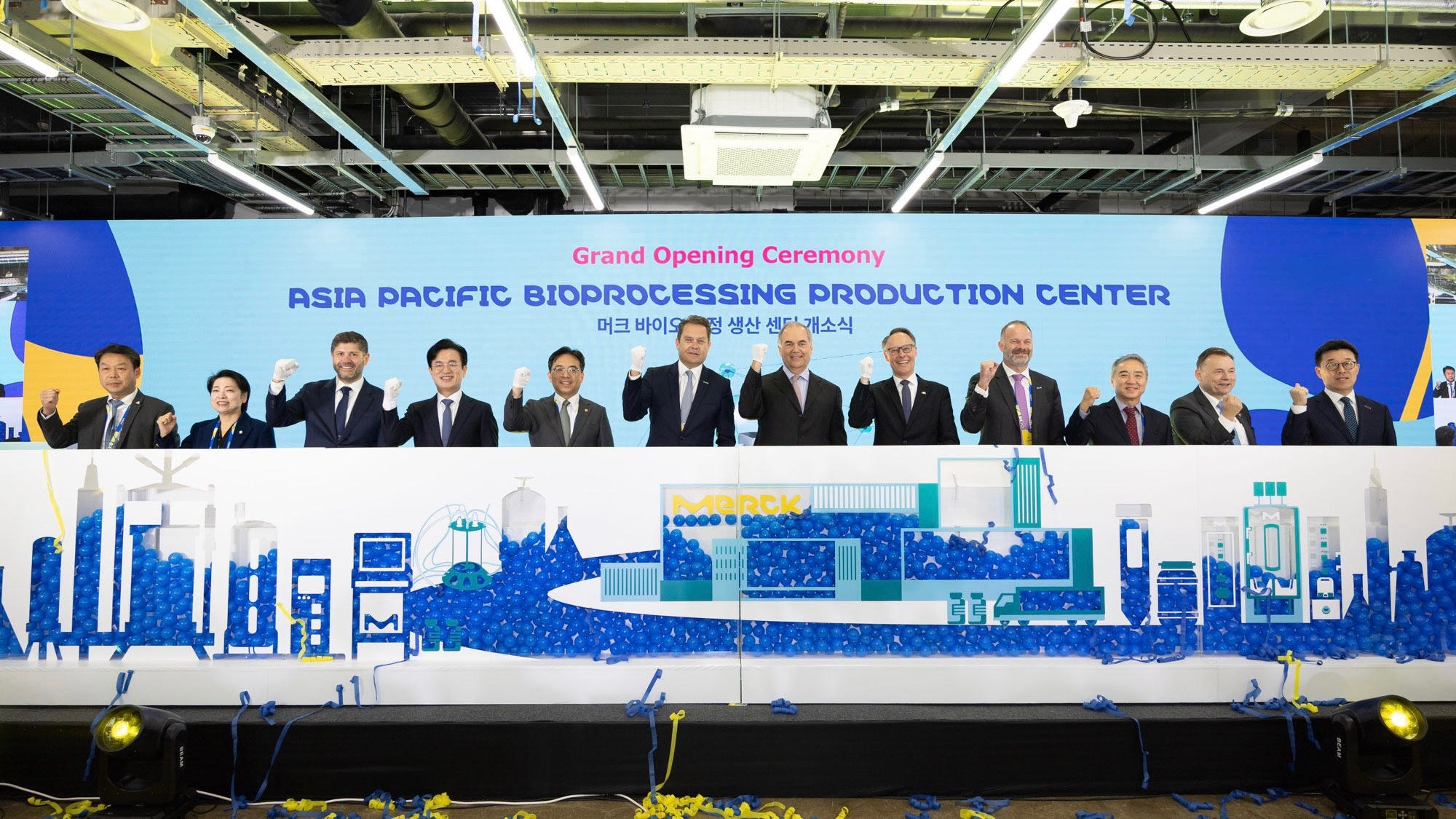
Merck has opened a bioprocessing production centre in Daejeon, South Korea, following investment of more than €300m. The 44,500m² plant will supply materials and components used in developing and manufacturing biological medicines, including cell culture media, process liquids and sterile sampling systems. Integrated digital production systems have been installed to capture process data and trace individual batches through the facility.
The Daejeon site is Merck’s largest life science investment in Asia-Pacific to date and extends its regional manufacturing network. Biopharmaceutical customers require qualified materials as production moves from development work to larger manufacturing campaigns, with consistency of composition and supply becoming important across successive stages. Locating production closer to customers in South Korea and other Asia-Pacific markets gives Merck an additional manufacturing route for those materials while maintaining its stated global quality standards.
Cell culture media supply the nutrients and chemical environment needed for cells to grow and produce biological medicines. Formulations can contain salts, amino acids, sugars and other ingredients, with quantities adjusted to the cell line and manufacturing process. Daejeon will make both dry powder and liquid media, including small-scale custom products through Merck’s imMEDIAte ADVANTAGE service. The same manufacturing site can therefore supply material for earlier process-development work and larger-scale production, subject to the specifications of each product.
Powder and liquid media need different handling and quality controls. Powders require homogeneous blending and measures that protect the finished material during storage and reconstitution; liquids demand controlled preparation, filling and suitable packaging. Merck intends to use animal-component-free raw materials for the facility’s media and process liquids, in accordance with its global manufacturing standards. Process developers and manufacturing customers can qualify those products against their existing cell culture requirements before integrating them into routine production.
The portfolio also includes ready-to-use process liquids and cleaning-in-place solutions. In cleaning-in-place systems, prepared solutions pass through vessels, pipework and other equipment under controlled flow, concentration and contact-time conditions. Manufacturing these liquids at a regional site can reduce the preparation work required by receiving facilities, while their storage and use still need to align with the customer’s validated cleaning procedures. These products sit alongside the cell culture materials used during active production.
Merck is also manufacturing single-use sterile sampling products based on its NovaSeptum system. Samples are taken during bioprocessing to monitor conditions, test product characteristics and identify potential contamination. A closed sampling arrangement helps maintain separation between the process and its surroundings, while single-use components can limit the cleaning and preparation needed between sampling operations. Installation and handling remain important to preserving that controlled pathway.
Digital manufacturing systems at Daejeon are designed for automated data capture and end-to-end batch traceability. The records connect manufacturing conditions and inputs with completed batches, making it easier to investigate deviations and assemble the documentation needed for regulated supply. The same information can support quality management when equivalent materials are manufactured at different regional locations. Merck’s customers will apply their own incoming-material controls as those products enter their manufacturing processes.
The building incorporates solar generation, heat pumps, energy recovery in air handling systems and rainwater reuse. Merck designed the facility to eliminate fossil-fuel use on site while improving energy and water efficiency. Heat recovery reduces the conditioning load in ventilation systems, and heat pumps can supply heating through electricity rather than on-site fuel combustion. These systems form part of the plant’s operating infrastructure alongside its controlled manufacturing areas.
Daejeon joins an expanding international production network that includes filtration manufacturing at Blarney, Ireland, and drug product testing at Darmstadt, Germany. Distributed manufacturing can shorten some supply routes and provide alternatives when demand shifts between regions, while consistent specifications help customers qualify materials from more than one location. The new Korean site extends that arrangement across the Asia-Pacific bioprocessing market, serving customers at different stages of biological drug development and production.
The Daejeon development follows an investment plan established in 2024 and has now reached its opening milestone. South Korean authorities have identified approximately 300 jobs as the project’s expected employment contribution by 2028. The new facility will supply cell culture media, process liquids and sampling systems to regional biopharmaceutical manufacturers, while the integrated traceability system supports production and quality records. Those inputs feed different parts of a biologics manufacturing process, from the preparation of production cultures to equipment cleaning and ongoing process sampling, with customers qualifying each material for its intended application.