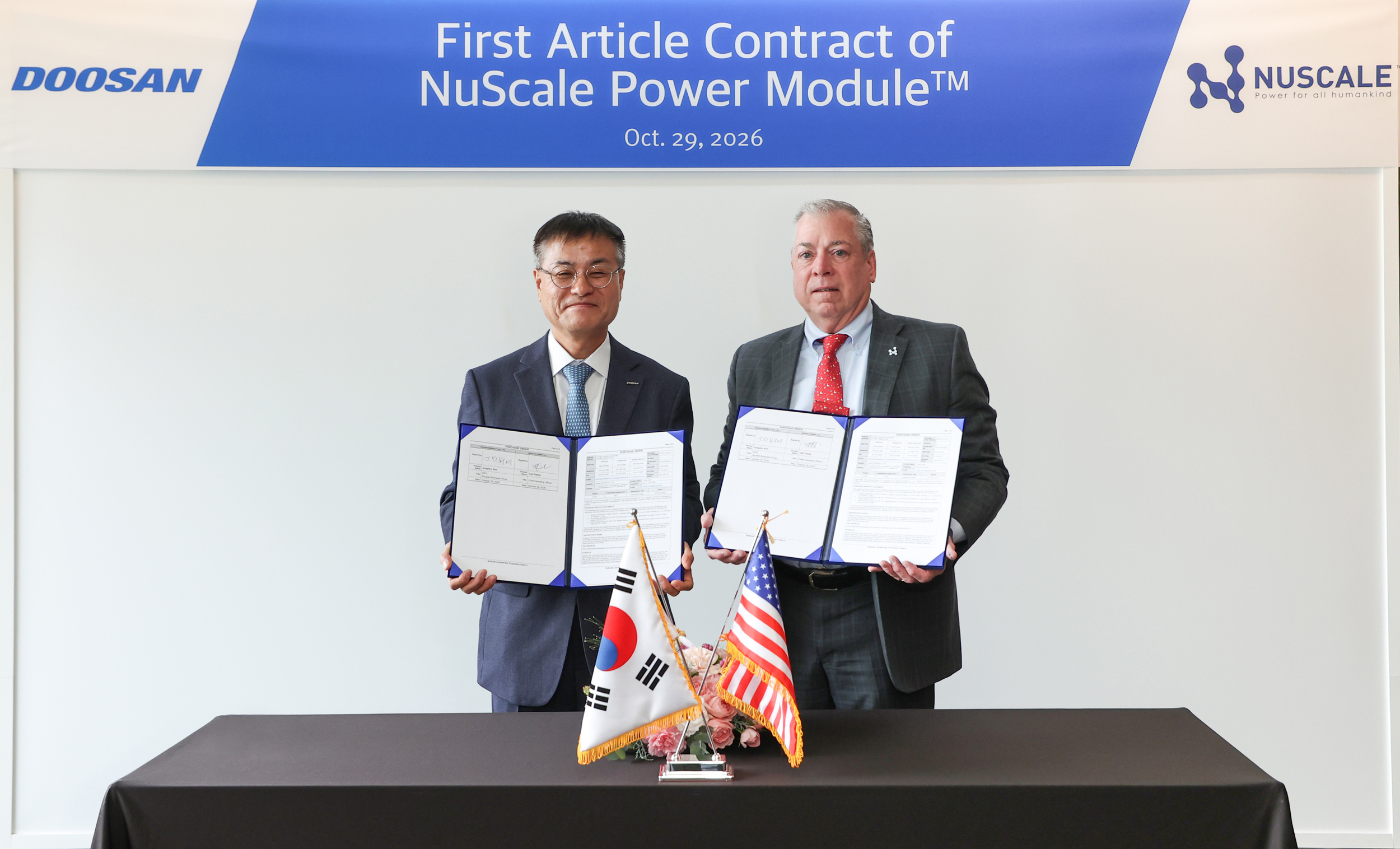
Doosan Enerbility has signed a contract to manufacture the first upper reactor coolant system assembly for NuScale Power’s small modular reactor design. The work will be carried out at Doosan’s nuclear equipment factory in Changwon, South Korea, and will produce a major component of the reactor pressure vessel. The agreement advances a manufacturing partnership established in 2019 into first-article production, allowing the companies to apply their prepared designs and production processes to an actual reactor assembly.
The contract follows years of work on production methods, component supply and factory readiness for the NuScale Power Module. Doosan has previously undertaken material supply and manufacturing preparation associated with the programme. Its latest scope concerns the upper reactor coolant system, or URCS, which forms the top section of the pressure vessel containing reactor coolant under elevated temperature and pressure. It represents a defined first manufacturing commitment in the module supply chain, with subsequent production dependent on future project orders and delivery arrangements.
A reactor pressure vessel contains coolant under elevated temperature and pressure and forms a critical physical barrier around the reactor system. Its upper section must interface with the rest of the vessel and the equipment located around it while maintaining the structural integrity required by the design. Manufacturing such a component involves heavy-section fabrication, precise machining and controlled preparation of joining surfaces. Dimensions, material characteristics and the condition of the finished pressure boundary are important because the assembly must remain compatible with the other factory-built sections during later integration.
The first article requires production plans and quality procedures to be executed on an actual assembly. Heavy components have to move through material handling, machining or forming, controlled fit-up, joining and inspection as specified by approved drawings and procedures. The work must achieve the dimensional requirements needed for later integration with the other sections of the reactor module. Records made during first-article fabrication will also support repeatability if subsequent URCS assemblies are ordered.
Nuclear pressure-boundary manufacturing demands an auditable record of the materials and operations used to produce each component. Material certificates, identification records, approved joining procedures and inspection results connect the finished assembly to its specified requirements. Dimensional and non-destructive examinations are established quality techniques for heavy pressure equipment; the exact checks for the URCS will follow the component’s applicable specifications. Configuration control must also preserve traceability if engineering changes are introduced during production.
NuScale’s reactor technology has received approval from the US Nuclear Regulatory Commission, providing a design basis for the manufacturing programme. Doosan’s production work now brings part of that design into factory fabrication, with quality acceptance, integration and project-specific authorisations forming later stages of deployment. The manufacturing agreement establishes a component supply commitment within that sequence, while each eventual power project will have its own procurement, construction and licensing requirements.
Modular reactor programmes seek to fabricate major components in specialised industrial facilities and subsequently integrate them into larger assemblies for transport and installation. Concentrating work in a manufacturing plant can support repeatable processes, dedicated equipment and a trained workforce, but the outcome depends on maintaining production tolerances and moving large components through transport and site installation operations. The change in factory workload is significant for established heavy engineering suppliers because vessel fabrication relies on equipment and skills that have long lead times to develop and qualify. Moving from the first article to repeat production would also require sustained availability of approved raw materials, qualified inspection capacity and suitable factory scheduling as orders develop.
Doosan’s Changwon site already makes major power-generation equipment, giving the URCS programme access to heavy fabrication infrastructure and specialist personnel. The companies have used their partnership to refine manufacturing approaches and prepare suppliers for the module design. NuScale says this development work has improved manufacturability while preserving the approved safety and performance characteristics. Completion and acceptance of the first assembly will provide a measurable result for the arrangements established over the preceding years.
Additional module production will depend on NuScale projects reaching firm procurement and delivery stages. The Changwon facility’s immediate task is the manufacture, inspection and acceptance of the first upper reactor coolant system assembly. Its successful integration readiness would provide a reference for further components, connecting the existing engineering partnership with a repeatable manufacturing route for future reactor modules.