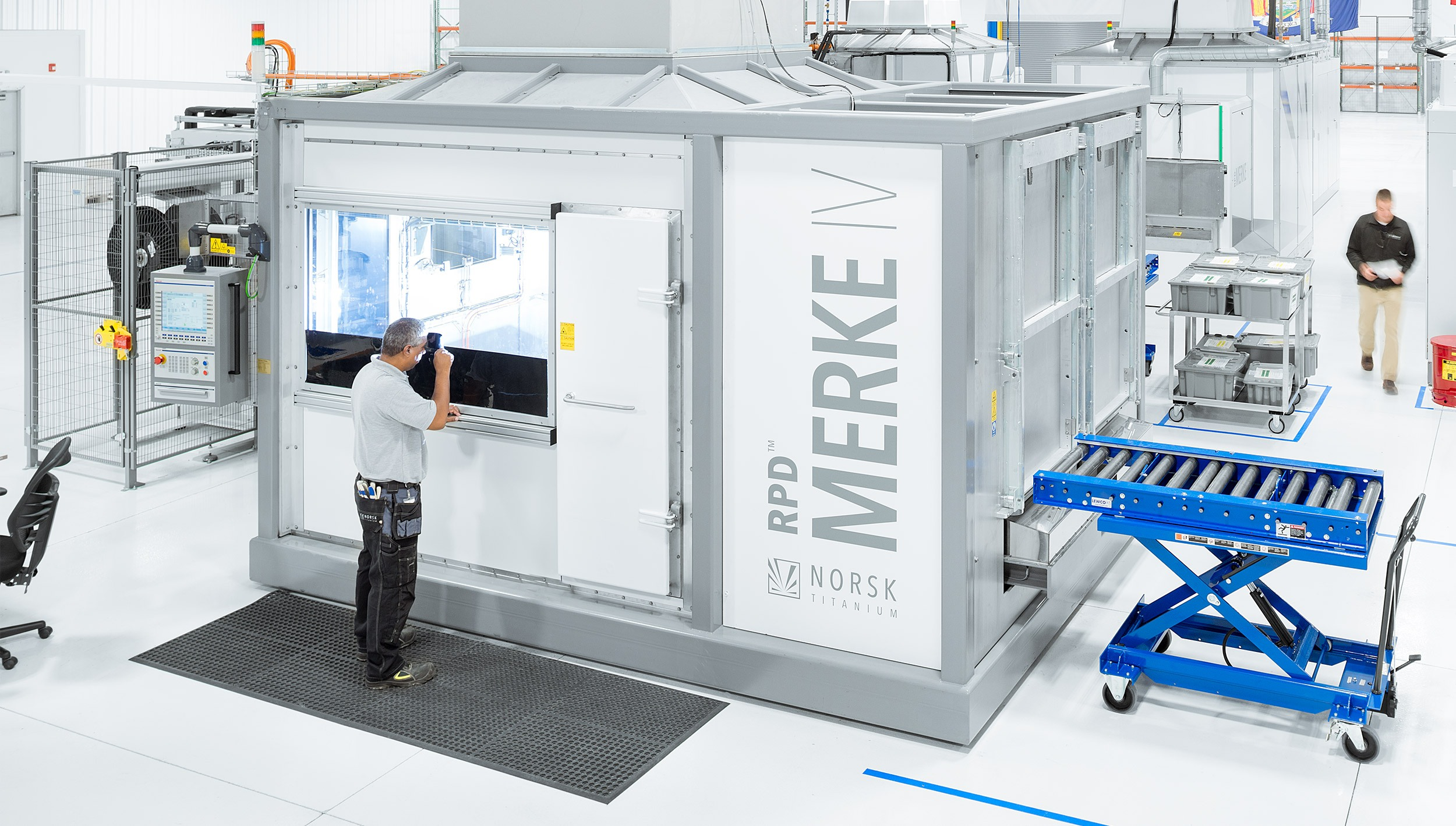
Norsk Titanium has received a purchase order from Rolls-Royce for a titanium structural component being assessed for possible use in current civil aircraft engine programmes. The Ti-6Al-4V part has been manufactured at Norsk Titanium’s Technology Center in Norway using its Rapid Plasma Deposition process, with final machining being completed in Germany. The order establishes the company as an approved supplier for Rolls-Royce development activities, not a confirmed supplier of series-production engine components.
Rolls-Royce will use the development component to assess wire-deposited titanium as a possible manufacturing route within its existing civil aerospace engine programmes. The purchase order covers exploratory work; production approval would require separate evaluation of the component and its manufacturing process. The companies have not specified the component’s geometry, order value or an engine installation timetable.
Rapid Plasma Deposition, or RPD, is Norsk Titanium’s version of wire-based directed energy deposition. Titanium alloy wire is supplied to a plasma arc, which melts and deposits the feedstock layer by layer along a programmed toolpath. An inert argon environment protects the metal during deposition, while process monitoring and control help manage consistency. The deposited shape is a preform rather than a fully finished engine part, and it subsequently enters established machining and inspection stages.
Ti-6Al-4V contains nominally six per cent aluminium and four per cent vanadium, giving a widely used aerospace alloy a combination of strength, relatively low density and corrosion resistance. Applying that alloy in an engine assembly still calls for evidence of the finished part’s behaviour under the relevant loading and operating conditions. Material qualification, dimensional accuracy, fatigue requirements and traceable manufacturing records must be addressed within the component-specific assessment.
Conventional routes to structural titanium parts can begin with large forged or wrought blanks that lose a substantial share of their mass during machining. Wire deposition instead builds a shape closer to the required component geometry, allowing less machining stock where the geometry is suitable. It does not remove finishing operations: contact surfaces, features requiring close tolerances and inspected regions may still need subtractive machining and other post-processing before the part can be used.
Norsk Titanium describes deposition rates of about five to ten kilograms of metal per hour, depending on the machine and application. Throughput for a finished aerospace component is determined by the wider sequence of programming, deposition preparation, inspection, treatment and machining. The economic advantage depends on how much starting material can be avoided and how the complete process compares with the delivery times and production volumes of the established route.
The part has passed through two stages in different countries: additive deposition at Norsk Titanium’s Norwegian Technology Center and final machining through the German project supply chain. Manufacturing the preform close to the required geometry still leaves precision surfaces and other features to be finished and inspected. Process records and material traceability must accompany the component through those stages so the results can be evaluated against the intended specification.
Wire deposition creates repeated local heating and solidification, with toolpaths, cooling conditions and post-processing affecting material behaviour and distortion. The development programme therefore needs to assess the deposited and machined component together, including its relevant microstructure, dimensions and documented production history. That evidence will be particularly important if the proposed route advances towards the qualification requirements of a specific engine programme.
The Rolls-Royce order follows Norsk Titanium’s broader work to industrialise the technology. In June, the company entered a cooperation and research agreement with Airbus covering higher-criticality structural titanium parts. Norsk Titanium has separately reported production and certification progress on an Airbus A350 lower frame fitting. Those airframe developments demonstrate experience with aerospace qualification, but approval of one aircraft structure cannot be assumed to approve a different component in a turbine engine.
Engine components face different combinations of temperature, load and vibration depending on their location and duty. A structural bracket has different assessment requirements from a rotating or hot-section part, so development findings need to be related to the actual geometry and service conditions being considered. The companies have identified the ordered item as a structural component, with its eventual application to be determined through further evaluation.
The development order gives Norsk Titanium another opportunity to combine deposition, finishing and aerospace inspection within a customer’s established supply chain. Its experience with Airbus airframe structures supplies a separate example of qualified production, while the Rolls-Royce work will be judged against the requirements of the specific engine application. Further orders would depend on technical assessment and subsequent procurement decisions.
Rolls-Royce and Norsk Titanium will use the development part to assess further applications for RPD within civil engine programmes. The next engineering decision depends on how the deposited, machined and inspected component performs against the relevant requirements. Any repeat supply would follow separate component-specific qualification and procurement decisions.