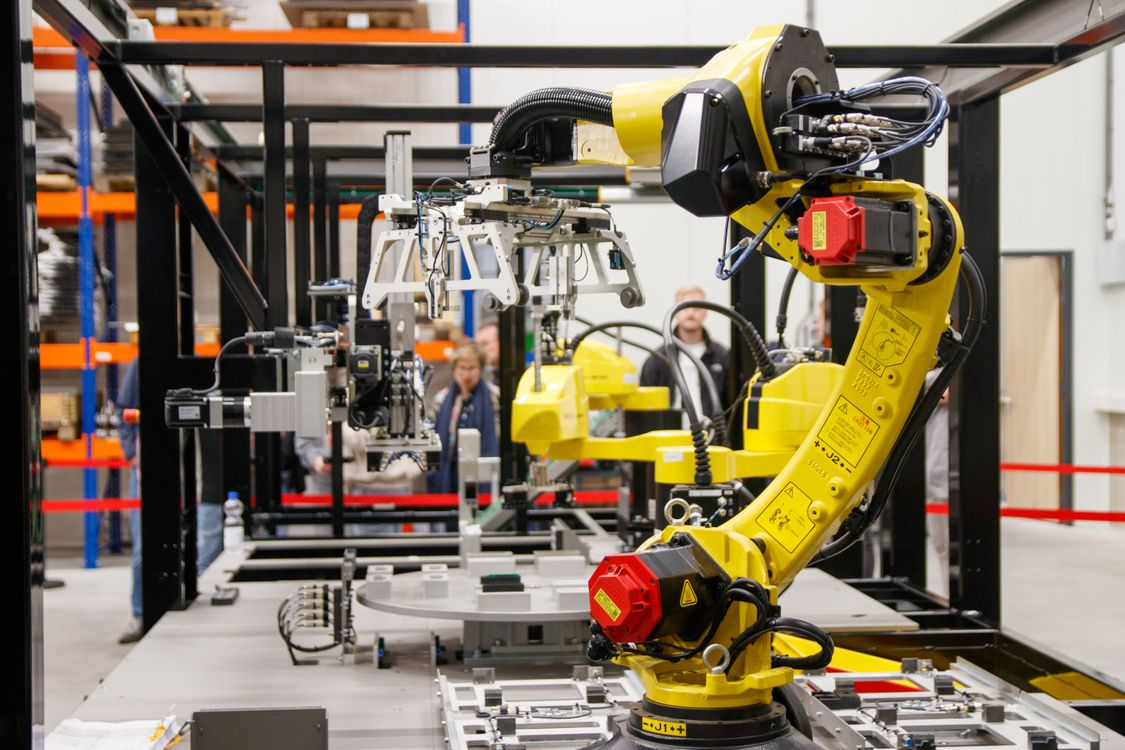
Schaeffler has opened a 7,500 sq m manufacturing facility in Taicang, China, where humanoid robots assemble components for other humanoid robots. Six machines work across five stations on a line producing joint modules, including linear and rotary actuators. The site combines that assembly operation with robot training, data acquisition and digital simulation, bringing component manufacture and practical assessment of robotic tasks together in one factory.
The humanoids undertake part staging and sorting, joining, inspection, labelling and packaging, according to Schaeffler. These activities require different forms of control: a component must arrive at a station in the correct orientation, a joining operation must achieve its prescribed fit, and an inspection must identify departures from the specified result. The factory has begun operating, although Schaeffler has not published its annual capacity or the division of work between robots and human employees.
Linear actuators create straight movement, while rotary actuators deliver controlled angular motion at robot joints. In a complete humanoid, their characteristics influence lifting force, joint speed, positioning accuracy and how loads pass through an arm or leg. Manufacturing the modules repeatedly involves managing component fit and assembly variation, since a small dimensional or alignment error can influence the movement and service life of a finished joint.
Taicang’s training centre provides industrial conditions in which the company can develop robotic tasks before assigning them to the line. Its stated activities include visual inspection, material transport, packaging, movement of containers and replenishment beside assembly equipment. A robot handling several part types must identify each item, approach it without striking surrounding equipment and apply a suitable grip. Correct recognition alone will not ensure that the part is seated in the orientation required by the following operation.
Data from those exercises is linked with the production environment and a digital twin of the line. The virtual representation allows engineers to model a station and examine proposed changes before applying them to equipment in operation. Schaeffler says sensors collect data on such measures as assembly quality, process duration, energy use and equipment condition. Bringing these measurements into the assessment of a task makes it possible to compare the intended sequence with the behaviour recorded on the factory floor.
Training conditions are informed by the industrial work undertaken across Schaeffler’s network of roughly 100 manufacturing plants. Tasks developed in Taicang could consequently be tested against recurring requirements from several businesses, rather than being designed around a single demonstration. Different parts, fixtures and layouts can still change the movements and gripping demands involved, so a routine validated at one station needs further testing before transfer to another.
The combination of mechanical components and task data also places responsibilities on the control system. A robot has to synchronise its motion with the equipment and people around it, while the assembly process must preserve traceability and allow a failed inspection to be acted upon. Fixed automation already performs many of these functions where components arrive predictably; humanoid equipment is being assessed for work taking place in spaces and at stations originally arranged for human operators.
Schaeffler’s background in bearing, transmission and motion technology gives it an existing route into manufacturing robotic actuators. In March 2026 the company announced a partnership with Chinese humanoid developer Leju Robotics, part of a broader programme to supply robot manufacturers. The Taicang opening adds an operating assembly and training location to those relationships rather than marking the start of its interest in humanoid components.
Commercial orders provide a separate measure of the programme. Schaeffler says it secured two additional humanoid robotics customers in Greater China during the third quarter, taking global incoming orders in the field to approximately €400 million. That figure covers orders for its humanoid robotics business; it is not a measure of sales made by the Taicang factory, and Schaeffler has not assigned a production volume or revenue contribution to the new line.
Integrating a training environment with working assembly equipment gives the company a means of examining repeatability under production conditions. A part picked up successfully once may be harder to handle after a change in surface finish or position, while a robot that can complete an isolated task may struggle with the timing of adjoining stations. Measurements of these variations, together with inspection records, provide a firmer basis for adjusting tasks than an isolated demonstration of movement.
Schaeffler is now producing joint components at Taicang while developing the applications its humanoids may perform elsewhere in the group. The next operational evidence will come from sustained component quality, the number of repeatable tasks transferred from training to production and any future disclosure of line output. Those results will establish how far the factory’s combined manufacturing and training model can be extended beyond its first five stations.