Berlin-based Gefertec will present large metal components manufactured using wire arc additive manufacturing at Formnext 2026, alongside its arc10X and arcTitan equipment. Its Frankfurt display, scheduled for 17–20 November, includes a 700 kg compressor impeller, a titanium aircraft emergency exit frame, a tooling mould and a seawater pump impeller with elongated blades. The programme places production applications alongside machinery introduced earlier in the year.
Of those examples, Gefertec identifies the seawater pump impeller as being shown publicly for the first time. The company says its blade form is intended to improve the prospects for fish passing through the pump and that the shape cannot be made by conventional casting. Those are design and manufacturing claims rather than published test results: the announcement does not establish fish survival rates, hydraulic efficiency or durability under prolonged operation.
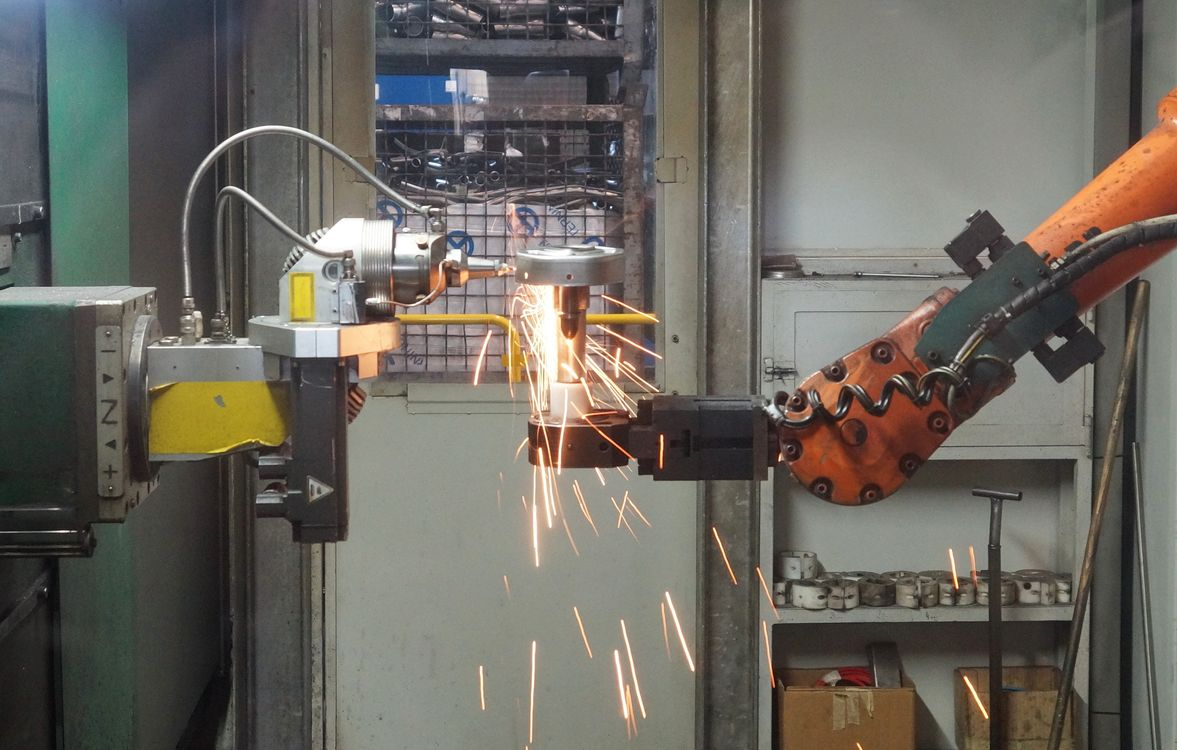
Wire arc additive manufacturing, or WAAM, uses a controlled electric arc to melt metal wire and deposit material along a programmed path. A multi-axis machine positions the deposition head relative to the growing workpiece, allowing successive passes to produce a relatively large near-net-shape form. Once deposition is complete, machining, inspection and sometimes heat treatment may be required to achieve the specified geometry and material properties.
The approach differs from powder bed fusion, where a heat source melts selected areas of fine powder in a constrained build chamber. A wire-fed arc system can deposit substantial volumes of metal using welding-derived equipment, making it attractive for large components that would otherwise start as heavy forgings, castings or billets. The trade-off is that deposited bead shape, thermal input and distortion have to be managed, and the unfinished surface cannot generally replace a precision-machined finish.
Gefertec’s compressor impeller demonstrates the relationship between a large near-net-shape blank and the material removed during finishing. A conventional billet-machining route can generate substantial swarf when the final component contains channels or curved surfaces, whereas directed deposition can place much of the metal close to its eventual position. Actual material savings still depend on the reference manufacturing route and the machining allowance retained for the particular component.
The titanium emergency exit frame illustrates a different production requirement. A relatively intricate aerospace component may be expensive to machine from a larger piece of costly material. Producing a closer starting form can reduce unnecessary removal, while qualification still demands control of mechanical properties, defects and traceability. The exhibited part should not be treated as evidence of approval for a specific aircraft programme unless that approval is established separately.
Gefertec describes arc10X as a modular industrial production platform that can be configured for three- or five-axis operation. Published features include process data logging, high-resolution monitoring, integrated sensors and arc control. These functions give operators information about deposition conditions and support repeatability, although logged process parameters still have to be linked to physical inspection and, where required, destructive testing of representative material.
The separate arcTitan system is aimed at titanium components and combines plasma-based deposition with an enclosed process environment. Titanium is reactive at elevated temperatures, so limiting oxygen and other contamination during melting and cooling is necessary to protect material quality. Gefertec also lists aluminium and nickel-based alloys as possible applications. Its disclosed equipment description supports the protective atmosphere concept without establishing a particular production yield or deposition rate for the displayed parts.
Machine size must be matched to the equipment specified. Gefertec assigns an eight-cubic-metre build volume to its arc80X, a different model within the portfolio; that capacity does not describe the arc10X or arcTitan. Selection for a large component also involves fixture space, access for the deposition head, handling arrangements and the dimensions of the machine tools needed for subsequent finishing.
Heat management remains a significant part of the manufacturing route. As successive beads are deposited, their thermal history can alter microstructure and introduce residual stress. Controlling interpass conditions, recording the build and choosing suitable post-processing are therefore relevant to repeatable component properties. Complex internal geometries also demand a practicable plan for inspection and surface finishing after deposition, particularly where channels will carry fluid or where loads concentrate at thin sections.
The complete production cost cannot be inferred from deposition time alone. Workshops have to account for wire consumption, energy, machine preparation, finishing cuts, heat treatment, inspection, rejected builds and the availability of suitably qualified operators. For a component with long conventional lead times, the ability to produce a near-net-shape blank locally may be attractive even where final machining remains extensive. For simpler geometries, established processes may still be more economical.
Gefertec previously exhibited large WAAM parts at Formnext, so the 2026 programme is best understood as an updated applications display alongside newer equipment rather than the first demonstration of large-part printing. The upcoming exhibition will allow visitors to inspect the claimed geometries and discuss manufacturing routes, while repeatable production performance must ultimately be demonstrated through documented component qualification and operating results.