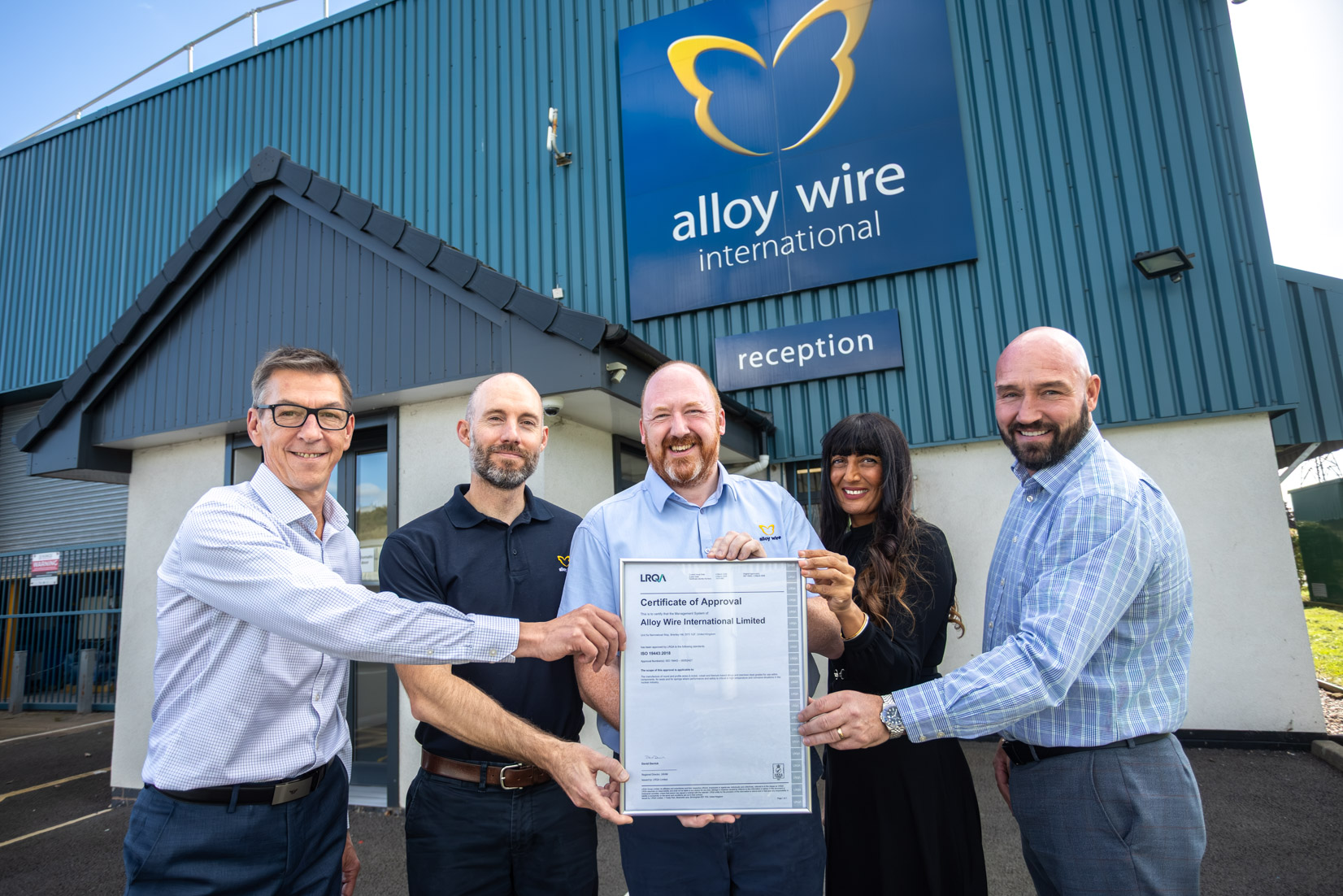
Alloy Wire International has secured up to £150,000 in additional nuclear sector sales following accreditation to ISO 19443, reporting a 15% increase in its existing business serving the industry. The Brierley Hill manufacturer announced the increase during the formal presentation of its certification by quality assurance specialist LRQA.
The company employs 29 people and produces precision drawn round, flat and profile wire in specialist alloys. Its customers manufacture components for demanding applications, including nuclear reactors, smaller reactor technologies and decommissioning projects.
AWI achieved the ISO 19443 accreditation earlier in 2026, completing an assessment process lasting nine months with zero non-conformities, according to the company. The latest development is the additional commercial work secured after certification, rather than a newly completed accreditation process.
The standard specifies quality management requirements for organisations supplying products or services important to nuclear safety. It builds on ISO 9001 and places additional emphasis on identifying safety-related activities, maintaining traceability, controlling processes and supporting an organisational culture in which personnel understand the potential consequences of non-conforming work.
Precision wire may eventually become part of a spring, seal, fastener or other component manufactured further along the supply chain. Its final application is not necessarily apparent from the wire’s dimensions alone, making material identification and accompanying records particularly important where the finished component performs a nuclear safety function.
The manufacturer’s production process changes the dimensions and mechanical condition of alloy wire through controlled drawing operations. Material is pulled through forming dies to reduce its cross-section, creating the specified diameter or profile while influencing properties such as tensile strength and surface condition.
The relationship between dimensional accuracy and component performance can be demanding. A spring manufactured from wire outside its specified tolerance may respond differently to loading, while a component subject to repeated movement or elevated temperatures must retain the required mechanical properties throughout its intended operating conditions.
AWI supplies materials selected for high-temperature strength and corrosion resistance. The alloys requested by nuclear customers include Inconel 718, Inconel X750, Alloy 400, Nimonic 90, Alloy 80A and 316 stainless steel.
These grades have different chemical compositions and operating characteristics. Some are nickel-based alloys developed for demanding temperature or corrosion conditions, while stainless steel provides a different combination of mechanical properties and environmental resistance. The appropriate material depends on the application and the specifications established by the component manufacturer.
AWI’s role is to produce wire to the specified dimensions and condition while retaining the evidence needed to establish material identity and conformity. Subsequent forming, heat treatment or assembly may be performed elsewhere, with each manufacturing stage creating its own quality and documentation requirements.
Traceability begins with the information supplied alongside incoming raw material. Mill certificates and relevant inspection records provide evidence of material composition and other specified characteristics, allowing the wire manufacturer to connect its own processing information to the original material batch.
That connection must be maintained as material passes through production. Drawing, inspection, packaging and dispatch can all affect how a batch is identified and which records accompany it, particularly where customers order relatively small quantities in different alloys or dimensions.
The purpose is to make the route from source material to delivered product demonstrable. If an issue is discovered later, reliable records help establish which batches, processing stages and customer deliveries may need further investigation.
Kevin Guest, head of quality, health and safety and environmental management at Alloy Wire International, identified staff understanding as an important element of the ISO 19443 assessment. He said employees across production, packaging and sales had to recognise the importance of traceability and the potential end uses of the material they handle.
The standard’s requirements extend beyond the inspection of finished wire. Purchasing controls, supplier information, personnel competence, production documentation and the handling of non-conforming material contribute to the reliability of the system used to release products to customers.
AWI’s latest certification was assessed by LRQA, whose representatives presented the accreditation at the company’s factory. The process also brought the two organisations together on their first quality certification project, according to the announcement.
Guest has highlighted the importance of obtaining original material data from AWI’s suppliers so it can be incorporated into the manufacturer’s own management system. That approach allows information generated at the mill to remain connected to subsequent manufacturing and inspection records.
Testing capability is another part of the company’s quality programme. AWI reports investing more than £500,000 in bringing subcontracted testing services in house, allowing it to perform more verification work directly and reduce its dependence on the availability of external testing facilities.
In-house testing does not remove the need for suitable equipment, approved procedures or customer acceptance of particular results. Its practical value depends on which tests the company can perform, the competence of personnel and the evidence required by each customer’s specification.
Controlling those activities within the factory can nevertheless simplify the transfer of material between production and inspection. Equipment availability and the time required to obtain results influence when a batch can be released, particularly for orders needing additional assurance before dispatch.
The manufacturer says the six alloys most frequently requested by its nuclear customers are currently available with a three-week delivery arrangement. The achievable lead time for an individual order will still depend on the alloy, quantity, dimensions and any additional requirements specified by the customer.
AWI previously identified a larger potential nuclear sales pipeline after achieving accreditation. Those opportunities were distinct from confirmed orders. The newly reported £150,000 relates to additional business the company says it has secured, although individual customers, contract periods and order quantities have not been disclosed.
The company has also described the certification as opening discussions with customers involved in reactor construction and associated engineering. Its reported 15% increase relates to the existing nuclear business, not a 15% increase in the manufacturer’s total company turnover.
ISO 19443 certification does not automatically qualify every product for every nuclear application. Individual wire grades and finished components must continue to satisfy the technical requirements, inspections and approval procedures imposed by the customer and the applicable project.
AWI’s latest orders provide a commercial result associated with its investment in nuclear quality assurance. Further growth will depend on customer procurement programmes and the company’s ability to maintain the material performance, documentation and delivery standards required throughout the supply chain.