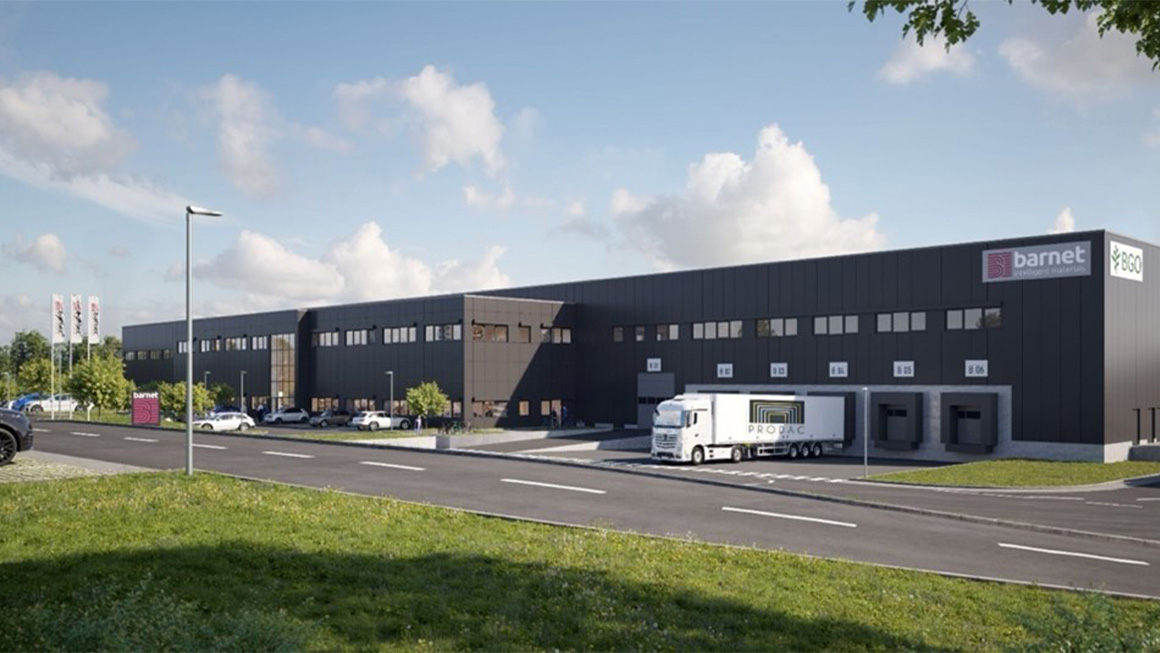
Barnet Europe has completed its new European headquarters in Eschweiler, Germany, bringing production, recycling, warehousing and administration that were previously distributed across several locations onto one industrial site.
The development provides around 23,000 sq m of production, warehouse and office space on a 41,400 sq m plot, including roughly 19,400 sq m of logistics space, 1,800 sq m of office and social areas and a further 1,700 sq m warehouse mezzanine. Two industrial buildings and a two storey office element were completed about eleven months after groundbreaking.
Barnet handles fibres, polymers and yarns alongside recycling and specialist material processing, so consolidation changes the physical movement of incoming material, work in progress and finished products rather than simply bringing office teams into the same address. Production capabilities include fibre cutting, pulling, garnetting, washing, rewinding, twisting, plying, dyeing and coating.
The product range spans conventional synthetic fibres and specialised materials including carbon, aramid, PPS, PBO, PEEK and ultra high molecular weight polyethylene. Different fibres and yarns require different storage, handling and processing conditions, while customers may request short production runs or tailored specifications that create many material variants even when individual volumes are modest.
When those activities are divided between sites, stock can move through several warehouses before processing and dispatch, adding handling time and creating more inventory locations to control. A consolidated layout allows incoming material, conversion processes and outbound logistics to be planned as one flow, provided the buildings keep incompatible products separated while locating frequently moved stock close to the equipment that uses it.
Because Barnet also works with production waste, off specification material and residues returned from customer processes, its recycling operation adds another layer of material control. Reuse depends on identifying material accurately and preserving enough consistency for the recovered output to enter another manufacturing process without introducing quality problems downstream.
Mechanical preparation can involve cutting, opening or garnetting textile material into a form suitable for blending or further conversion, while polymer streams may require sorting and reprocessing before reuse. Contamination, fibre length, surface treatment and previous heat exposure can all alter the applications available to recovered material, leaving quality as important as nominal recycling throughput.
Some customer programmes operate in closed loops, with residues returned for processing and then supplied back into the original manufacturing chain. Accurate segregation and traceability are required throughout because material from one specification cannot simply be mixed with another without changing the properties of the recovered product.
The Eschweiler site also supports technical fibre products and European activity around Barnet’s Nega Stat antistatic yarns, adding more specialised stock to the same logistics system. A broad range of fibre types, counts, finishes and technical grades creates substantial inventory complexity even where the physical products themselves occupy relatively little space.
Bringing production and warehousing together gives Barnet an opportunity to reduce duplicated stock and unnecessary transfers, but the larger building does not create those savings automatically. Inventory accuracy, warehouse discipline and production scheduling will determine whether the site reduces material movement or merely concentrates the same complexity inside one property.
Its location near Aachen connects the operation with European road networks and routes towards major ports, while Barnet supplies customers in more than 70 countries. Material arriving for processing and finished product leaving Eschweiler therefore moves between local manufacturing activity and a much wider international logistics network.
Completion of the headquarters follows Barnet Europe’s move to Eschweiler earlier in 2026 and confirms that production, recycling, trading and storage can now operate from a facility designed around those functions. The previous arrangement required several properties to accommodate an evolving product range, whereas the new site brings those flows into one manufacturing and logistics system.
As production settles into the new layout, changes in inventory, internal transport, equipment utilisation and order flow will show whether consolidation has improved operating efficiency. Removing the distance between sites creates the opportunity, while material control and production planning inside Eschweiler will determine how much of that opportunity becomes usable capacity.