American Lithium Energy has opened an expanded battery manufacturing facility in Vista, California, increasing the site’s footprint from 23,000 to 82,000 sq ft as it scales lithium-ion cell production for aerospace, defence and other demanding applications.
The expansion adds manufacturing capacity around the company’s cylindrical cells and silicon anode technology and has been supported by more than $13 million from the California Energy Commission. American Lithium Energy employs between 150 and 200 people across San Diego County, with the larger site intended to move cell designs from pilot production into repeatable higher volume manufacture.
Cell production becomes less tolerant of manual variation as output rises because electrode preparation, assembly, electrolyte filling, formation, testing and grading all have to remain inside controlled process limits. A pilot operation can accommodate more engineering intervention when a problem appears, whereas larger volume production depends on equipment producing the same result repeatedly across thousands of cells.
The Vista programme includes a low rate initial production line used to validate silicon anode batteries before manufacturing is transferred to higher output equipment. Running the chemistry through pilot production allows engineers to identify material, equipment and yield problems while process changes can still be made without disrupting a fully committed production line.
Silicon can store considerably more lithium than graphite, creating a route towards higher energy density, but the material also expands and contracts significantly during charging and discharging. Repeated volume change can damage the electrode structure and reduce cycle life unless the cell chemistry, electrode design and manufacturing process keep that movement under control.
American Lithium Energy says its cells can reach energy densities of roughly 350 to 410 Wh/kg depending on configuration, while the wider portfolio covers very different discharge requirements. A satellite application may place greater emphasis on stored energy and mass, whereas an unmanned aircraft or defence system may require much higher current over a shorter period.
The company’s 100C cylindrical cell illustrates the latter requirement, with a design intended to supply discharge currents above 200A while operating under severe thermal, vibration and pressure conditions. Delivering that output without excessive heating depends on low internal resistance, controlled current paths and a cell construction able to tolerate rapid electrochemical activity without becoming unstable.
Manufacturing variation becomes particularly costly in cells operating near those limits because small defects can increase internal resistance or create local heating that only appears during demanding electrical tests. Coating thickness, moisture control, electrode alignment and assembly pressure therefore influence final performance even when the completed cell looks dimensionally correct.
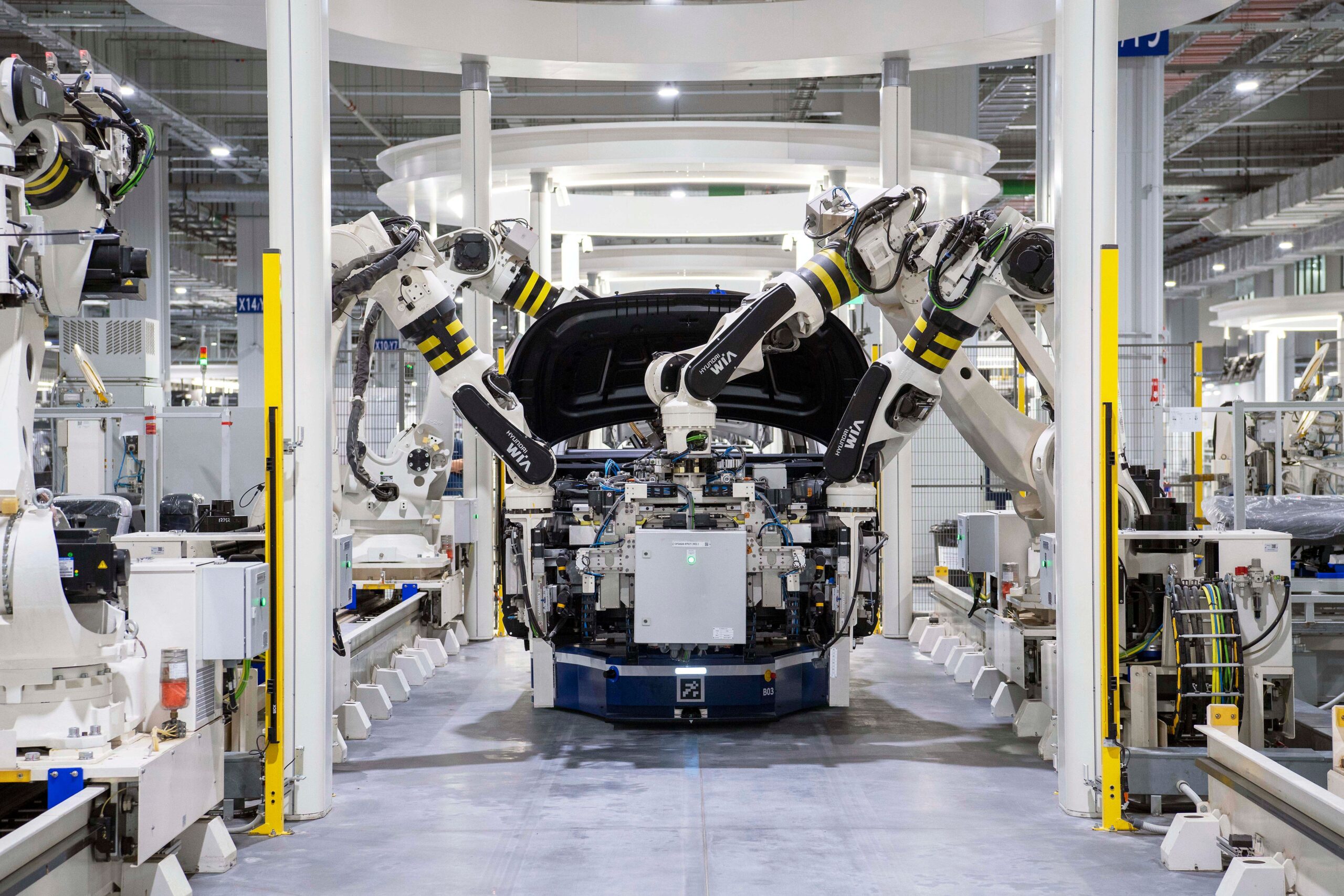
Automating more of the Vista production route can reduce handling variation and record process data at each stage, allowing the manufacturer to compare final cell performance with the conditions under which it was built. That link becomes useful when yield begins to drift because engineers can trace a failed electrical test back through coating, assembly or formation data rather than examining the finished cell in isolation.
Safety testing remains integral to the process because aerospace and defence batteries can be installed in systems where additional containment adds mass and occupies valuable space. American Lithium Energy’s SafeCore technology is intended to limit progression into thermal runaway, while its validation work covers pressure, heat, shock, vibration and other environmental stresses expected in service.
The California Energy Commission is also supporting pilot production of silicon anode prismatic cells, extending the company’s manufacturing work beyond cylindrical formats. Prismatic cells can use space efficiently within a battery pack, although their larger flat surfaces introduce different requirements around electrode stacking, enclosure stiffness, swelling and thermal management.
State funding has helped the company attract further private and federal investment, according to the Energy Commission, allowing production equipment and supporting infrastructure to expand beyond the original grant programme. That capital is being used to turn a broader building footprint into working manufacturing capacity rather than simply adding development space.
Factory scale will ultimately depend on yield as much as installed machinery because rejected cells carry the cost of materials and several processing stages before failure is detected. Stable output requires the larger Vista operation to reproduce the energy density, discharge capability and safety performance demonstrated during development without allowing scrap or rework to rise as volumes increase.
The opening therefore moves American Lithium Energy further into industrial production while leaving the most difficult part of the expansion ahead: automated equipment, pilot chemistry and quality systems now have to deliver consistent cells at a rate high enough to support customers whose aerospace and defence programmes depend on performance remaining predictable from one batch to the next.