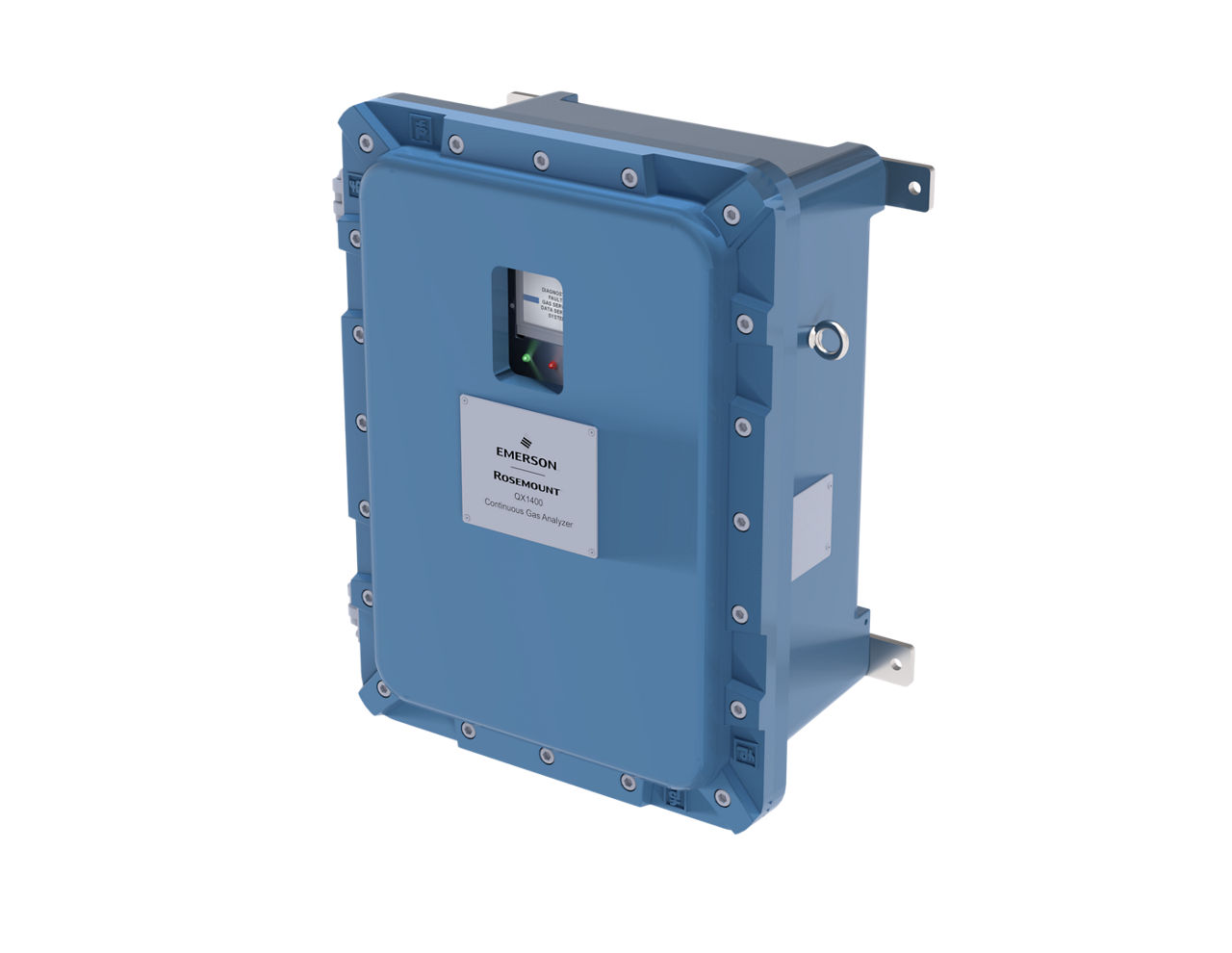
Emerson has added hazardous area certification to its Rosemount QX1400 continuous gas analyser, extending a hybrid measurement architecture already described in product documentation during September into applications where combustible gases or vapours restrict the equipment that can be installed. The October announcement therefore marks a certification and deployment step rather than the first public appearance of the analyser itself.
The European version carries ATEX II 2G Ex d IIB H2 T4 certification, while international markets are covered by IECEx Ex db IIB+H2 T4 Gb. Emerson expects North American Class I, Division 2 certification for Groups B, C and D with a T4 temperature rating before the end of 2026, which would extend the same platform across another major hazardous-location regime.
QX1400 combines two measurement methods inside one analyser. Oxygen is measured through paramagnetic detection, which uses the magnetic properties of oxygen, while other configured gases are measured through quantum cascade laser direct absorption spectroscopy. Emerson lists gases including carbon monoxide, carbon dioxide, oxygen, nitric oxide, nitrogen dioxide and sulphur dioxide, with methane and nitrous oxide available in additional configurations.
Using separate sensing principles reflects the fact that no single measurement method is optimal for every gas and concentration range. Paramagnetic detection is well established for oxygen measurement, while narrow-band laser absorption can provide high selectivity for gases whose spectral features can be isolated within a complex process stream. The combined analyser allows each component to use the more appropriate method without requiring a plant to build the complete measurement system from several standalone instruments.
Emerson is targeting applications including continuous emissions monitoring, natural-gas quality, LNG, carbon capture and underground storage, hydrogen purity, ethylene purity and other chemical or petrochemical processes. Several of those environments contain classified areas where an electrical enclosure, cable entry or hot surface has to be designed so that the analyser does not become an ignition source if flammable gas is present.
Certification changes how the instrument can be engineered into those installations. An analyser without the required hazardous area approval may have to sit outside the classified zone or be protected through a separately engineered enclosure and purge arrangement, adding utilities, alarms, controls and maintenance around the measurement equipment. A certified analyser can be positioned within the approved area when the complete installation satisfies the relevant protection requirements.
Location affects measurement performance because process analysers frequently depend on an extracted sample reaching the instrument without changing composition on the way. Long sample lines can introduce delay, condensation, adsorption or leakage, while filters, pressure regulation and temperature control influence whether the gas arriving at the measuring cell remains representative of the process. Installing approved equipment nearer the sample point can shorten that path where the plant layout allows it.
Sample conditioning remains necessary even when the analyser itself carries hazardous area approval. Dust, liquids, temperature, pressure and corrosive components can all affect measurement or damage the system if the sample is not prepared correctly, so the certification removes one installation barrier rather than replacing the engineering around extraction and conditioning.
The product page describes QX1400 as a low-consumable platform with few moving parts and advanced diagnostics, reflecting Emerson’s effort to reduce routine maintenance around continuous measurements. Actual service demand will still depend on the gas stream and sample system because optical surfaces, filters, tubing and conditioning components can accumulate contamination even when the core detector has little mechanical wear.
Continuous emissions monitoring gives the hybrid architecture one of its more direct applications because regulated plants may need several gas measurements available continuously from the same stack or process. Combining several components inside one analyser can reduce the number of separate cabinets and communication interfaces, although it also concentrates more measurements around one instrument and makes planned maintenance and system redundancy important where data availability is tied to regulatory compliance.
LNG, hydrogen and carbon-capture applications use similar measurements for different reasons. Oxygen can indicate contamination or process condition, while carbon dioxide, methane and other gases influence product quality, safety or process control. Hazardous classification is common around those processes, placing certification alongside accuracy, response time and selectivity when the analyser is specified.
Emerson’s September document register shows that QX1400 product literature and application notes were already available before the October release, while the company had launched the related QX1000 hybrid platform earlier in 2026. QX1400 therefore extends an existing measurement concept into a more demanding installation environment rather than introducing a new spectroscopy principle.
The remaining North American approval will broaden the range of plants able to use the same package without separate hazardous area protection, but certification alone will not determine adoption. Long-term analyser stability, sample-system reliability, calibration requirements and maintenance under real process conditions will decide whether combining paramagnetic oxygen measurement and laser spectroscopy in one certified enclosure reduces system complexity over the operating life of the installation.