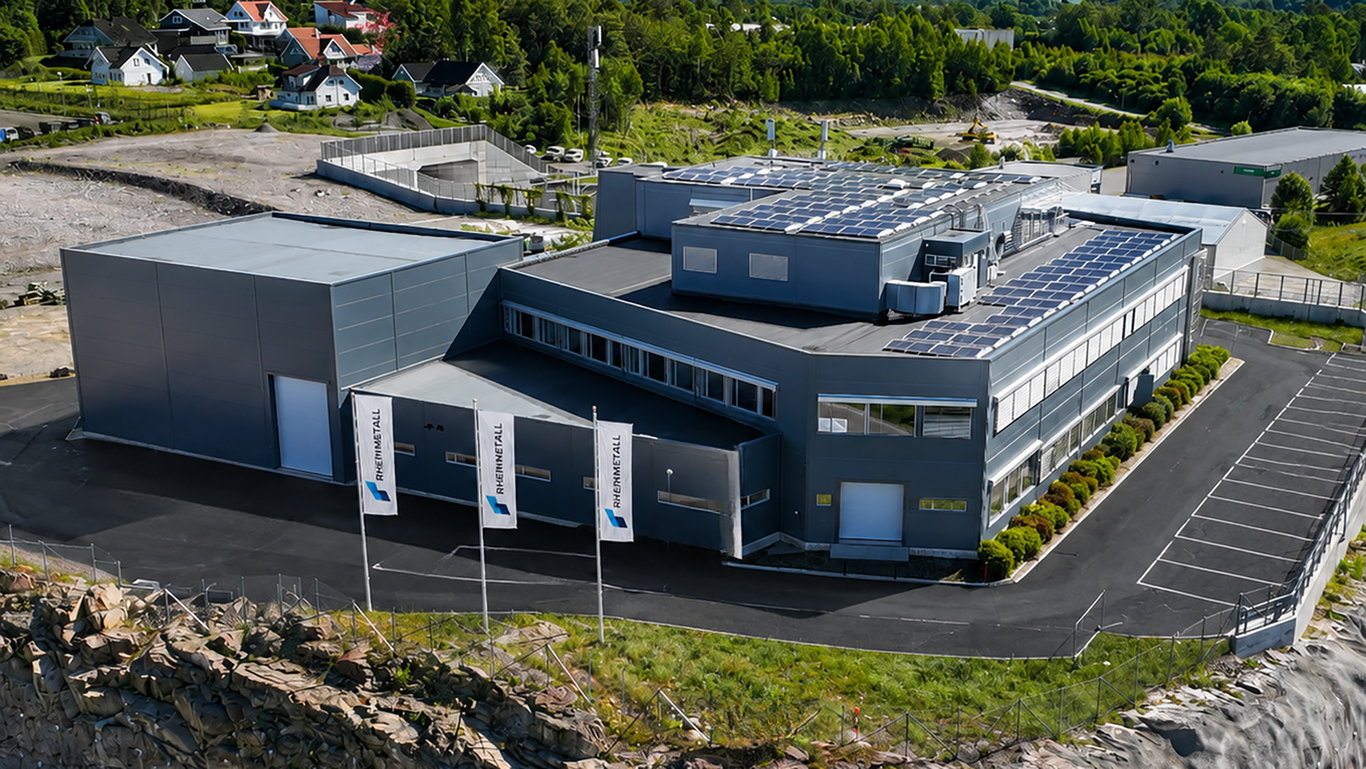
Rheinmetall Nordic has opened a new production and engineering site at Skoppum in Norway, increasing local capacity for development, manufacturing, systems integration, logistics and lifecycle support across several defence technology programmes. The 4,579-square-metre facility begins operations with 100 employees, provides space for 127, and sits on a site that can accommodate roughly another 5,000 square metres if programme demand requires further expansion.
Rheinmetall has signed a 15-year lease on the building, giving the Norwegian operation a long planning horizon for production equipment, specialist test systems and technical staff. Development, production, logistics and customer support are being brought together inside the same operation, allowing engineering changes to move through assembly, integration, acceptance and later service without the additional hand-offs created when those functions sit at different locations.
The Skoppum business works across electro-optical systems, fire-control equipment, situational-awareness technology, weapon accessories and other digitally enabled defence products supplied to the Norwegian Armed Forces, international customers and other Rheinmetall businesses. Rheinmetall Nordic also acts as the group’s Advanced Land Autonomy Centre of Excellence, placing software, sensors and control systems alongside the mechanical, electrical and manufacturing disciplines needed to turn those technologies into fielded equipment.
Electro-optical and fire-control systems impose manufacturing demands that extend well beyond the assembly of electronic modules. Thermal imagers, cameras, laser rangefinders, navigation equipment, processors, housings, mounts and cabling have to be integrated to controlled mechanical and optical tolerances, while calibration, environmental sealing and software configuration determine whether the completed system performs as intended outside the factory.
Rheinmetall’s Vingtaqs II target-acquisition system reflects that combination of technologies by bringing thermal imaging, laser ranging, navigation and other sensors into a single modular platform, while the Vingmate family adds optics, ranging and ballistic computation around weapon installations. Greater production capacity therefore depends on more than available floor space, with output constrained by qualified suppliers, specialist components, trained technicians and enough inspection and calibration equipment to support complete systems rather than individual parts.
Lifecycle activity has also been incorporated into the Skoppum layout because many defence electronics products remain in service for years and accumulate modifications rather than being replaced outright. Repairs, replacement modules, software updates and obsolescence management can feed directly back into engineering and production documentation when the same site retains responsibility for the equipment after delivery, reducing the separation between original manufacture and later fleet support.
Rheinmetall Nordic has operated in Norway for more than 70 years, so the new site expands an established industrial base rather than creating a national presence from scratch. Its portfolio already includes observation systems, target-acquisition equipment, mortar systems, fire-control technology and weapon accessories, giving the enlarged facility existing product families and customer programmes around which additional capacity can be organised.
European defence manufacturers have been increasing regional capacity as governments seek shorter replenishment times and greater resilience in equipment supply, although the effectiveness of those investments depends on the depth of the supplier network feeding each plant. Skoppum will continue to rely on sensors, processors, precision machining, specialist glass, electronics and coatings sourced beyond the final assembly operation, leaving procurement and supplier qualification closely tied to any rise in output.
A larger Norwegian operation nevertheless gives Rheinmetall more room to retain integration and support work locally rather than moving every engineering change through another group factory. Stable facilities also make it easier to justify training, dedicated test equipment and longer supplier relationships, particularly where products require repeated calibration, software updates and customer-specific configurations over their service lives.
The factory opens close to its planned initial staffing level, with 100 employees already in place against a capacity of 127. Rheinmetall has not disclosed a capital value or annual production target for Skoppum, so workforce utilisation, programme throughput and the eventual use of the additional expansion area will provide more meaningful measures of how quickly the new facility is being absorbed into the group’s production network.
The 15-year commitment gives those programmes time to develop through several product and support cycles rather than around a single contract. Skoppum now has the space and organisational structure to carry more work from engineering through manufacture and long-term support; the rate at which its remaining capacity is filled will depend on orders, component availability and the number of systems that can be moved through integration and acceptance without creating new test or supply bottlenecks.