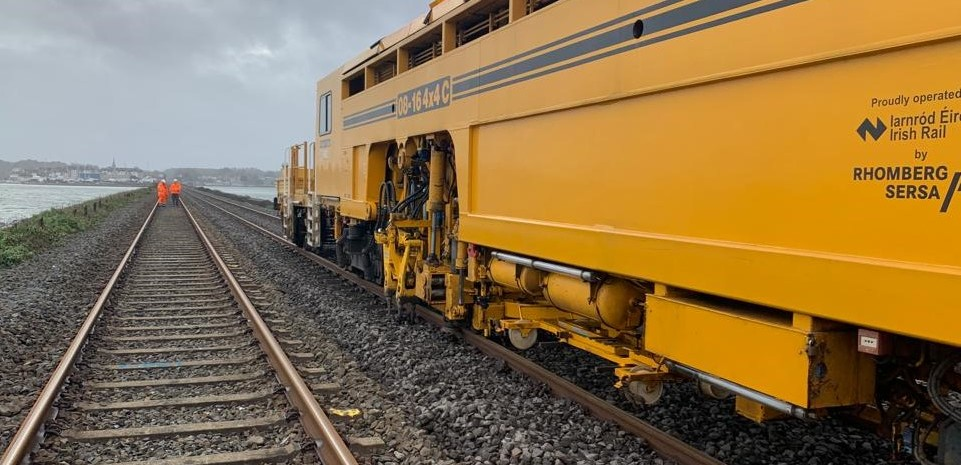
Rhomberg Sersa Rail Group has been awarded a contract worth more than €140 million by Iarnród Éireann to operate and maintain the national railway’s fleet of specialist on-track machines, extending a maintenance relationship that began in 2019 and increasing the number of machines covered from 14 to 19.
The agreement has an eight-year base term with an option for a further two years and follows a competitive tender launched in February 2025. Rhomberg Sersa will provide the operators, maintenance personnel and support required to keep the fleet available for tamping, ballast cleaning, regulating and other infrastructure work carried out across the Irish network.
Iarnród Éireann owns the machines while Rhomberg Sersa operates and maintains them under its own railway safety framework, leaving the infrastructure manager with strategic control of the assets and the contractor responsible for the specialist workforce and technical support required to keep them productive. The previous agreement began as a five-year contract worth around €40 million for 14 machines, with Irish Rail subsequently exercising a two-year option that extended the arrangement to July 2026.
The larger replacement contract reflects both a bigger fleet and a longer operating period. Track maintenance machinery carries a high capital cost and works within limited possession windows, so availability can be more consequential than the nominal number of machines owned. A ballast cleaner or tamper that develops a fault during a planned closure can waste access time that has already been coordinated around passenger and freight operations, leaving the engineering task unfinished until another possession becomes available.
Tamping machines restore track geometry by lifting and aligning rails and sleepers before compacting ballast beneath them, correcting the movement that accumulates under repeated train loading. Ballast cleaners address a different deterioration mechanism by removing and screening fouled material, returning usable ballast to the track and taking away material that no longer provides the required drainage and support, while regulating machines redistribute the ballast profile around sleepers and track shoulders.
Irish Rail says work carried out under the existing partnership has allowed approximately 400,000 tonnes of ballast to be reused during the past five years. Recovery reduces the amount of new quarried stone required and cuts the volume of spent ballast transported away from the railway, although suitability for reuse still depends on contamination, particle grading and the engineering requirements of the individual section being maintained.
The complete on-track fleet has also been converted to run on 100% hydrotreated vegetable oil fuel, giving Irish Rail a route to reduce fossil diesel use without replacing machines whose mechanical systems and specialist work equipment may remain serviceable for many years. Heavy rail machinery poses a more difficult electrification problem than road vehicles because duty cycles, remote operating locations, work intensity and access time all influence how alternative propulsion would need to be supported across the network.
Rhomberg Sersa currently employs around 70 people within the Irish operation, with much of the maintenance activity carried out overnight and at weekends when infrastructure access can be made available with less disruption to normal services. The company is certified in Ireland and the UK as an Entity in Charge of Maintenance and operates on the Irish network under its own safety case, placing responsibility for machine condition and operation within a formal railway regulatory framework rather than treating the fleet as conventional contractor plant.
A long contract term changes how the contractor can approach overhauls, replacement parts, workforce development and machine utilisation because major maintenance can be planned across several operating cycles instead of being managed around a short project horizon. Components in tamping, cleaning and regulating equipment experience high mechanical loads and abrasive wear, while hydraulic, electrical, measurement and control systems need to remain reliable enough for machines to work productively during possessions that may last only a matter of hours.
Ireland’s railway network contains substantial infrastructure more than a century old, ensuring a continuing requirement for track geometry correction, ballast treatment, inspection and renewal even as new signalling, rolling stock and infrastructure projects are delivered elsewhere. Mechanised maintenance cannot remove the underlying deterioration caused by traffic and weather, but higher machine availability can increase the amount of work completed during each access window and reduce the number of repeat possessions required for the same task.
The move from 14 machines under the original 2019 contract to 19 under the new agreement also increases the maintenance burden carried by Rhomberg Sersa itself. Fleet expansion means a larger spare-parts requirement, more inspections, additional operator competence and more complex work planning, while the increased contract value leaves greater exposure if machine availability or labour coverage falls below the level required by Irish Rail.
For Iarnród Éireann, retaining ownership while renewing the specialist operating contract preserves continuity around machines that have already been integrated into national maintenance planning. Rhomberg Sersa keeps the workforce and technical responsibility it has built since 2019, while Irish Rail avoids replacing the complete operating model at the same time as the fleet itself has increased.
The next contract period will be judged through ordinary infrastructure measures rather than the headline €140 million figure: machine availability, productive hours during possessions, ballast recovered, maintenance completed to programme and the reliability of a fleet that has to work around an operating railway. With the base contract running for eight years, those results will accumulate across several maintenance cycles before Irish Rail has to decide whether to exercise the final two-year option.