Eaton has expanded its manufacturing plant at Schrems in Austria by 5,000 square metres, adding fully automated miniature circuit-breaker production and further low-voltage systems assembly capacity as European demand for electrical protection and power-management equipment continues to increase.
The project was completed in less than ten months and combines additional manufacturing equipment with digital integration across production, material handling and enterprise systems. Eaton says the expanded operation provides end-to-end product traceability and greater real-time visibility across the factory, extending the Industry 4.0 systems already deployed at Schrems rather than establishing a separate production operation alongside the existing plant.
Schrems has developed into one of Eaton’s more heavily automated European sites, producing electrical components for customers across industrial, commercial, residential and data-centre markets. The plant manufactures several million component and assembly variants each year and employs around 700 people, with existing technologies including autonomous inline quality checks, computer vision, machine learning, intelligent material movement, predictive maintenance and real-time equipment monitoring.
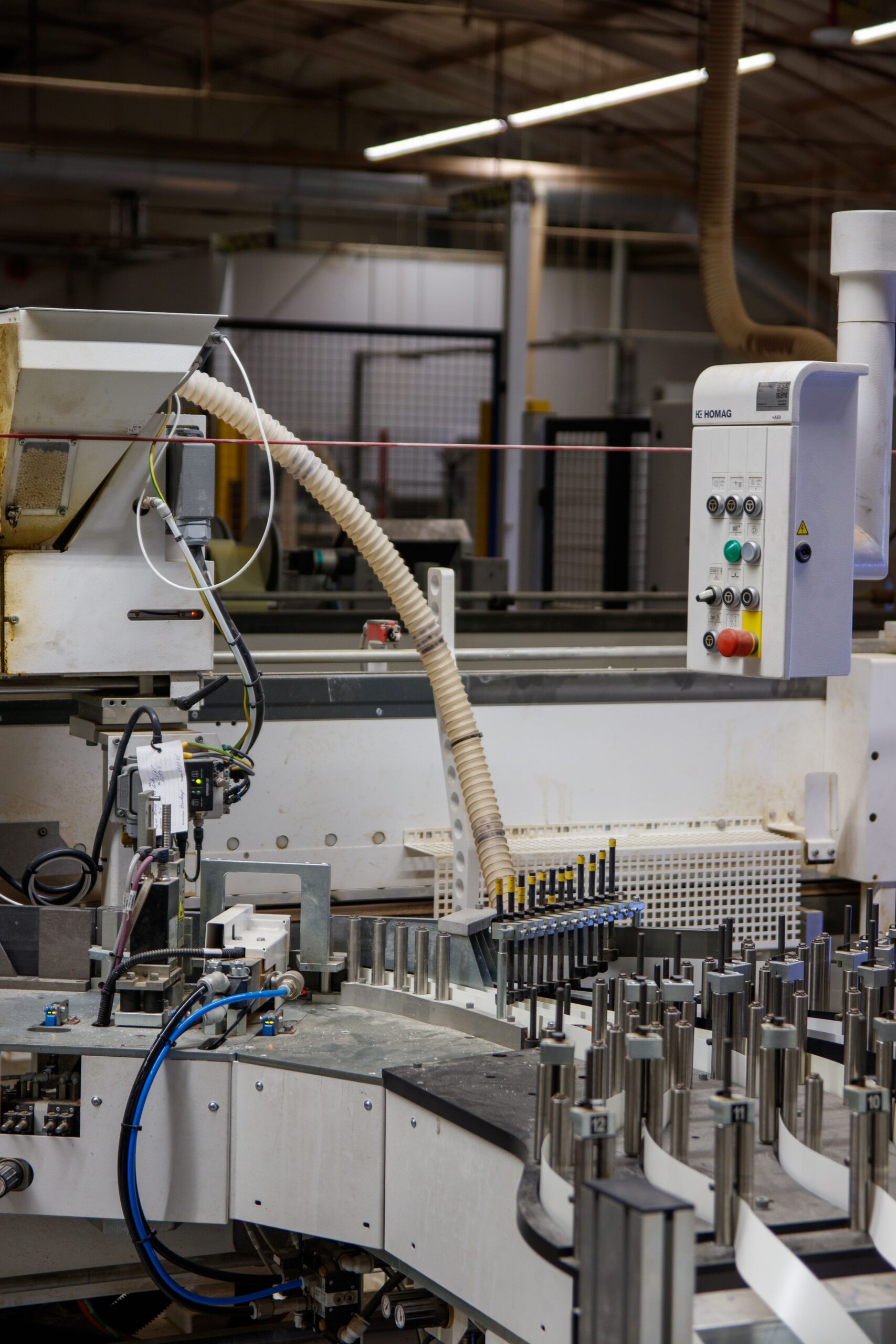
The new miniature circuit-breaker line expands a high-volume product family whose manufacturing requirements extend well beyond the apparent simplicity of the finished device. Plastic and metal components, switching mechanisms, trip elements, arc-control parts and electrical connections have to be produced and assembled within tight tolerances before completed units are tested against defined protection characteristics, leaving automated inspection and traceability closely tied to throughput rather than functioning as separate quality processes.
Connecting production equipment through a manufacturing execution system gives Eaton a record of how materials and individual products move through assembly and test, allowing faults to be traced against process history when equipment readings or quality results begin to drift. High-volume automated lines can create large quantities of non-conforming material quickly if a problem remains undetected, so identifying changes while production is running can protect both yield and downstream assembly capacity.
Material flow becomes equally important as the number of automated operations increases. Components have to reach machinery in the correct sequence, intermediate assemblies need to move between operations without building excessive work in progress, and final products require testing and dispatch against changing order priorities. Integrating intralogistics with production and enterprise planning gives the factory a more direct route between customer demand, component availability and the machines carrying out the work.
Eaton’s existing Schrems operation already includes in-house engineering teams that design, build and program automated production machinery, covering processes such as welding, soldering, coil winding, laser marking and quality inspection. Retaining that capability inside the plant allows equipment to be modified around product changes and operating data rather than treating each production improvement as an external machine-building project.
The factory’s expansion arrives as electrical equipment manufacturers respond to investment across data centres, renewable generation, grid reinforcement, industrial electrification and building power systems. Those markets place demand on equipment at several voltage levels, and while much of the current capacity debate centres on transformers and medium-voltage switchgear, higher infrastructure spending also moves through lower-voltage protection and distribution products installed closer to individual loads.
Eaton has been expanding its European electrical manufacturing base through several routes during 2026, including its separate agreement to acquire Italian medium-voltage manufacturer COL Group. The Schrems project operates at a different point in the product range, increasing existing Austrian capacity rather than acquiring another business, while both developments enlarge the company’s regional ability to supply equipment into the same broad electrification cycle.
Additional floor space alone would provide limited benefit if the factory could not recruit and develop the skills needed to operate increasingly software-dependent production. Schrems has a long-standing apprenticeship programme and a Connected Learning Center used to build capability in automation, programming, robotics, additive manufacturing and other digital production disciplines, complementing an operation where mechanical maintenance, controls, quality and data analysis increasingly overlap.
The factory’s existing smart-manufacturing systems also give Eaton a base against which the expansion can be measured. Schrems was designated an Eaton smart factory in 2024 after a programme covering asset monitoring, inline quality, computer vision, machine learning, material movement and predictive maintenance, so the current investment adds capacity to an established digital architecture rather than using automation as a label applied to a conventional extension.
Eaton has not disclosed a percentage increase in output from the new lines, leaving utilisation, product mix and order intake to determine the actual capacity gain once the extension is fully loaded. The company has nevertheless brought another 5,000 square metres into service in under a year, with automated circuit-breaker manufacturing, low-voltage assembly and digital traceability being expanded together rather than as separate investment programmes.
Schrems now has to convert that additional machinery and connected production space into higher effective output while retaining the plant’s existing quality and delivery performance. Growing electrification demand gives the operation a large addressable market, but the value of the expansion will ultimately be visible in line utilisation, yield, lead times and the ability to move a broader volume of products through the factory without creating new material or test bottlenecks.