BMW Group has started series production at its new Irlbach-Straßkirchen battery plant in Bavaria, moving a roughly €1 billion investment into operation two-and-a-half years after construction began and supplying sixth-generation high-voltage batteries to the company’s Munich vehicle plant for the new BMW i3.
Production has begun directly on a two-shift pattern because demand for Neue Klasse models has accelerated the ramp-up beyond BMW’s original plan. Construction started in April 2024, the first pre-series battery was completed in March 2026, and the 60-hectare site is now moving into regular production with two battery lines and capacity for several hundred packs a day once the operation reaches full scale. Around 1,600 people are expected to work at the plant when the planned workforce is in place.
BMW’s Gen6 manufacturing process integrates cylindrical cells directly into the high-voltage battery under its cell-to-pack architecture, while the completed battery becomes part of the vehicle structure through the group’s pack-to-open-body design. Cells supplied by external manufacturers are checked on receipt before being connected into clusters with cooling components, after which the cell clusters and contact system are laser-cleaned and welded, protected through a foaming process, enclosed within the housing and fitted with the Energy Master control unit before final inspection.
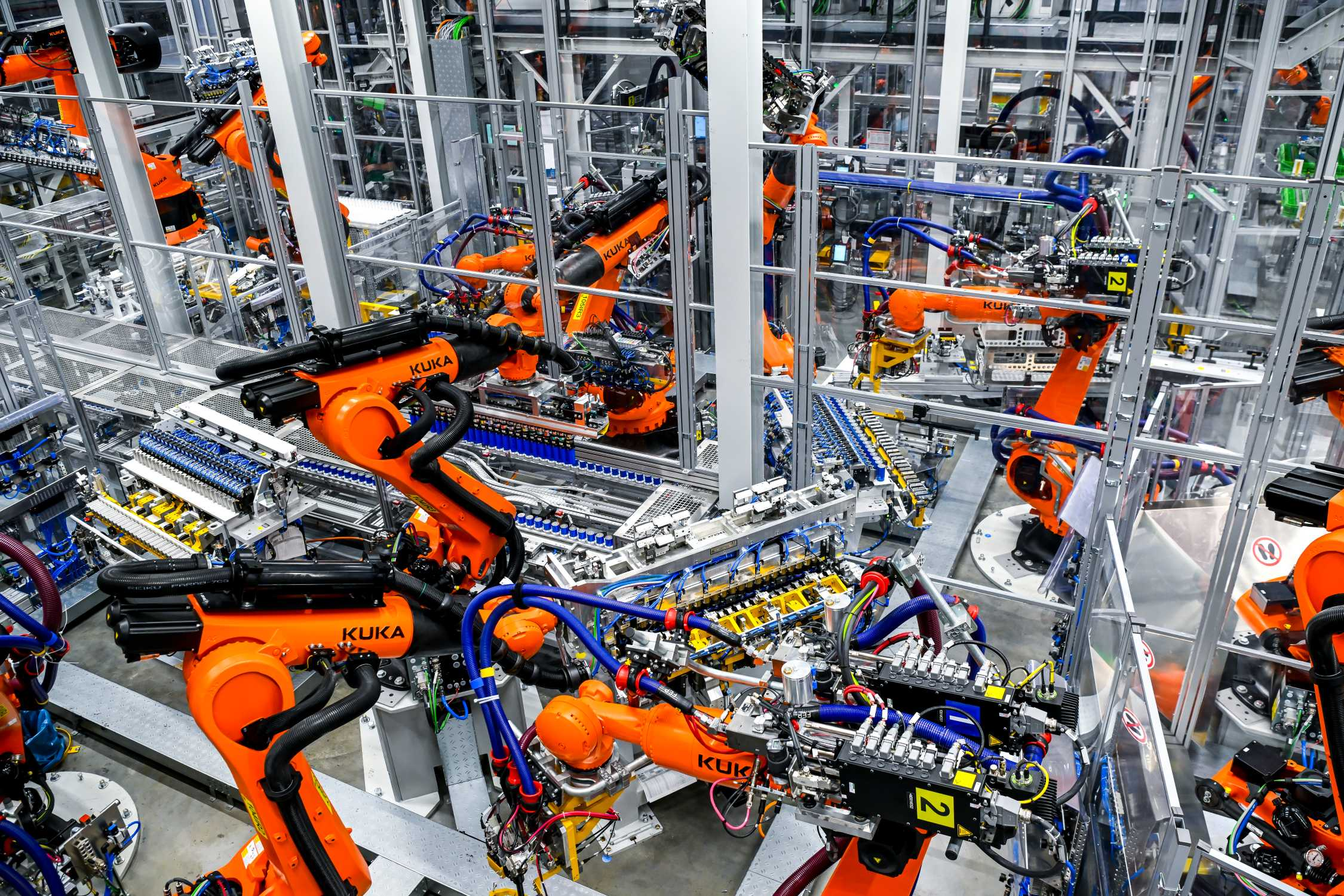
Every battery passes a 100% end-of-line check, while more than 3,500 process data points are collected and monitored during production. Around 500 robots operate across a 50,000-square-metre production area, supported by AI-based tools that BMW uses to analyse manufacturing data and equipment performance. The same digital approach extends into plant preparation, where virtual models and simulation have been used to develop production sequences and train employees before physical equipment reaches full output.
The amount of data collected reflects the structural role the battery now plays within the vehicle. Weld quality, cooling contact, sealing, electrical connections and dimensional accuracy all influence how the pack performs once it becomes part of the body, leaving less separation between battery manufacturing and vehicle engineering than in architectures where the pack is treated as a more self-contained component. Process variation that would once have affected only a battery assembly can therefore extend into vehicle integration, making inline measurement and traceability part of the production architecture rather than an additional quality layer.
Irlbach-Straßkirchen is one of five new Gen6 battery assembly operations being placed close to BMW vehicle plants, alongside Debrecen in Hungary, Shenyang in China, Woodruff in the US and San Luis Potosí in Mexico. The company describes the network as a “local for local” strategy, reducing the distance travelled by large finished battery packs while keeping assembly, testing and final configuration close to the vehicle factories that consume them.
That regional model still depends on an international cell supply chain, because BMW does not manufacture the cylindrical cells used at Irlbach-Straßkirchen, yet it moves a substantial part of the battery value chain inside the group’s own factories. Receiving inspection, clustering, thermal integration, joining, control electronics and final testing are carried out within BMW production rather than being completed entirely by a battery supplier, giving the vehicle manufacturer more direct control over the processes that determine pack quality and structural integration.
The Bavarian site is also tied into a wider local development and recycling network. Pilot plants at Parsdorf and Hallbergmoos are used to develop and validate production processes before transfer into series factories, while the Cell Recycling Competence Center at Salching, around 16 kilometres from Straßkirchen, has been operating since December 2025. BMW uses the centre to recover material from production residues and battery cells through a direct mechanical recycling route intended to return usable material to the battery production chain.
Domestic suppliers have taken a significant share of the investment around the new factory, with BMW reporting that all directly contracted construction companies came from Germany, including a majority from Bavaria, while more than three-quarters of the plant engineering suppliers are German. The arrangement keeps a large proportion of construction and equipment spending within the national industrial base at the same time that German vehicle manufacturers are committing substantial capital to battery production and electric vehicle platforms.
Regular operation at Irlbach-Straßkirchen uses no fossil fuels, with photovoltaic generation supplying part of the site’s electricity and the remainder coming from renewable sources. BMW also says no water is required during high-voltage battery assembly, while renewable energy is used in parts of upstream electrode and cell production and secondary materials are incorporated into cobalt, lithium and nickel supply. The company estimates that the resulting Gen6 cell carries around one-third less carbon dioxide equivalent per watt-hour than its Gen5 predecessor.
BMW’s battery investment therefore reaches beyond adding pack assembly capacity beside an existing vehicle factory. The company has created a linked development, production and recycling system in Bavaria while establishing equivalent assembly operations in other major manufacturing regions, allowing production methods developed in Germany to be transferred through a common industrial architecture.
With series production already running on two shifts, the factory now has to convert a heavily automated launch process into sustained daily output while Munich increases Neue Klasse vehicle production. Equipment availability, battery yield, supplier performance and the consistency of thousands of monitored process parameters will determine how quickly the €1 billion site reaches its planned throughput and how effectively the same manufacturing model transfers across BMW’s wider Gen6 network.