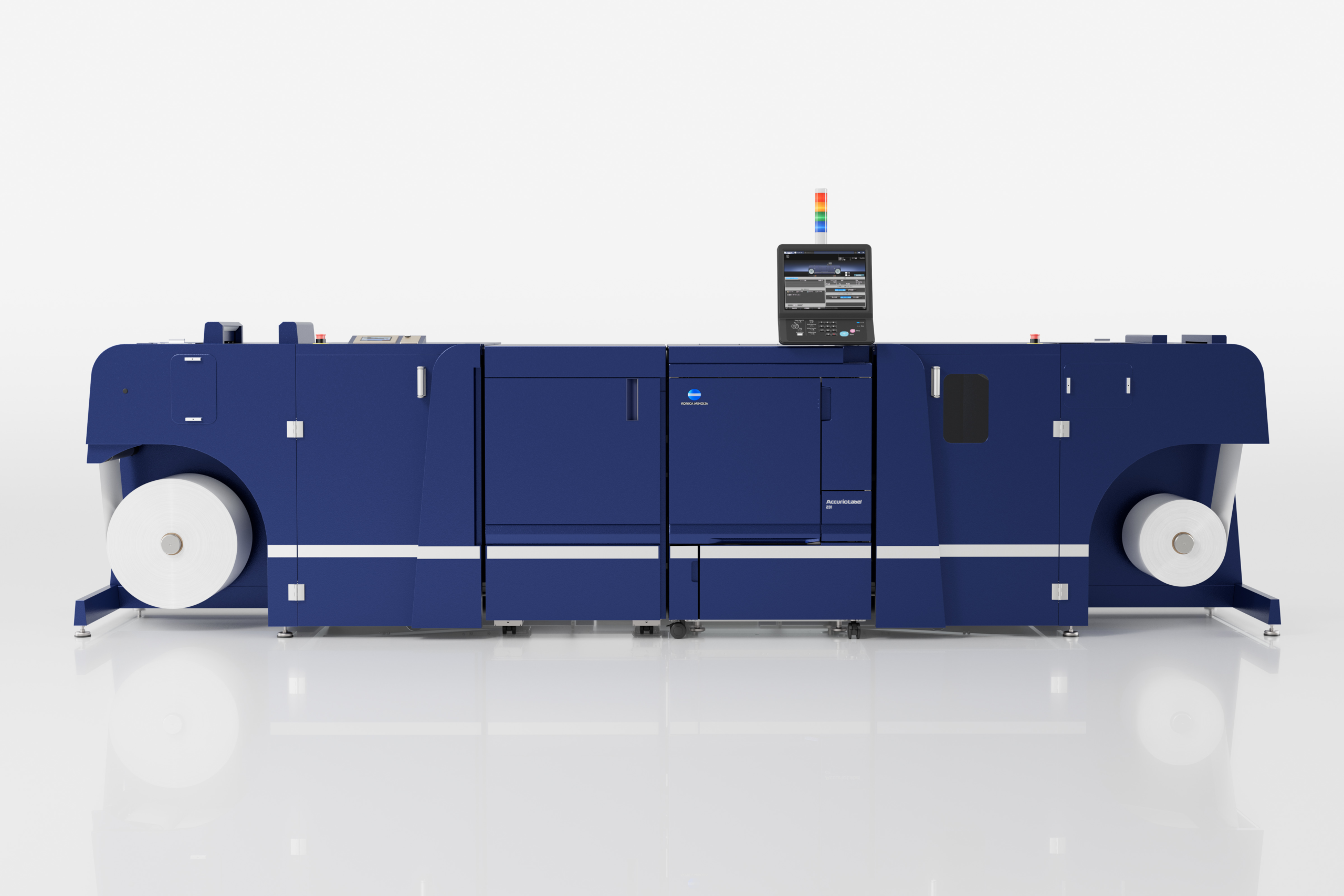
Konica Minolta Business Solutions UK has secured the first UK order for its AccurioLabel 231 digital label press, with Handy Labels preparing to install the system at its Portishead operation near Bristol.
The order was signed at The Print Show 2026 in Birmingham by Handy Labels founder Martyn Kilford and Alex Parkin, a director of the company’s employee ownership trust. The machine made its UK debut at the event following its launch in September as the successor to the AccurioLabel 230.
Handy Labels was established in 2007 around small and medium volume label and sticker work and now serves more than 44,000 returning customers. Rapid turnaround is central to the operation, with the business committing to dispatch work within 48 hours of PDF proof approval, making press availability and changeover time as important as nominal production speed.
The AccurioLabel 231 operates at up to 23.4 metres per minute and, when fitted with the optional IQ-530 quality optimisation unit, increases maximum continuous print length from 300 metres on its predecessor to 1,600 metres. Fewer roll changes and stops should allow a greater proportion of each shift to be spent producing saleable work, particularly as a digital press takes on longer repeat jobs alongside short runs.
Konica Minolta also specifies approximately twice the main unit durability of the AccurioLabel 230. Supported media widths run from 250mm to 330.2mm, with stocks including self-adhesive paper, coated materials, synthetic media, polypropylene, and PET.
The IQ-530 option addresses another source of lost production time by automating colour calibration and monitoring colour variation during printing. It can make corrections while the machine is running, reducing the dependence on manual adjustment and experienced operators during longer jobs.
Those functions are more significant than the usual argument that digital printing avoids plates. Once a digital label press begins carrying a substantial share of a converter’s daily workload, productivity depends on how much intervention is required between and during jobs. Colour correction, substrate changes, roll handling, inspection, and downstream finishing can quickly become more important than maximum print speed.
Martyn Kilford, founder of Handy Labels, said: “We are proud to be the first UK customer for the AccurioLabel 231.”
The order gives Konica Minolta an early UK production reference for a machine aimed at smaller and medium sized converters that need to increase digital capacity without moving into a substantially larger production platform. It also gives Handy Labels additional capacity as the company attempts to scale without compromising a business model built around short lead times.
The underlying economics depend heavily on job mix. Digital equipment is particularly useful where frequent version changes and short runs make analogue make-ready work expensive, but longer jobs still have to move efficiently through printing, rewinding, finishing, and dispatch. Extending continuous print length helps only where the rest of the production process can absorb the additional throughput.
That is why automation around the print engine matters. A press capable of running for longer without stopping can simply move the constraint downstream if finishing or inspection remains labour intensive. Conversely, automatic colour monitoring and fewer roll changes can reduce intervention at the press itself and free operators to manage other stages of production.
Konica Minolta is also positioning the new model against a labour problem familiar across manufacturing. Skilled press operators remain difficult to recruit, while converters are being asked to handle more job variation and shorter delivery windows. Automating routine calibration does not remove the requirement for production expertise, but it can reduce the number of adjustments that depend on individual operator experience.
The AccurioLabel 231 therefore represents an incremental rather than disruptive change in label production: longer uninterrupted runs, greater hardware durability, and more automated quality management within a familiar digital process. For Handy Labels, the relevant result will be whether those changes increase daily productive capacity without adding equivalent labour or extending turnaround.
That will also depend on how effectively the press is integrated with finishing, workflow software, stock control, and operator scheduling. Digital print capacity is commercially useful only when those surrounding processes can support the same pace and job variability without creating queues elsewhere in the plant.
Installation at Portishead will provide the first UK evidence. If the machine can absorb more jobs while maintaining the converter’s 48-hour dispatch commitment, the value of the new platform will be measured in utilisation and throughput rather than the first-customer designation attached to the order.