General Motors reportedly plans to increase its use of robots and other factory automation across North American manufacturing operations by 20% by 2028. The target was described by people familiar with the plans and has not been confirmed by the company. The prospective expansion includes autonomous mobile robots for moving material through production sites and an effort to assemble some robotic equipment internally, alongside purchases from established equipment suppliers. A plant-by-plant deployment timetable has not been disclosed.
The proposed expansion comes as the US automaker faces rising manufacturing costs and expenses associated with locating more production in North America. Two people familiar with the programme described the 20% objective, while additional sources identified development and assembly of internally designed robots at GM’s Kokomo operation in Indiana. That account indicates a change in how automation could be sourced as well as in the amount of equipment deployed, although the underlying measure used to calculate the percentage has not been disclosed.
GM’s reported priorities include autonomous mobile robots, which transport parts and other materials between work areas without following the fixed path of a conventional conveyor. Such vehicles generally combine route planning, localisation and obstacle detection with interfaces to production and warehouse systems. Their effectiveness depends on accurate information about material demand, handover positions, pedestrian movements and line sequencing. A robot moving a container to an assembly station provides little benefit if the station lacks the correct components or cannot accept them at the required time.
The company still acquires robotics equipment from outside manufacturers. Its parallel internal development work was outlined by executives during 2025, when GM said it had around 100 roboticists, artificial intelligence engineers and hardware specialists working on advanced robotic systems. The reported plan would extend that work across more production tasks, although no verified count of internally developed machines in routine factory service has been disclosed.
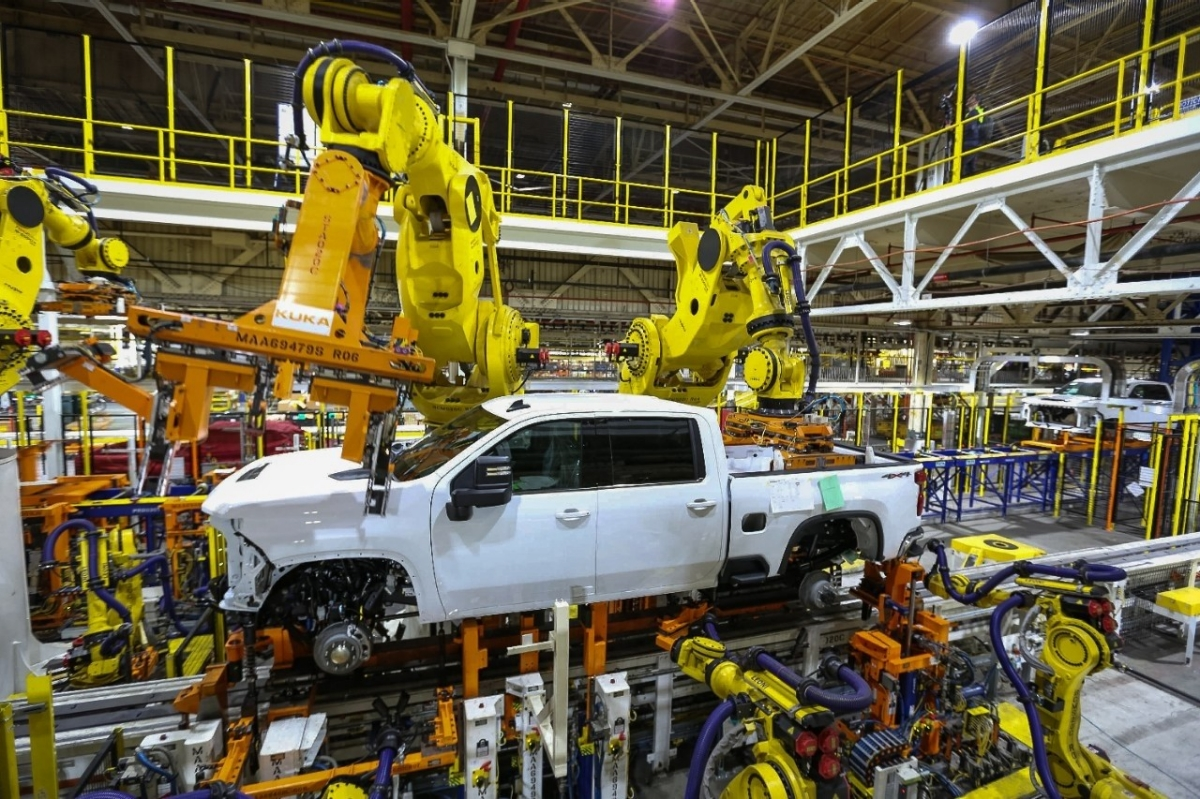
Automotive manufacturing already relies extensively on robots for welding, painting, handling and repetitive assembly. Increasing their number is therefore different from introducing automation for the first time. The more immediate engineering challenge is identifying operations where additional machines can raise throughput without transferring a bottleneck elsewhere. Material movement, end-of-line handling and tasks that vary across model configurations present different requirements from a fixed, high-volume welding cell.
A mobile robot deployment must also coexist with the equipment and people already operating in a plant. Battery charging, traffic management, safety zoning, wireless connectivity and manual recovery procedures can all affect the achievable operating rate. Deployments typically require careful integration with manufacturing execution, inventory and production scheduling systems, so that vehicles carry the right load at the right time rather than simply increasing the number of journeys inside the factory.
The reported expansion comes as automakers absorb higher labour costs following agreements reached with the United Auto Workers in 2023. GM previously estimated that its contract would add about $575 in labour cost per vehicle. The company has also cited expenses associated with bringing production closer to the US market and investing in its North American supply chain. Those pressures provide a commercial reason to examine automation, although the 20% target has not been accompanied by a verified estimate of savings or a workforce reduction figure.
The UAW has challenged the proposition that greater automation necessarily delivers shared gains. UAW vice president Ryan Hiestand criticised the reported approach, arguing that automation plans put the jobs of workers who make the company’s products at risk. That intervention makes the labour consequences part of the reported programme, rather than an assumption that robots will automatically eliminate a particular number of positions.
The reported programme may also affect supplier requirements, with people familiar with the plans indicating that GM has asked prospective suppliers about their automation capabilities. A supplier’s ability to document repeatable process control, quality inspection and material traceability could therefore influence discussions about future production readiness. No new mandatory supplier standard, award decision or factory-specific investment has been established from that account, however, and it should not be interpreted as a completed procurement policy.
Any increase in robot numbers must be assessed against its effect on throughput, quality and maintenance demand. Additional equipment can reduce repetitive work or improve consistency when tooling, component presentation and line balance are suitable. It can also add maintenance requirements, programming complexity and new failure points. Overall equipment effectiveness, quality losses, stoppage duration and material delivery performance can reveal whether an additional robot improves line output or simply moves delays to another workstation.
GM’s reported target extends to 2028, leaving considerable scope for programmes to be phased, redesigned or changed before completion. Confirmation of the intended baseline, individual plant investments, equipment orders and deployment results will determine how far the planned increase changes output, manufacturing cost and the organisation of work across its North American network.