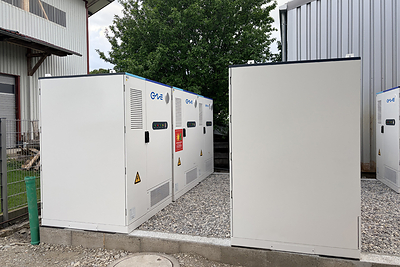
Vulcan Energy has started commercial-scale production in Germany of VULSORB, its proprietary lithium-extraction adsorbent, moving a critical process material for the Lionheart project from demonstration work into repeat manufacture.
The first commercial batches will provide the initial fill for adsorption-type direct lithium extraction columns being installed for Lionheart, where Vulcan intends to recover lithium from geothermal brine in Germany’s Upper Rhine Valley.
VULSORB is an aluminate-based adsorbent designed to selectively capture lithium ions from hot brine. The remaining brine can then continue through the geothermal system and ultimately be reinjected underground, while the captured lithium is washed from the material into a concentrated lithium chloride stream for downstream processing.
Vulcan has developed both the adsorbent formulation and its manufacturing method. The company says the material has completed thousands of operating cycles under real-world conditions, with lithium extraction efficiency reaching up to 95% during testing.
The move into commercial production is an important step because direct lithium extraction depends on far more than the vessels and pipework visible in a processing plant. The behaviour of the adsorbent inside the columns has a direct influence on recovery, cycle time, wash requirements, pressure drop, impurity management, and operating cost.
A material that performs well during laboratory testing therefore still has to be manufactured consistently enough for thousands of kilograms of product to behave in broadly the same way once packed into a commercial process train.
Vulcan has spent several years validating VULSORB through laboratory, pilot, and industrial demonstration work. Trials have been conducted with real geothermal brine rather than simplified laboratory solutions, allowing the company to assess how competing ions and changing process conditions affect lithium selectivity.
Commercial batches are now being produced with a local tolling partner following production trials with a selected group of European manufacturers. Vulcan intends to build first-fill inventory ahead of Lionheart commissioning in the second half of 2028.
The manufacturing programme therefore starts well before the extraction plant itself is ready to operate. That lead time provides an opportunity to qualify larger batches and build enough inventory for the columns before start-up rather than attempting to scale adsorbent production at the same moment the plant enters commissioning.
Lionheart forms the first commercial phase of Vulcan’s integrated geothermal lithium programme. The project is targeting production capacity of 24,000 tonnes of lithium hydroxide monohydrate annually alongside renewable electricity and heat recovered from the same geothermal resource.
Those remain planned capacities rather than current production. The development still has to bring together wells, geothermal systems, lithium extraction, chemical conversion, utilities, logistics, and quality control before battery-grade material can be produced consistently.
Direct extraction changes the process route compared with conventional hard-rock lithium production. There is no mine crushing and mineral concentration stage, because the lithium is already dissolved in brine, but that advantage is replaced by a different collection of engineering constraints.
Well performance, fluid temperature, brine chemistry, corrosion, filtration, adsorption behaviour, water balance, reagent use, and reinjection all affect how the plant operates. Downstream purification then has to remove unwanted species before the lithium chloride intermediate can be converted into final battery-grade product.
VULSORB sits near the front of that chain. Variations in adsorbent properties could influence how much lithium each column captures, how long a cycle takes, and how rapidly material performance changes after repeated use.
Manufacturing quality is consequently part of process performance. Particle characteristics, chemistry, mechanical stability, and batch-to-batch consistency all have to remain within acceptable limits if operating data from demonstration equipment are to translate into a commercial plant.
Vulcan is also positioning ownership of the adsorbent technology as a supply-chain advantage. The company describes VULSORB as a Western-developed adsorption DLE technology using a manufacturing chain outside China, at a time when access to some Chinese lithium-extraction technology has become subject to tighter export controls and licensing.
That does not make the process independent of every external supplier, but it gives Vulcan control of a material central to its extraction method rather than requiring a third-party adsorbent licence for the main commercial plant.
The company intends to use VULSORB across other Upper Rhine Valley developments and says selective licensing to third parties may eventually provide another commercial route for the technology.
For Lionheart, however, the immediate task is more prosaic: produce enough material to fill the commercial columns and show that industrial batches reproduce the extraction behaviour established during years of testing.
Commercial production removes one more scale-up step from the commissioning sequence. Instead of reaching plant start-up with an adsorbent that still exists primarily as a demonstration material, Vulcan can now manufacture, inspect, and stock the same process consumable intended for the operating extraction circuit.
The next 18 to 24 months will determine whether that manufacturing process remains stable as volumes increase. For a project built around direct lithium extraction, the answer matters just as much as the construction progress of the larger plant around it.