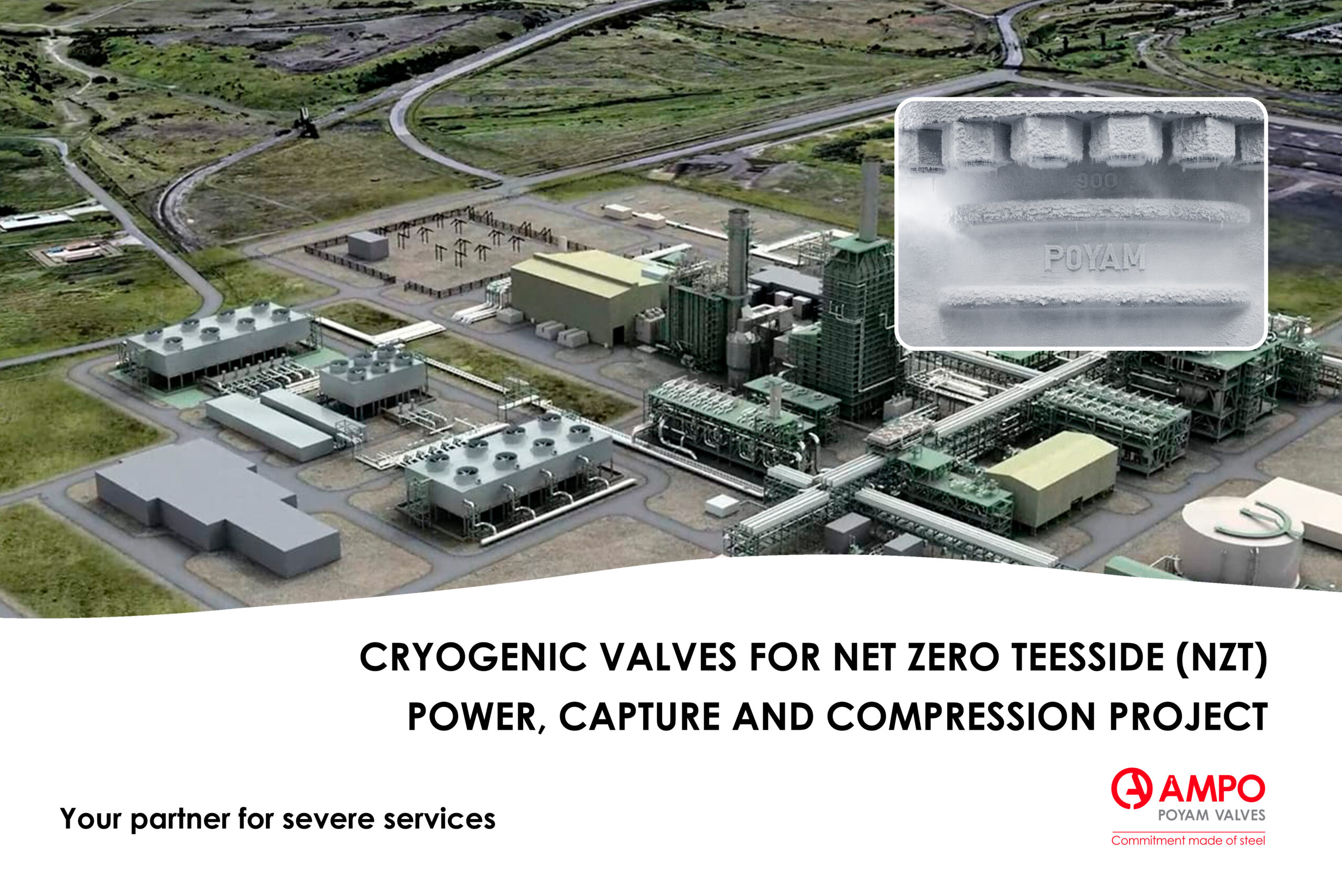
AMPO will supply cryogenic gate, globe, and check valves for the power, carbon capture, and compression package at Net Zero Teesside, adding specialist flow-control equipment to one of the UK’s largest carbon capture and storage developments.
The Spanish manufacturer will begin deliveries in September 2026, with the remainder of the package scheduled during 2027. The valves will be used within the section of the project combining a combined-cycle gas turbine power station, post-combustion carbon capture, and high-pressure carbon dioxide compression.
Net Zero Teesside Power is being developed by bp and Equinor. Technip Energies is leading engineering, procurement, and construction for the power, capture, and compression package, which is designed to generate dispatchable electricity while removing carbon dioxide from the plant’s flue gas before transport to offshore storage.
The compression system is being designed for up to four million tonnes of carbon dioxide annually. It will also be capable of handling captured volumes from additional industrial emitters connected to the regional network, placing the equipment within a shared infrastructure system rather than a stand-alone power-station capture plant.
Carbon capture introduces a wide range of process conditions across steam, water, solvent, gas, and compressed carbon dioxide services. Valves have to maintain isolation or flow-control performance while operating across different pressures and temperatures, with materials and sealing arrangements selected around the fluid and duty at each point in the process.
AMPO’s package covers cryogenic gate, globe, and check designs. Its wider cryogenic range uses extended-bonnet configurations to distance stem sealing components from very low process temperatures, although the exact sizes, pressure classes, and materials specified for the Teesside order have not been disclosed.
The contract arrives as Net Zero Teesside progresses through physical construction. Civil and foundation work is under way, while major mechanical and electrical packages are moving through procurement and fabrication before increasingly dense equipment installation begins across the site.
That transition exposes the size of the industrial supply chain sitting behind a carbon capture project. Compressors, turbines, heat exchangers, absorber and regeneration equipment, pumps, valves, electrical systems, instrumentation, controls, pipework, and structural steel all have to arrive in a sequence that allows the process plant to be assembled and commissioned as one system.
Much of the equipment is established process technology rather than equipment developed exclusively for carbon capture. The engineering challenge lies in integrating familiar components around new duty cycles, carbon dioxide specifications, compression requirements, and a network expected to accept material from several industrial sources.
The Teesside development is being built alongside the Northern Endurance Partnership transport and storage system. Offshore construction has already begun on the carbon dioxide pipeline, with pipe manufacture, handling, and mobilisation progressing through Hartlepool before subsea installation.
The shared network is designed to move captured carbon dioxide from Teesside and the Humber to permanent geological storage beneath the North Sea. That creates an interdependent chain in which capture plants, compressors, pipelines, injection wells, and storage capacity have to become available in a coordinated sequence.
Carbon dioxide transport also imposes strict requirements on fluid quality. Water and other impurities influence corrosion, phase behaviour, and the operation of compressors, seals, and valves, making specification control important across every emitter feeding the common network.
For equipment suppliers, the developing UK cluster provides a new application for capabilities established in petrochemical, LNG, refining, and gas-processing plants. Cryogenic and severe-service valve designs already have mature manufacturing and qualification routes, but carbon capture places them into a new infrastructure chain with its own operating profile.
The first AMPO deliveries now move the order from design and procurement into project execution. Further valve shipments during 2027 will coincide with the period when Net Zero Teesside shifts from heavy civil construction towards mechanical completion and process integration.
The success of the eventual capture system will depend on thousands of individual items performing reliably rather than any single headline component. AMPO’s package forms one part of that equipment chain, but valve availability, sealing performance, maintainability, and correct specification will be required before the larger capture and compression system can operate continuously.