Loop Technology is using FANUC’s M-2000 heavy-payload industrial robots as the motion platform for its FibreLINE composite preforming system, targeting higher production rates for large aerospace structures without relying on a bespoke gantry for every installation.
The Dorset automation specialist has developed FibreLINE around the challenge of handling very large pieces of uncured composite material accurately and at production speed. The system combines cutting, sorting, lay-up, inspection, tacking, consolidation, machine vision, photogrammetry, and robotic handling within an automated manufacturing architecture.
At the centre of the process is FibreFORM, an active conformal pick-and-place end effector capable of handling composite plies more than 20 metres long. The carbon-fibre material itself is comparatively light, but the equipment needed to support, form, and place large flexible sheets without distortion can weigh well over a tonne.
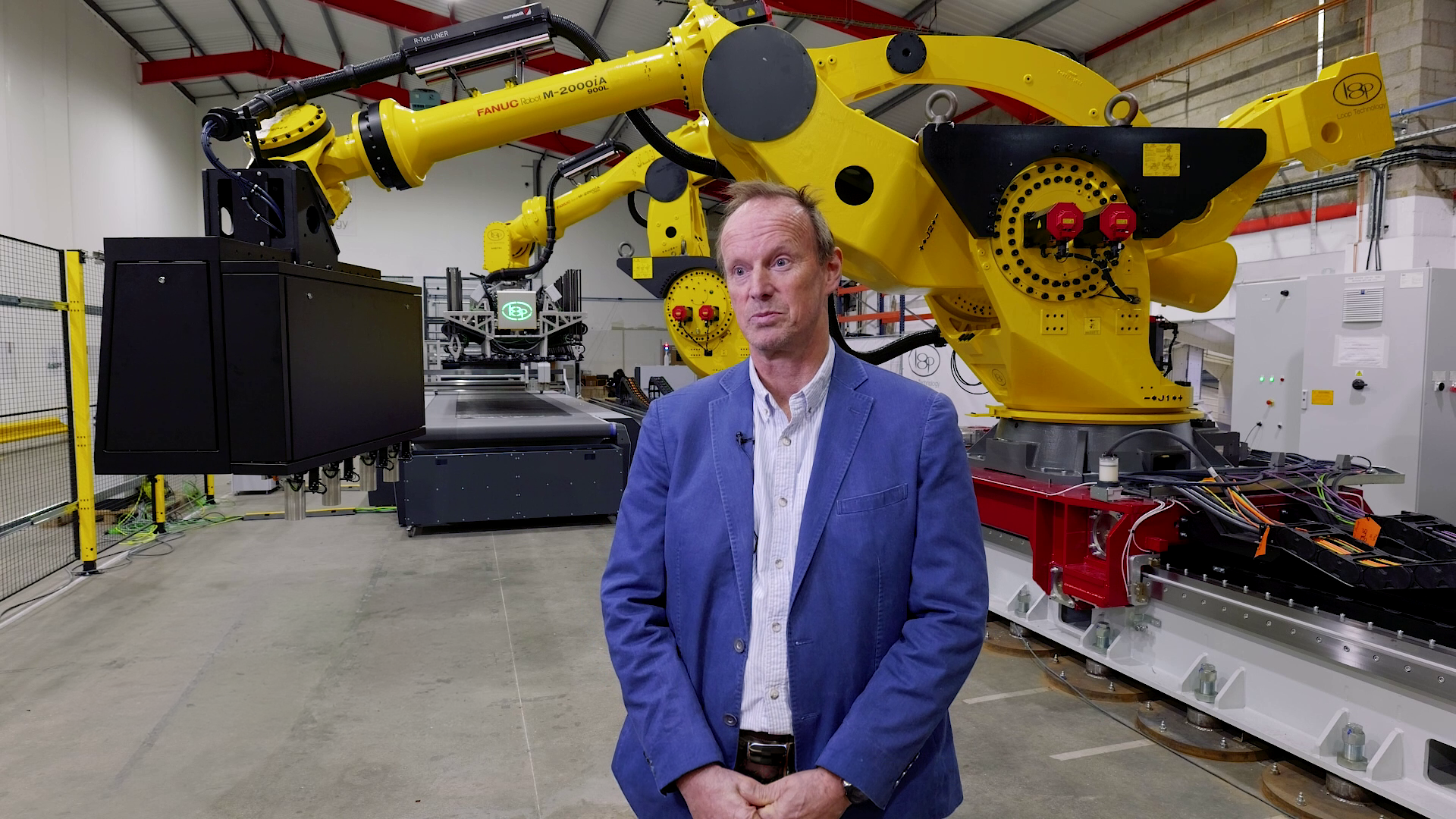
That requirement led Loop to FANUC’s M-2000 series. Configurations used across FibreLINE projects include the M-2000iA/1700L, M-2000iA/1200, and M-2000iA/900L, giving the integrator access to industrial robots designed to carry unusually heavy tooling across large working envelopes.
Payload alone does not solve the manufacturing problem. Primary aerospace composite structures require tightly controlled material placement, while individual uncured plies can be damaged, stretched, folded, or distorted if they are handled poorly.
Loop therefore combines the robot with machine vision, photogrammetry, motion control, and specialist end effectors. FANUC’s current case study says the system is pushing towards approximately ±1mm production tolerance even on large structures.
That tolerance represents the performance of the complete cell rather than the robot in isolation. Tool stiffness, calibration, cell geometry, camera performance, rail positioning, temperature, material behaviour, and the accuracy of the component tool all influence the position finally achieved.
The traditional alternative for manipulating very large aerospace tooling can be a custom gantry. Gantries provide a rigid and predictable motion architecture but occupy considerable factory space and can limit access around the manufacturing cell.
Loop uses M-2000 robots on single-axis rails to extend working reach while retaining access from one side of the cell. The company says this gives it greater flexibility and allows the same broad robotic architecture to be configured around different customer requirements instead of designing a new heavy gantry for every programme.
FibreLINE is also intended to automate more than material placement. Loop’s wider composite platform covers cutting, kitting, lay-up, inspection, tacking, and consolidation, allowing multiple stages of preform manufacture to be integrated rather than treating the heavy robot as a standalone handling device.
That integration is becoming more important as aerospace manufacturers investigate future single-aisle production rates well above those associated with many current composite manufacturing processes. FANUC’s case study cites industry ambitions around 80 to 100 aircraft per month, increasing pressure on suppliers to raise material deposition and inspection rates without sacrificing quality.
Loop’s current FibreLINE specification claims composite deposition rates of up to 200kg per hour. That is a system capability rather than a guaranteed component-production rate: actual throughput depends on ply geometry, material type, inspection requirements, component complexity, tool access, tacking, consolidation, and the sequence required by the finished structure.
The same distinction applies to claims that one FibreLINE can replace several conventional machines. Consolidating operations into a robotic cell can reduce factory footprint and handling between processes, but capacity still depends on which tasks are integrated and how the bottleneck moves as individual operations are accelerated.
The technology already forms part of substantial aerospace research infrastructure. Loop previously supplied five FANUC M-2000 robots for the University of Sheffield Advanced Manufacturing Research Centre’s composite manufacturing capability, including three 1.7-tonne-payload M-2000iA/1700L units.
Those installations form part of work intended to demonstrate higher-rate composite aerostructure production, with the robot carrying Loop end effectors used for material handling, forming, placement, inspection, and associated processes.
The hardware illustrates how the automation problem changes as structures become larger. Increasing robot speed alone does not produce useful output if flexible material cannot be picked reliably, if the ply changes shape between inspection and placement, or if the manufacturing cell has to stop repeatedly for manual checks.
The value increasingly sits in the integration between motion and process knowledge. FANUC supplies the heavy-load robot and control platform; Loop adds composite-specific end effectors, metrology, vision, and production sequencing needed to turn that motion into an aerospace manufacturing operation.
FibreLINE itself is not a newly introduced technology. Loop has developed and promoted the platform over several years, and its relationship with FANUC predates the current case study. The relevant industrial development is the maturity of the architecture as aerospace manufacturers continue pushing automated composite processes towards production rates required by future aircraft programmes.
Its performance will ultimately be measured through factory metrics rather than robot payload: material deposition, first-time quality, inspection time, rework, changeover, cell availability, and the ease with which new component geometries can be introduced. Heavy robotics provides the reach and strength; sustained aerospace output depends on everything wrapped around it.