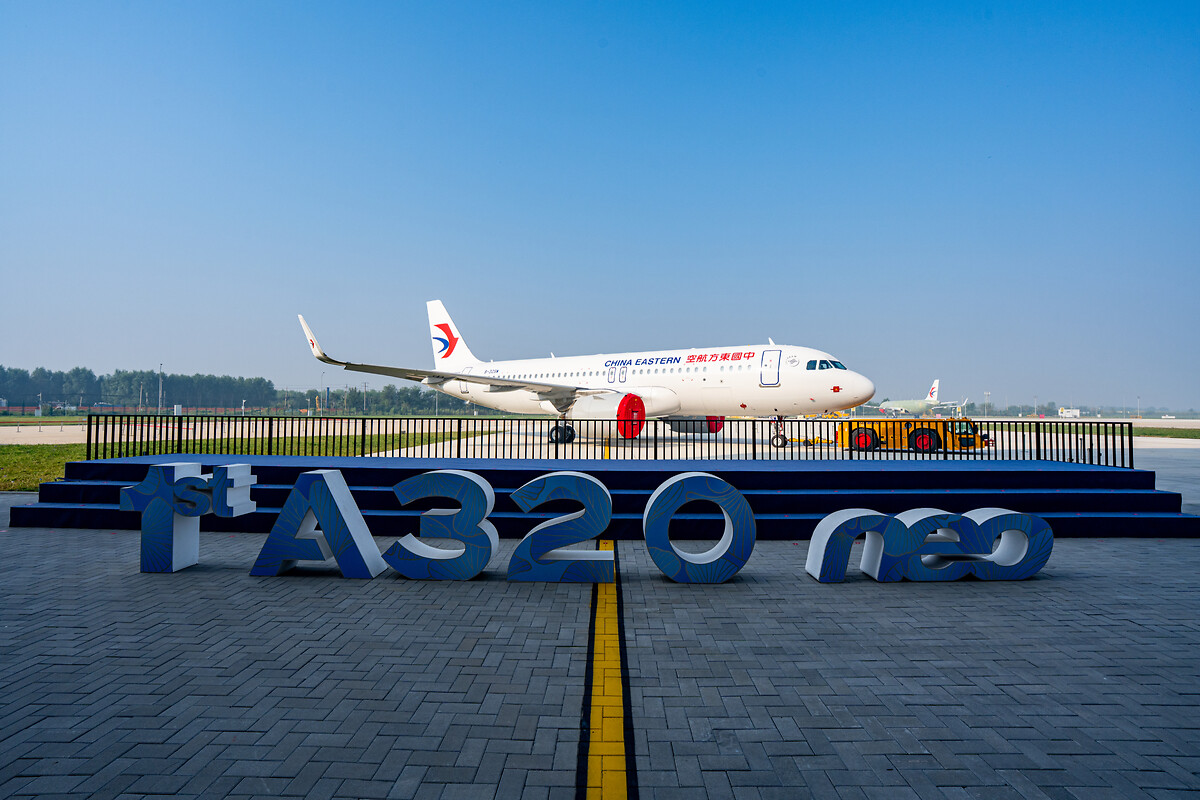
Airbus has delivered the first A320 Family aircraft assembled on its second final assembly line in Tianjin, moving the additional Chinese facility from commissioning into customer production less than a year after its inauguration.
The aircraft is an A320neo for China Eastern Airlines. Airbus opened the second Tianjin line in October 2025 as part of a wider expansion intended to support its A320 Family production ramp towards a sustained rate of 75 aircraft per month.
Tianjin now operates two A320 Family final assembly lines alongside four in Hamburg, two in Toulouse, and two in Mobile, Alabama. Airbus therefore has ten final assembly lines distributed across four industrial locations and three continents for the same single-aisle aircraft family.
The first Tianjin line began operating in 2008 as Airbus’s first commercial-aircraft final assembly facility outside Europe and has since assembled and delivered more than 800 A320 Family aircraft. The second line builds on an established local workforce, logistics chain, supplier interface, flight-test operation, and customer-delivery system rather than creating a greenfield industrial network around the aircraft.
Final assembly is nevertheless only one part of the production-rate equation. Wings, fuselage sections, engines, landing gear, cabins, avionics, electrical equipment, and thousands of other parts have to reach the line at the correct configuration and cadence before additional assembly positions can improve output.
The narrowbody ramp is therefore as much a supply-chain programme as a factory expansion. Airbus can add working positions in Tianjin, Toulouse, Mobile, or Hamburg, but those positions create little extra capacity if major aerostructures or constrained equipment arrive late.
The delivery to China Eastern is an important milestone because it confirms that the second Tianjin line has completed the full production sequence through assembly, ground testing, flight activity, acceptance, and customer handover. One aircraft does not demonstrate mature line rate, but it moves the facility beyond installation and process proving.
Production generally becomes more demanding after that first delivery. Early aircraft can receive concentrated engineering attention; a stable ramp requires the same build, test, quality, and rework processes to be repeated at progressively shorter intervals without increasing disruption elsewhere in the system.
Workforce learning is central to that process. Final assembly involves tightly sequenced tasks across structures, systems installation, cabin completion, software loading, testing, rectification, and documentation. Increasing output means reducing variation in those tasks while maintaining the configuration control and inspection required for certified aircraft.
The distributed network gives Airbus additional capacity and some flexibility across its industrial system, but it also increases the importance of standardisation. Tooling, digital production systems, work instructions, engineering definitions, quality requirements, and supplier interfaces have to produce the same certified aircraft regardless of which final assembly line completes the build.
Airbus says the second Tianjin line is a critical contributor to its wider rate-75 objective. That target reflects both strong demand for the A320neo family and a backlog that extends production visibility well into the next decade.
China also remains central to the manufacturer’s market expectations. Airbus’s current global forecast estimates demand for 8,830 new passenger aircraft in the country over the next 20 years, representing more than one fifth of its forecast worldwide passenger-aircraft requirement.
That forecast does not mean those aircraft will all be Airbus products or assembled in China, but it explains the strategic value of placing final-assembly capacity close to one of the largest aviation markets. Local assembly also creates a substantial industrial and customer-support presence around airlines operating large Airbus fleets.
China Eastern is already one of those operators. At the end of August 2026, Airbus recorded the airline as operating 393 A320 Family aircraft, 56 A330 Family aircraft, and 20 A350-900s. Its relationship with Airbus dates to the delivery of an A310 in 1985.
The second Tianjin line also forms part of a broader capacity programme. Airbus has added or modernised A320 Family production capability in Toulouse and Mobile while continuing to develop its Hamburg operation, spreading the rate increase across the complete final-assembly network rather than asking a single site to absorb the programme.
The advantage of that approach is additional capacity and geographic resilience; the disadvantage is greater industrial coordination. Component shortages or configuration changes affecting the aircraft family can propagate across several plants simultaneously, while local problems have to be contained without undermining common production standards.
The first China Eastern delivery shows that Tianjin’s additional line is now contributing completed aircraft. The harder measure comes next: how quickly the facility can move from a first customer handover towards a stable production cadence while Airbus and its suppliers continue raising output across the other nine A320 Family lines.