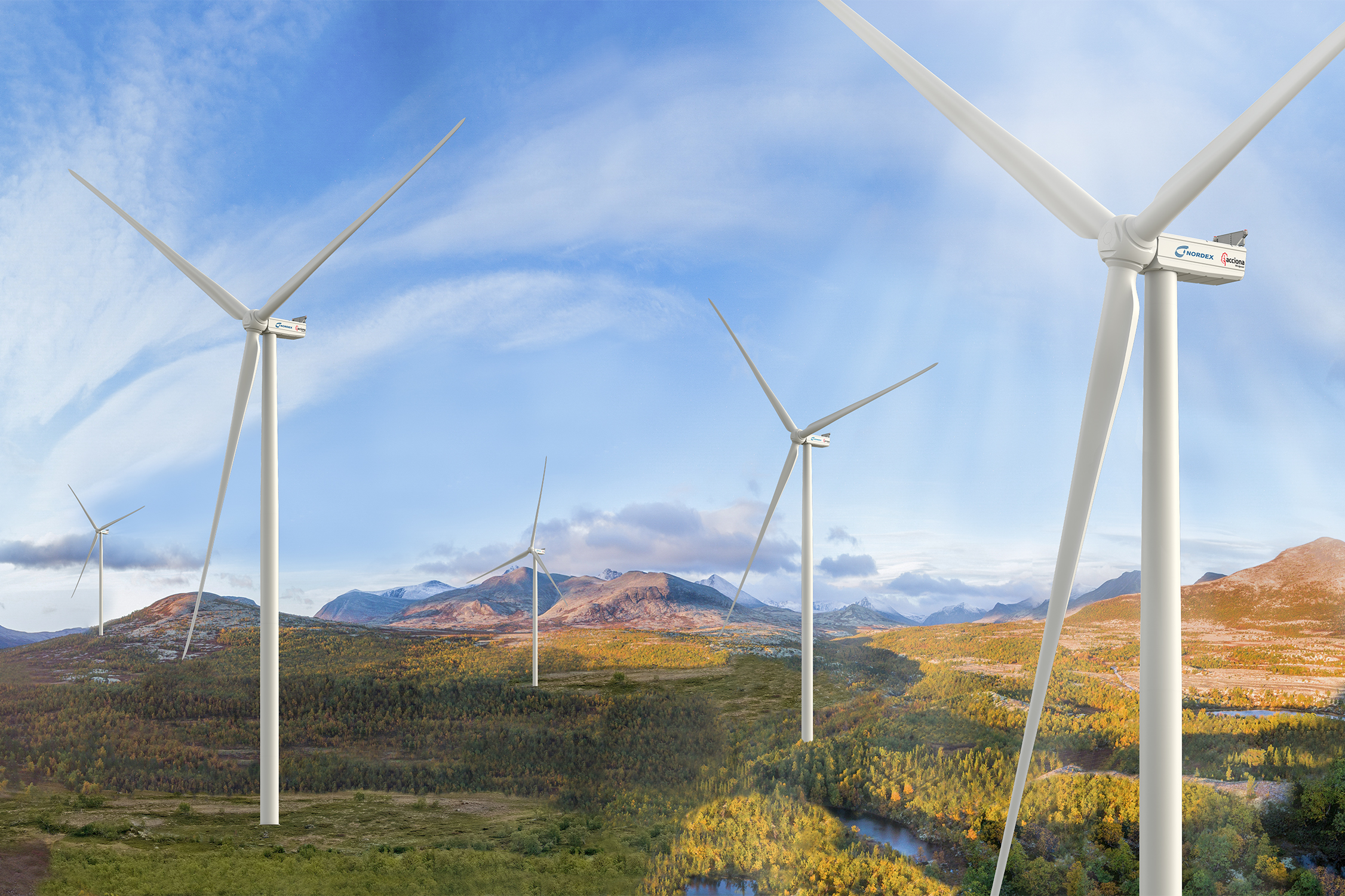
Nordex Group has secured a 91MW order for the Schönermark-Passow wind project in Brandenburg, covering 13 N163/6.X turbines and a 20-year Premium Service agreement.
The order has been placed by TEUT Energieprojekte GmbH for a development near Schwedt/Oder in the Uckermark district. Construction, delivery, and turbine installation are scheduled to begin in September 2027, with commissioning of the first machine planned for January 2028.
Each turbine will use a 164-metre hub height. The project is being developed by TEUT together with Austrian utility Salzburg AG, extending a long-standing relationship between TEUT and Nordex across several German wind developments.
The N163/6.X belongs to Nordex’s Delta4000 platform and combines a 163-metre rotor with output in the 6MW-plus class. That configuration is aimed at extracting higher annual generation from suitable onshore sites without automatically moving to the still larger rotor and tower combinations now appearing elsewhere in the market.
Turbine selection remains a site-specific engineering calculation rather than a straightforward search for the highest possible generator rating. Wind resource, noise limits, permitted overall height, transport access, crane availability, foundation conditions, electrical connection, component logistics, and expected lifetime energy yield all influence the final choice.
The 164-metre towers specified for Schönermark-Passow illustrate the increasing use of height to reach stronger and more consistent winds. Moving the rotor further above the surface can improve yield at suitable sites, but it also changes foundation loads, tower design, erection strategy, transport requirements, and the lifting equipment needed during construction.
Those dependencies will shape the period between contract award and installation. Civil works must provide access routes and hardstanding capable of supporting heavy transport and cranes, foundations have to be completed ahead of tower delivery, and electrical infrastructure must be ready to accept generation as turbines are commissioned.
The 20-year service agreement is another material part of the contract. Wind-farm economics depend on energy delivered across the operating life of the asset rather than its nameplate capacity on the day it is commissioned, placing long-term maintenance and component availability alongside initial turbine performance.
Modern turbines rely on scheduled maintenance, remote monitoring, lubrication, inspection, software support, component replacement, and increasingly detailed condition data. A failure that leaves a turbine unavailable while specialist parts or technicians are sourced can remove a significant amount of annual generation even where the wind resource remains strong.
Long-term service arrangements give the original equipment manufacturer an enduring role after construction. Nordex retains direct access to machine-specific engineering knowledge and fleet information, while the owner gains a defined service framework intended to support availability and planned maintenance across much of the project’s operating life.
That does not eliminate operational risk. Gearboxes, bearings, blades, converters, generators, pitch and yaw systems, transformers, and control equipment all remain subject to wear or failure, while weather conditions can restrict certain interventions. The value of the service contract will ultimately be visible in how effectively those issues are anticipated and resolved.
Schönermark-Passow also extends an established customer relationship. TEUT previously ordered eleven Nordex turbines with a combined 65.7MW for its Mürow-Neukünkendorf and Willmersdorf-Tempelfelde wind farms, with those projects due to enter service during 2027.
Repeat business can simplify parts of project delivery because the developer and turbine supplier already understand each other’s engineering, contracting, and operating requirements. It does not remove the physical constraints around a new site, but it can reduce some of the organisational friction attached to specification, construction planning, and long-term servicing.
For Nordex, converting current order intake into commissioned capacity also depends on the wider manufacturing chain. Large onshore turbines draw on blades, towers, castings, forgings, bearings, generators, power electronics, control systems, cables, and specialist transport equipment produced across multiple factories and suppliers.
A turbine assembly line therefore cannot increase deliveries indefinitely unless those upstream components arrive at the required rate. Delivery performance into 2027 will provide a clearer indication of whether current European wind orders are translating into stable production across the supporting supply base.
The Schönermark-Passow order gives Nordex a defined 13-turbine programme, a September 2027 installation start, and two decades of planned service work. The next meaningful milestones will be physical — site preparation, component delivery, erection, grid connection, and the first N163/6.X entering operation in January 2028.