
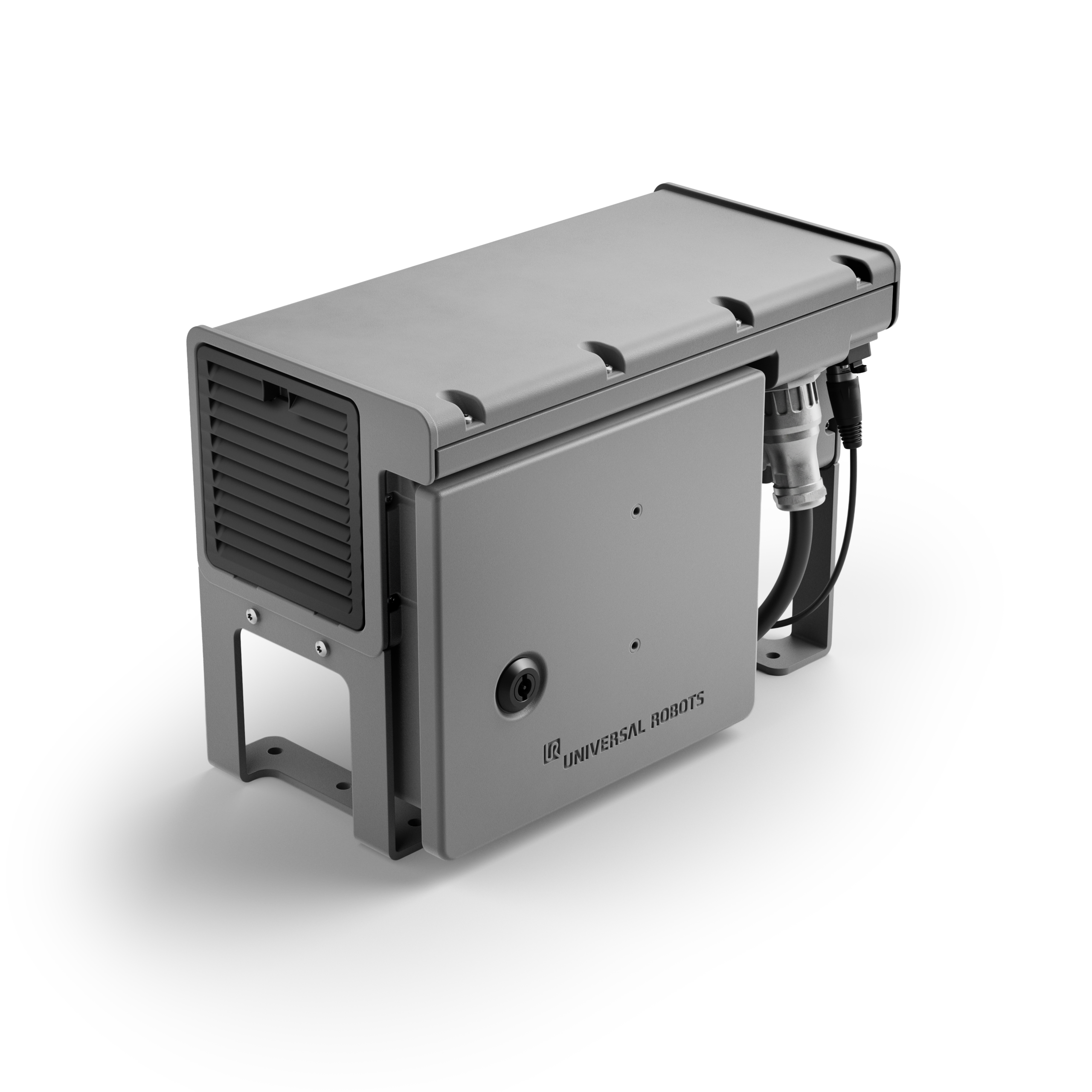
Universal Robots has introduced its seventh-generation collaborative robot platform, redesigning the controller, tool interface and operator hardware around higher-bandwidth sensing, connectivity and computing requirements as manufacturers begin deploying more adaptive automation.
Gen 7 combines three new g-Series robot arms with the CB7 Core controller, TP7 Core teach pendant, SP7 Smart Panel and PolyScope X operating system. The platform was introduced at IMTS in Chicago and is intended to provide a common architecture for established robotic tasks alongside machine vision, edge computing and what the company describes as physical-AI applications.
The three new arms are the UR10g-1750, UR17g-1300 and UR18g-950, with model names reflecting nominal payload and reach. They extend Universal Robots’ existing portfolio with different combinations of working envelope and carrying capacity while sharing the Gen 7 control and software architecture.
The more consequential change is at the tool flange. Universal Robots has integrated network connectivity, power and configurable I/O closer to the end effector, allowing cameras, sensors and intelligent tooling to connect without the same quantity of separate external cabling.
That becomes useful as robot applications consume more data. A fixed pick-and-place cell may need only basic digital signals, while adaptive manipulation can combine camera images, force information and external processing in real time. Each additional interface creates installation work and potential failure points if it depends on separate cabling, switches and control hardware.
The g-Series also incorporates force-torque sensing and impedance control. Those functions allow the robot to react to physical contact and measured forces rather than execute every movement purely by position, extending the range of applications that can cope with variation in component location or assembly conditions.
The CB7 Core controller provides the computing layer. Universal Robots says it offers around 40% more processing performance than the previous controller generation while using a smaller physical footprint.
Its connectivity includes multiple Gigabit Ethernet ports intended for direct communication with PLCs, HMIs, manufacturing execution systems, industrial PCs and vision equipment. That reduces the need for additional network hardware inside some robot cells and reflects how collaborative robots are being integrated into broader production systems.
PolyScope X provides the common software environment. It includes open interfaces and ROS 2 communication intended to make it easier for integrators and software developers to connect external processing and specialist applications to the robot.
The platform also supports industrial communications and safety functions required when robots form part of larger automated lines. Universal Robots is positioning cybersecurity alongside functional safety as robot controllers become more closely connected with factory networks and external computing devices.
That connection is important because the industrial-AI discussion can otherwise become detached from factory realities. An AI model may identify parts or determine an adaptive movement, but the robot still has to exchange signals with machinery, respect safety functions, maintain deterministic control and recover predictably when something goes wrong.
Gen 7 is intended to make the AI layer easier to add without compromising those conventional automation requirements. Cameras and other high-bandwidth sensors can connect more directly, while external computing can supply specialised processing without requiring the robot manufacturer to provide every application itself.
Universal Robots demonstrated the platform at IMTS with ecosystem companies including Cognex, Schunk, Robotiq and Inbolt. That partner model remains important because the value of a general-purpose robot depends heavily on end-of-arm tooling, vision and application software.
Inbolt’s 3D vision guidance provides one example. The new connectivity allows vision information to be integrated with fewer external components, reducing the hardware an integrator has to install and maintain around the cell.
The operator interface has changed as well. The TP7 Core teach pendant is more than 20% lighter than the previous generation, while the SP7 Smart Panel allows certain teaching and freedrive operations to be carried out at the tool flange rather than requiring every adjustment to be made from the main pendant.
Those changes are particularly relevant to high-mix production, where robots are reconfigured more frequently and programming time can become a material part of the cost of automation. A cell that is technically flexible but requires specialist engineering intervention for every change is less useful to a manufacturer running short batches.
Universal Robots says its platform builds on more than 100,000 robots sold across previous generations. That installed base creates an incentive to evolve the architecture without making it unrecognisable to existing users, integrators and application developers.
The physical-AI label will attract attention, but factories will ultimately judge Gen 7 by conventional measures: integration hours, uptime, changeover speed and how reliably the system handles real variation. Additional computing and sensor bandwidth only matter where they reduce engineering complexity or make previously impractical tasks economical to automate.
Gen 7 therefore represents an infrastructure upgrade as much as a new robot generation. Universal Robots is preparing its collaborative platform for cells that exchange more data, rely on more sophisticated sensing and increasingly combine deterministic automation with external intelligence. The industrial test is whether that additional capability can be deployed without losing the simplicity that made cobots attractive in the first place.
