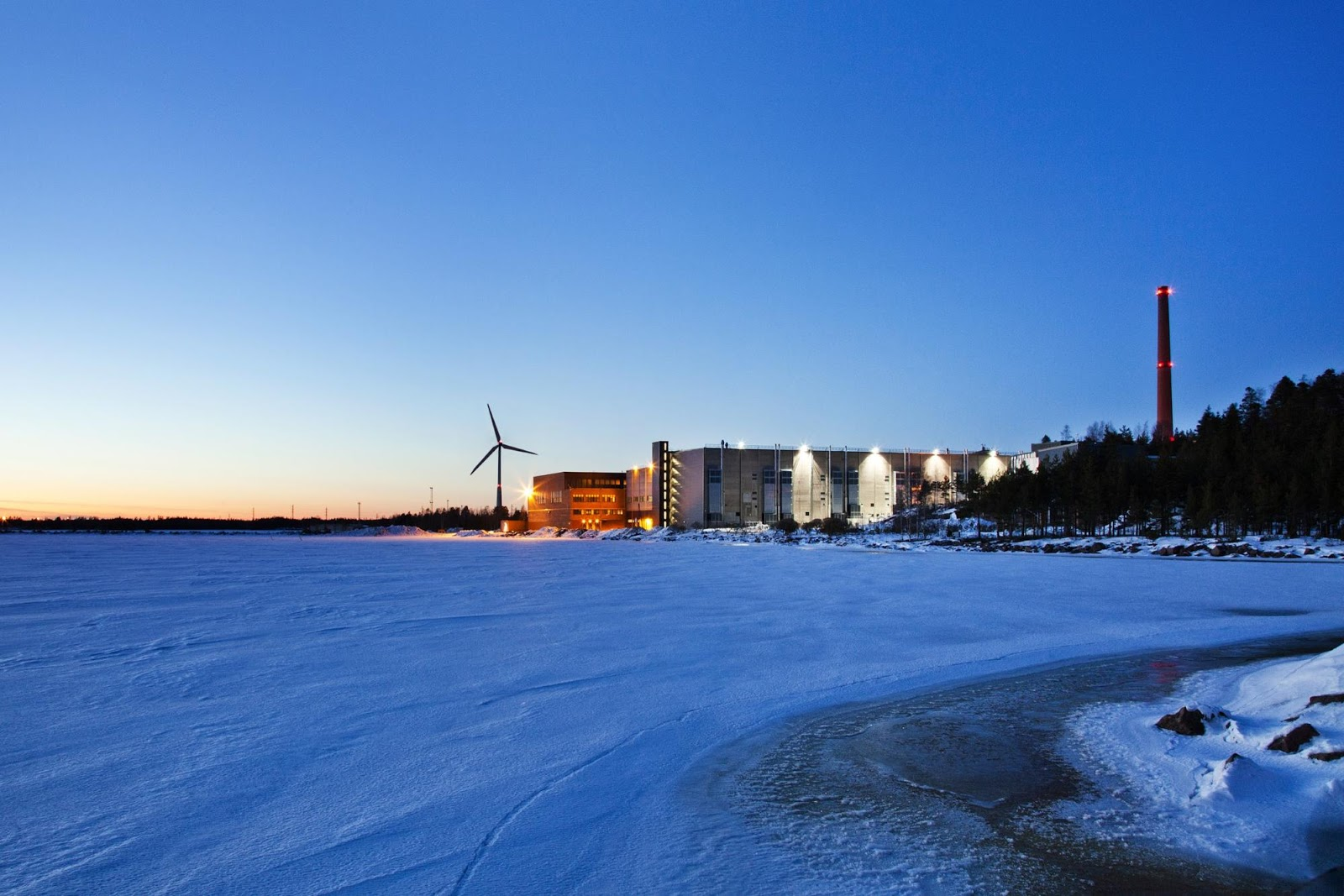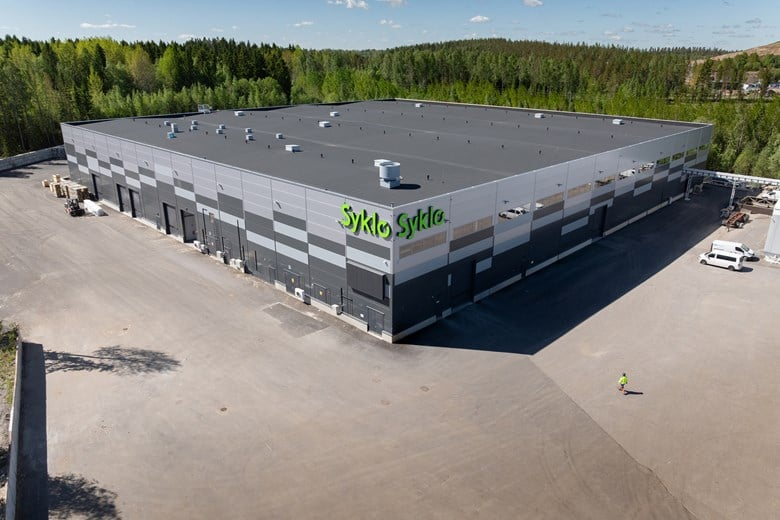
Syklo has opened its €70–80 million circular-economy hub at Hyvinkää in Finland, combining the country’s largest plastics recycling plant with an industrial-scale biocomposite facility aimed at higher-value manufacturing applications.
The plastics operation can process 50,000 tonnes of waste annually, with Syklo estimating that the plant alone will increase Finland’s plastics recycling capacity by around 50%. The company calculates an associated greenhouse-gas reduction of more than 100,000 tonnes of CO2 equivalent per year.
Alongside it, the biocomposite plant will initially have final-product capacity of 8,000 tonnes annually. The two operations are physically linked, allowing Sykloplast recycled polymer produced in the recycling plant to become a direct raw material for Syklocomp biocomposite production next door.
That integration is the more significant part of the site from a manufacturing perspective. Collecting and sorting plastic waste creates relatively limited value if the recovered polymer cannot meet the consistency and mechanical requirements needed for another engineered product.
Syklo is attempting to move material further up that value chain by producing recycled pellets for technically demanding applications and then using some of those pellets in its own composite process.
The recycling plant is designed around mixed plastic streams that can be difficult to separate economically. It uses patented technology from Scottish company Impact Recycling to distinguish plastics using small density differences, including black plastics that have historically presented problems for some conventional optical sorting systems.
Syklo has developed the wider plant concept, refining process, and quality-control arrangements around that sorting stage. Its Sykloplast range consists of post-consumer recycled polymer pellets intended for processes including injection moulding, extrusion, blow moulding, and film production.
The technical challenge is repeatability. Waste feedstock changes from load to load and can contain different polymers, additives, colours, fillers, contamination, and previous processing histories. An industrial customer cannot simply redesign its production process every time a batch of recycled resin behaves differently.
Secondary raw-material suppliers therefore have to narrow that variability through sorting, refining, blending, testing, and quality assurance until the finished pellet can be purchased against a useful specification. That is the point at which recycling becomes a manufacturing-material business rather than principally a waste-management activity.
The adjacent Syklocomp facility adds cellulose reinforcement to create a material intended to replace products including glass-fibre reinforcement, talc-filled compounds, and some technical plastics across packaging, electronics, and transport equipment.
Syklo uses its own patented wet-web technology, designed to preserve cellulose fibre length during processing. Fibre length and distribution influence how effectively a reinforcement carries load through a composite, making process control important if the material is to deliver repeatable strength and stiffness after moulding.
Both plants also use closed water circuits as part of the production concept. Syklo says that arrangement reduces environmental impact while keeping microplastics from entering water systems during processing.
The Hyvinkää facilities will operate on three shifts and are expected to create more than 100 jobs, covering roles from process operation to laboratory work. Syklo is targeting export customers as well as Finnish users and has stated an ambition to expand the manufacturing concept outside Finland through additional plants.
Regulation is beginning to improve the demand case for recycled material. European vehicle rules are introducing mandatory recycled-plastics content requirements over time, while the Packaging and Packaging Waste Regulation will impose minimum recycled-content levels across several plastic-packaging categories from 2030.
Those requirements matter because they move recycled polymers from a discretionary purchasing decision towards an engineering specification manufacturers must increasingly accommodate. The question for suppliers is whether they can produce enough qualified material without sacrificing mechanical performance, process stability, appearance, or supply reliability.
Syklo is already attempting to demonstrate that capability in electronics. Syklocomp has been selected for the 2026 Amazon Devices Climate Tech Accelerator, where the material will be assessed for possible use in device manufacturing.
The programme will evaluate processing behaviour, mechanical performance, and reliability of supply at industrial scale. That final requirement is particularly important: a technically attractive material has limited use to a large manufacturer if annual capacity, batch consistency, or delivery reliability cannot support a production programme.
The Hyvinkää layout gives Syklo closer control over several stages of the chain. Recycled polymer can move directly from one plant into the neighbouring composite facility, reducing intermediate logistics and allowing the company to understand the feedstock entering its own higher-value process.
It does not eliminate the challenge of scaling recycled materials into demanding applications. Automotive, electronics, and packaging companies operate qualification systems designed around repeatable material performance, and any alternative to virgin polymer must survive those tests as well as satisfy environmental targets.
The new complex gives Syklo the capacity to tackle that problem at industrial scale. The meaningful measure will not be the tonnes of waste entering Hyvinkää, but the proportion that leaves as a consistent material another manufacturer is prepared to specify repeatedly in a commercial product.