42 Technology has developed a natural-language Edge AI agent that allows industrial equipment to be queried and controlled using spoken or typed instructions, while keeping model processing and operational data on local hardware.
The system combines natural-language understanding with real-time equipment control and machine-state awareness. Operators can issue commands, ask questions, and retrieve contextual information from pre-configured manuals, technical documents, and fault-finding guides without switching between several separate interfaces.
Unlike cloud-based consumer assistants, the system is designed to run entirely on Edge AI hardware installed on the user’s premises. Data and models remain under local control, while the equipment can continue operating without dependence on an external cloud service or subscription.
42 Technology has also designed the interface around industrial working conditions rather than a quiet office environment. Options include foot-pedal activation and wireless headsets, while the system is intended to recognise incomplete spoken instructions and operate within predefined guardrails.
Human confirmation can be required before an action is executed in a safety-critical application. That separation between interpreting a request and being authorised to act on it is fundamental once conversational software moves beyond information retrieval and begins interacting with physical machinery.
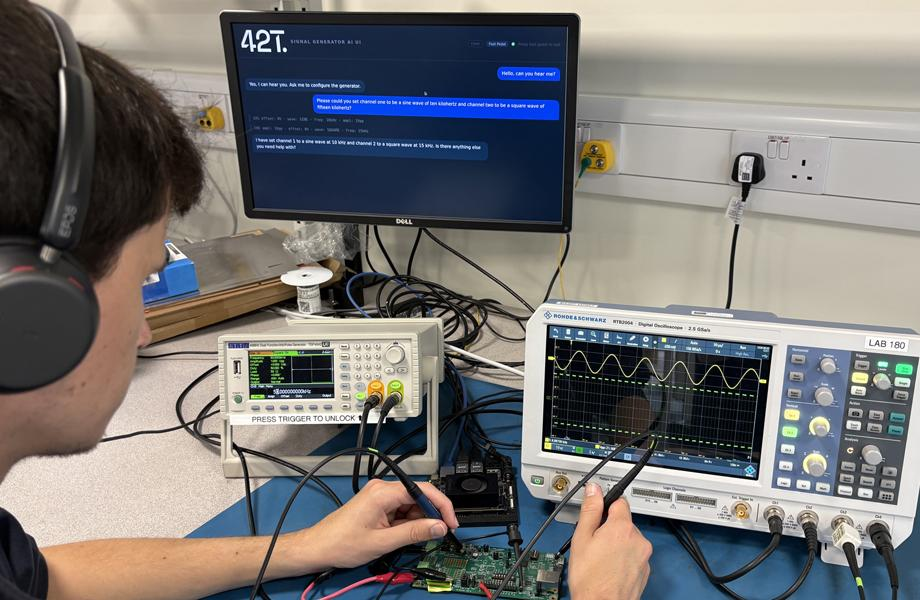
A working demonstrator controls a signal generator using spoken commands and a small language model running locally on a single-board computer. The same embedded hardware handles speech detection, speech-to-text conversion, and agent orchestration, providing a compact example of how the interface can operate without a remote computing stack.
Mike Sales, Head of AI at 42 Technology, said the interface can provide operators with “accurate, context-aware answers without interrupting their workflow”. The company is also working with an industrial equipment manufacturer to integrate a natural-language agent into selected products.
The engineering challenge sits below the conversation layer. Industrial control still depends on PLCs, safety systems, instrumentation, drives, deterministic software, and machine logic that have to behave predictably whether the instruction originated from a touchscreen, physical switch, or AI interface.
A natural-language agent therefore works most credibly as another controlled route into those systems, rather than as a replacement for them. The underlying machine state, permitted command set, interlocks, and operating sequence still have to determine what the equipment can actually do.
Local processing helps with several practical constraints. Production data can contain recipes, process values, maintenance history, equipment performance, and other commercially sensitive information, while many industrial systems are deliberately isolated from unrestricted external connectivity.
Latency also matters. An operator asking for diagnostic information beside a machine expects the response to arrive quickly and consistently, particularly during commissioning or fault-finding, and a locally hosted system removes one variable from that interaction.
The more difficult task is maintaining the information the agent uses. Equipment manuals change, software revisions alter menus and alarm behaviour, machine configurations differ between installations, and customer-specific modifications can make generic documentation misleading if it is not kept aligned with the actual asset.
That creates a configuration-management requirement around the AI layer itself. Manufacturers need to know which model, documentation set, permissions, and machine software were active when a recommendation was generated or a command became available, particularly in regulated or quality-controlled production environments.
Operator trust will depend on that traceability. A system that produces a useful answer most of the time but occasionally refers to the wrong revision of a manual could create more work than it removes, especially where technicians already have established procedures for resolving faults.
42 Technology’s approach also reflects a broader shift in industrial AI deployment. The practical value is increasingly found in connecting models to narrowly defined equipment and processes, where access to live machine state and controlled technical information can produce a specific operational benefit.
The company suggests that the same architecture could eventually expand beyond individual machines into a “digital foreman” capable of monitoring several production assets and directing operator attention towards emerging problems. That would introduce more complex questions around alarm prioritisation, authority, and interaction between different control systems.
For now, the demonstrator makes a more contained proposition: apply local language models to an industrial interface while leaving deterministic machine control underneath. That is a considerably less dramatic claim than replacing operators, but it is also closer to the sort of incremental automation manufacturers can test, validate, and deploy on real equipment.