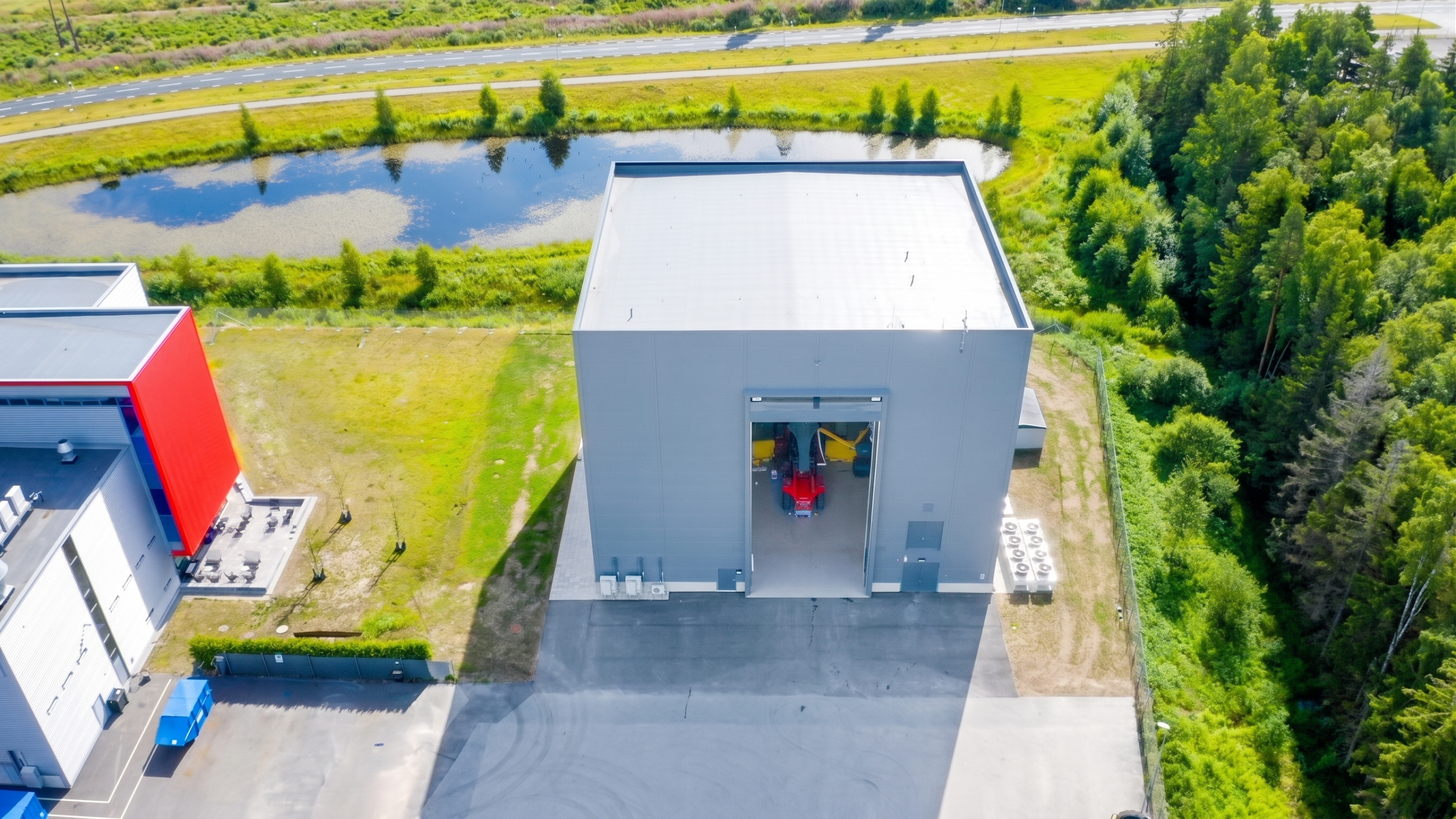
Kalmar has opened a fully automated test centre in Ljungby, Sweden, enabling unattended accelerated lifetime testing of electric and diesel material-handling equipment around the clock.
The facility sits next to Kalmar’s existing Innovation Centre and is designed to reproduce repeated operating conditions under controlled but deliberately demanding test programmes. Machines can undergo driving simulations, extreme-temperature exposure, and load testing of up to 45 tonnes.
Kalmar is using the centre to accelerate development while gathering reliability evidence before new equipment reaches customers. The company says the facility will support both electric and autonomous-product programmes as well as conventional diesel machines.
Accelerated lifetime testing attempts to compress years of repeated loading into a shorter development period. Frames, axles, lifting structures, hydraulic systems, bearings, electrical equipment, cooling systems, and control components can be cycled repeatedly until wear or failure mechanisms become visible.
The engineering challenge is making those tests severe enough to expose weaknesses without creating artificial failures that would not occur in service. A test profile therefore needs to reproduce the loads, movements, temperatures, vibration, braking, acceleration, and operating sequences seen in real ports, terminals, factories, and distribution operations.
Automation changes how quickly that evidence can be accumulated. A manually operated endurance programme is constrained by shifts, operator availability, and the practical difficulty of asking a driver to repeat the same manoeuvre for days or weeks. An unattended system can continue through nights and weekends while reproducing a defined cycle consistently.
That consistency improves comparisons between design revisions. If two structural components, control strategies, or drivetrain configurations experience the same repeated test sequence, engineers can separate genuine design differences from variation introduced by a human operator.
The ability to test electric and diesel machines within the same facility is also useful as Kalmar’s product range changes. Electrification introduces batteries, high-voltage cabling, inverters, motors, charging interfaces, software, and thermal-management systems, but it does not remove the traditional mechanical loads experienced by heavy handling equipment.
Frames, steering systems, wheels, brakes, bearings, booms, masts, spreaders, and hydraulic functions continue to experience repeated forces regardless of the power source. The test programme therefore needs to evaluate new electrical failure modes alongside familiar fatigue and wear mechanisms.
Temperature testing becomes particularly important for electric machines. Battery power capability, charging behaviour, cooling demand, and component lifetime can change substantially between cold and hot environments, while seals, lubricants, wiring, displays, sensors, and electronic control units face their own environmental limits.
Diesel machines have different thermal concerns but are hardly immune. Starting performance, lubricants, cooling circuits, hydraulic fluids, emissions after-treatment, and combustion behaviour can all change across extreme temperature ranges.
Load testing to 45 tonnes places the facility firmly within heavy materials-handling development rather than conventional automotive validation. Counterbalanced equipment and container-handling machines operate with large dynamic loads transmitted through structures and drivetrains that may remain below their ultimate strength on every individual cycle while still accumulating fatigue damage over thousands of repetitions.
The new centre can also provide a controlled environment for autonomous-system development. Repeated routes and manoeuvres allow software, sensing, stopping accuracy, steering control, diagnostics, and responses to defined faults to be exercised without placing experimental behaviour directly into a working customer operation.
That does not eliminate field testing. Real terminals and industrial sites contain variable surfaces, weather, traffic, operators, radio environments, obstacles, and operating practices that are difficult to reproduce completely inside a dedicated test facility.
The value of the centre will therefore depend on correlation between accelerated testing and field behaviour. If failures identified at Ljungby match the weaknesses that would otherwise emerge in customer fleets, engineers can redesign components earlier and potentially reduce later warranty, downtime, and service costs.
Reliability is especially important in material handling because a machine’s commercial value is tied closely to availability. A reachstacker or heavy forklift can be only one element in a larger material flow, yet its failure can interrupt container movements, production logistics, or warehouse operations well beyond the value of the repair itself.
Data from repeated tests can also inform maintenance schedules, spare-parts planning, inspection intervals, software thresholds, and component-life assumptions. A test centre can therefore influence the support model around the machine as well as its physical design.
Kalmar says the facility is intended to shorten time to market, but the useful distinction is that accelerated testing should compress validation time rather than remove validation. Running more representative cycles per calendar week can give engineers evidence earlier without reducing the amount of endurance work undertaken.
The centre was opened on 3 September with approximately 300 customers, dealers, suppliers, industrial partners, employees, and media representatives attending. The ceremony establishes the facility; the engineering evidence will accumulate more slowly.
The useful measure will come when Kalmar can compare products developed through the new test regime with field performance. Twenty-four-hour automation is impressive enough, but its value lies in whether failures happen in Ljungby before customers have the opportunity to discover them elsewhere.