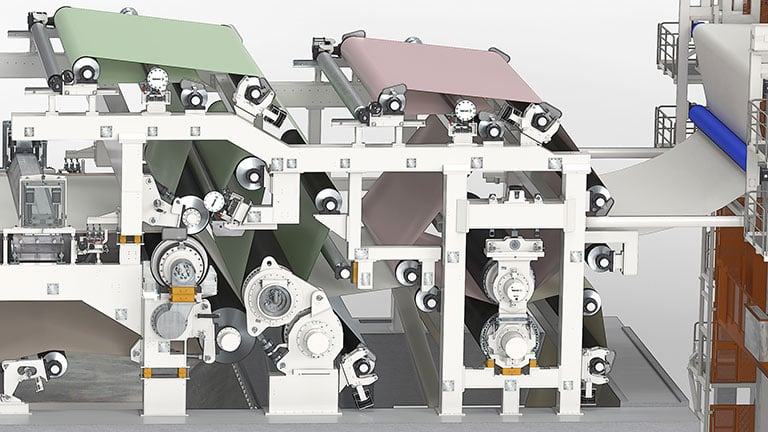
Valmet has been selected to rebuild the press and predryer sections of Jeonju Paper Corporation’s PM5 paper machine in South Korea, targeting lower energy consumption and improved machine efficiency.
Start-up is scheduled for autumn 2027. The order was included in Valmet’s second-quarter 2026 orders received, although its financial value has not been disclosed, and the scope combines mechanical process upgrades, a runnability-system modernisation, and a spare-parts package.
The press-section work is intended to reduce steam consumption later in the drying process. Water removed mechanically before the dryer section does not then need to be evaporated thermally, meaning improved dewatering at the press can reduce one of the larger energy loads in paper production.
Jeonju Paper expects the rebuilt section to lower drying-energy demand while maintaining production performance and product quality. Valmet has not published an expected percentage reduction, so the eventual efficiency gain will need to be assessed against PM5’s operating baseline after the rebuilt section has entered service.
The predryer rebuild addresses a related but separate issue. Its scope includes an upgraded runnability system intended to improve web handling and overall machine efficiency through the drying area, where the paper sheet has to remain stable as it passes between rolls, cylinders, and open draws at production speed.
Runnability affects more than nominal machine speed. An unstable sheet can generate breaks, slowdowns, additional threading, lost production, and material waste, so gains in drying efficiency have limited value if the machine becomes more difficult to operate consistently after the modification.
That relationship explains why the press and predryer work have been combined in the same rebuild. Increasing the dryness of the sheet before thermal drying changes the operating conditions presented to the next process stage, making mechanical dewatering and web stability part of the same system rather than independent retrofit decisions.
The project is also a lifecycle investment rather than a new-machine purchase. Rebuilding existing sections allows Jeonju Paper to address known energy and reliability constraints while retaining the wider machine, drives, foundations, buildings, utilities, and mill infrastructure already in service.
That approach is common across mature process industries where the basic production asset still has useful life but individual process sections no longer meet current requirements for efficiency, automation, reliability, or maintenance. The engineering difficulty lies in integrating new equipment into a machine whose dimensions, controls, foundations, and operating practices were established under an older design.
Valmet says the rebuild will extend PM5’s lifecycle as well as improve efficiency. The spare-parts package included in the contract reinforces that through-life focus, because a successful rebuild depends on maintenance, replacement components, operator familiarity, and technical support long after the commissioning team has left the mill.
Jeonju Paper produces newsprint and corrugated-board products for domestic and international customers from its integrated site in South Korea. Founded in 1965, the company operates in a sector where older assets can remain productive for many years provided their most restrictive process sections are periodically modernised.
The economic case for such work is different from a greenfield paper machine. There is no headline addition of several hundred thousand tonnes of new capacity; the return instead comes from reduced energy consumption, improved reliability, better utilisation, and a longer remaining life for equipment that is already installed and depreciating.
Steam consumption is a particularly visible target because thermal drying is energy intensive. Any improvement in press performance that increases sheet dryness before the dryers can reduce evaporation demand, provided the change does not compromise sheet properties, production speed, or operating stability.
The absence of a published percentage saving means there is little value in trying to assign a return before the rebuild is running. Variations in furnish, grade mix, production rate, existing equipment condition, and operating practice can all affect the realised result, even where the replacement technology performs as designed.
The same applies to runnability. Valmet expects the predryer changes to improve operational reliability and process efficiency, but those outcomes ultimately appear in fewer disturbances, more stable production, and the ability to maintain target speed and quality over long operating periods.
Detailed engineering, manufacture, outage planning, installation, and commissioning now sit between the order and the autumn 2027 start-up. For Jeonju Paper, the project will have to be fitted around an operating production asset, where the duration of installation work can matter almost as much as the eventual efficiency improvement.
The rebuild is modest beside a completely new pulp or paper line, but much of industrial energy efficiency is delivered through projects of exactly this kind. Mature factories are rarely replaced simply because newer technology exists; individual bottlenecks are modernised when energy, maintenance, reliability, and remaining asset life make the arithmetic worthwhile. PM5’s post-2027 operating data will show whether this rebuild earns that calculation.