Kongsberg has launched a family of commercial sonar systems designed for persistent monitoring around ports, offshore installations and critical subsea infrastructure, combining acoustic sensing with an AI-based virtual sonar operator.
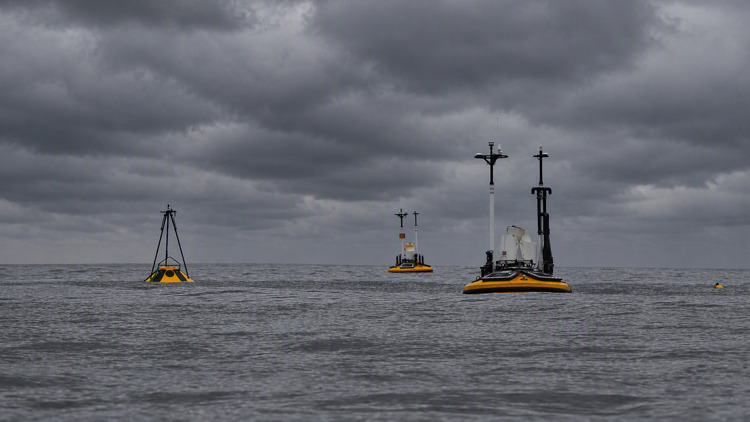
The Aegir Subsea Situational Awareness range was introduced at ONS 2026 in Stavanger and is designed to work across several deployment formats. Kongsberg says the sensors can be installed on small uncrewed surface vessels and buoys, fixed to permanent infrastructure or integrated into larger maritime platforms.
The system is intended to detect, classify and track objects beneath the water rather than provide only a stream of raw sonar imagery. Its virtual operator can analyse incoming information without requiring continuous human supervision, while customers can configure the software around particular operating environments and use their own sonar expertise to train it.
Automation addresses a practical problem created by persistent monitoring. Conventional inspections may produce concentrated datasets over a defined survey period, but a sonar running continuously around a port, cable landing point or offshore structure can generate large volumes of observations in which normal vessel traffic, marine life and stationary infrastructure have to be separated from unusual activity.
The virtual operator is therefore designed as a workload-reduction tool rather than an autonomous security authority. Classification still depends on acoustic conditions and the quality of the sensor data, while operators retain responsibility for deciding whether a detected object or behaviour requires action.
Kongsberg has already installed Aegir hardware in an operational marine setting. A unit is mounted on a Fugro SEAWATCH buoy connected to the Oslofjord Testbed, allowing live data from the deployed sonar to be demonstrated rather than presenting the product solely through simulation or tank testing.
A buoy installation can provide continuous sensing without keeping a crewed vessel on station. Power, communications and positioning are incorporated into a relatively compact platform, while the sonar monitors a defined underwater area and transmits information towards shore-based systems.
Fixed monitoring is particularly suited to locations where the infrastructure itself is concentrated. Ports, offshore substations, pipeline approaches and cable landfalls can represent small physical areas compared with the full length of an interconnector or export pipeline, allowing operators to place more persistent sensing around sections where damage or interference would carry greater operational consequence.
Long linear assets require a different approach. One stationary sonar cannot monitor hundreds of kilometres of cable or pipeline, so mobile sensors fitted to uncrewed or crewed vessels can complement fixed installations by examining wider routes or investigating an alert generated elsewhere.
Aegir’s ability to operate on multiple platform types reflects that difference in coverage. Kongsberg is not proposing that one sensor arrangement protects an entire offshore network; it is offering a common sonar family that can be distributed across several operating concepts.
Helge Andre Sundt, vice-president for subsea awareness at Kongsberg, described the underwater domain as a “critical operational environment” for government and commercial organisations. Recent concern around subsea infrastructure has increased demand for systems able to establish normal activity and identify changes without depending on occasional inspection campaigns.
Kongsberg has been building a wider business around that requirement. In July it announced a contract with an undisclosed international customer focused primarily on underwater surveillance and protection of critical infrastructure, while other work has combined subsea sensing with radar and surface surveillance around offshore energy assets.
Aegir adds an acoustic layer that can be integrated into those broader surveillance architectures. Information from subsea sonar can be combined with vessel tracking, radar, optical systems or other sensors, helping operators compare what is happening above the surface with objects detected below it.
The AI component does not remove the limitations of underwater acoustics. Sound propagation changes with water temperature, salinity and depth, while seabed type, bubbles, vessel noise and clutter can affect detection and classification. Shallow harbours can be particularly complicated environments because moving vessels and fixed structures generate dense acoustic returns.
That makes the Oslofjord installation more useful than a controlled demonstration. Persistent operation exposes the equipment to changing traffic and environmental conditions, giving Kongsberg and Fugro a larger dataset against which to assess automated interpretation and refine the system.
Commercial deployment will also depend on communications, power and maintenance rather than sonar performance alone. A sensor intended to stay in the water for long periods has to remain available, transmit enough useful data and avoid creating an inspection burden large enough to defeat the reason for installing persistent monitoring in the first place.
Aegir arrives as infrastructure owners are beginning to procure physical surveillance rather than merely acknowledge subsea vulnerability. The engineering task is no longer to demonstrate that cables and pipelines can be monitored; it is to build systems that can remain deployed economically and turn continuous sensing into a manageable quantity of operational information. Another unattended data stream would be a particularly elaborate way of discovering that visibility and awareness are not quite the same thing.