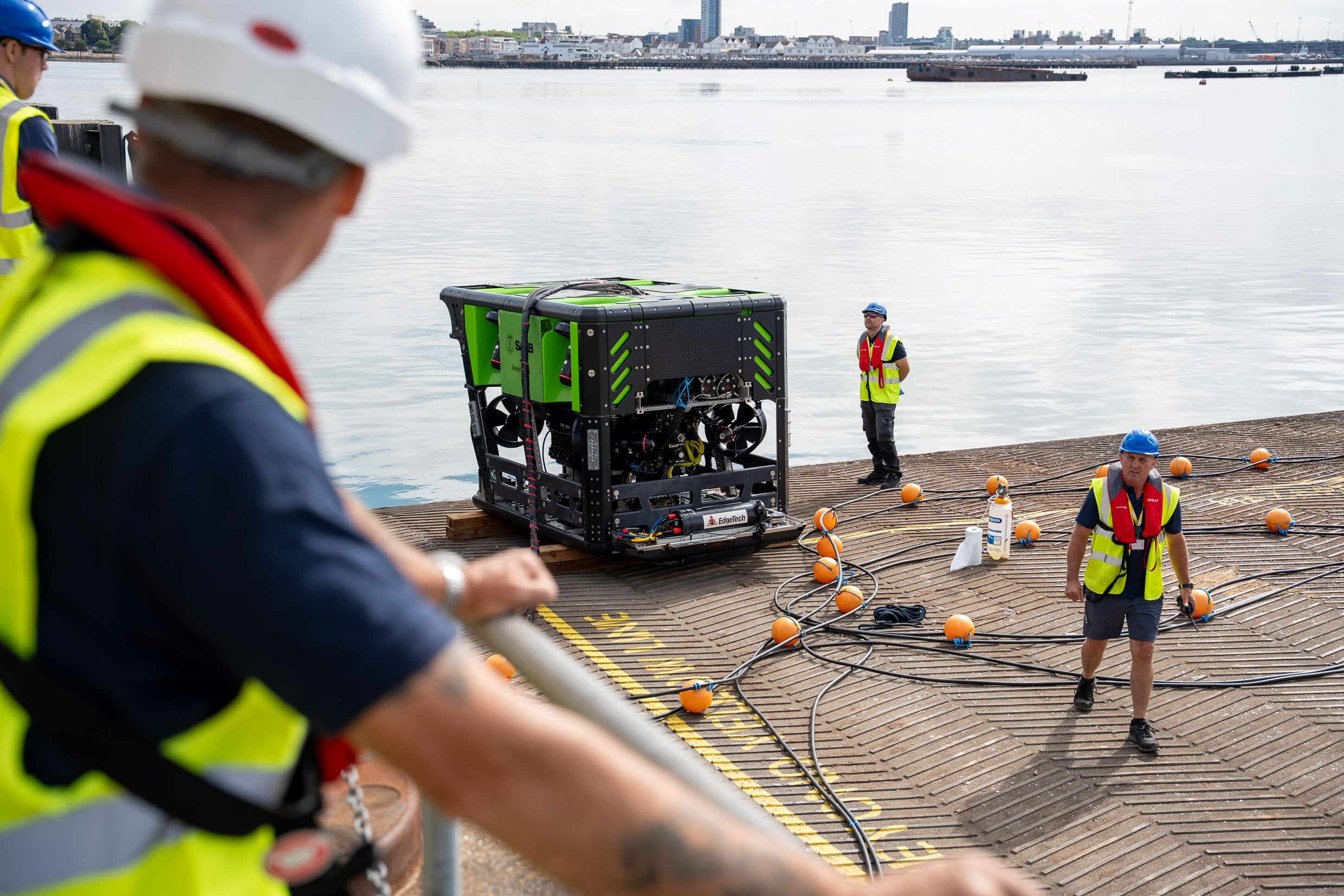
Saab UK has completed a new programme of inland water trials for its Seaeye SR20, advancing verification of the all-electric work-class remotely operated vehicle before the platform enters its next phase of testing.
The programme assessed the SR20 against its specification while stressing the vehicle as a complete system rather than testing individual components in isolation. Saab said the ROV demonstrated manoeuvrability, precise pilot control, and stable operation, providing further validation of its electric architecture and integrated control systems.
The SR20 is intended to deliver work-class capability using an electric architecture in a market where hydraulic systems have traditionally provided much of the power required for propulsion and tooling. Subsea intervention can demand high forces, precise control, and long operating periods, so replacing hydraulic functions requires more than exchanging one actuator technology for another.
Electric propulsion and manipulation can reduce hydraulic-fluid handling and allow more of the vehicle’s behaviour to be instrumented and controlled electronically. The trade-off is a greater dependence on subsea electrical distribution, motors, sealing, power electronics, controls, and software, all of which have to remain reliable in salt water and under pressure.
Work-class ROVs also operate through long tether and umbilical systems that impose their own dynamic loads. Thrusters must compensate for currents and tether drag while manipulators and tooling perform tasks ranging from inspection to valve operation and equipment connection, often with limited visibility.
The latest trials build on earlier inshore testing of the SR20. Saab has designed the platform around operating concepts that include resident deployment and remote control, allowing an ROV potentially to remain offshore for longer periods and be controlled from shore or another remote location rather than mobilising a full specialist team for every operation.
Jon Robertson, Seaeye managing director at Saab UK, said the trials had brought the programme “another step closer” to delivery. He said the electric architecture had been designed to support operating requirements including resident and remote operations.
Those operating models are becoming more attractive as offshore operators try to reduce dependence on large crewed support vessels for routine inspection and intervention. Vessel charter, fuel, specialist personnel, mobilisation, and weather downtime account for a substantial share of subsea operating cost, particularly when a relatively straightforward task requires an entire vessel campaign to put an ROV in the water.
A resident vehicle can alter that equation if it can remain available near an asset and operate for long periods without frequent recovery. The engineering requirements become more demanding, however, because diagnostics, communications, power management, maintenance intervals, and fault recovery all have to support operation with fewer technicians physically present beside the machine.
Saab has previously linked the SR20 to over-the-horizon operation, where control functions can be moved away from the offshore vessel. Communications latency and reliability then become part of the vehicle system alongside propulsion and tooling, while automation can take over some repetitive functions without removing the need for a human operator during complex intervention.
Seaeye brings an established production and support base to that development. Saab marked 40 years of Seaeye operations in 2026 and says more than 1,100 systems have been delivered across 74 countries, serving commercial, industrial, scientific, and defence applications. The operation is based at Fareham in Hampshire, where subsea systems are developed and manufactured.
Ocean Infinity was identified as launch customer for the SR20 under an earlier agreement covering ten vehicles with options for additional units. Its wider operating model is built around robotic and remotely operated marine systems, giving the SR20 a customer environment in which electric propulsion, remote control, communications, and vessel automation can be tested as parts of a larger system rather than isolated product features.
The inland trials do not replicate offshore conditions. Controlled water allows engineers to evaluate handling, system integration, software, and fault behaviour without the currents, vessel motion, weather, and operating cost attached to a full offshore campaign. It also provides an opportunity to correct integration problems before testing becomes more expensive.
The next programme phase will have to show whether the stable behaviour recorded inland can be maintained when tether dynamics, tooling loads, currents, and support-vessel motion become less predictable. Reliability will be as important as headline performance because a work-class ROV that requires frequent recovery can quickly erase the operating savings promised by a more remote or resident deployment model.
Saab has now demonstrated another controlled step towards that operating environment. The significant engineering work remains offshore, where an electric architecture must prove that it can deliver the thrust, dexterity, availability, and maintainability expected from established work-class systems without importing a different set of operational constraints.