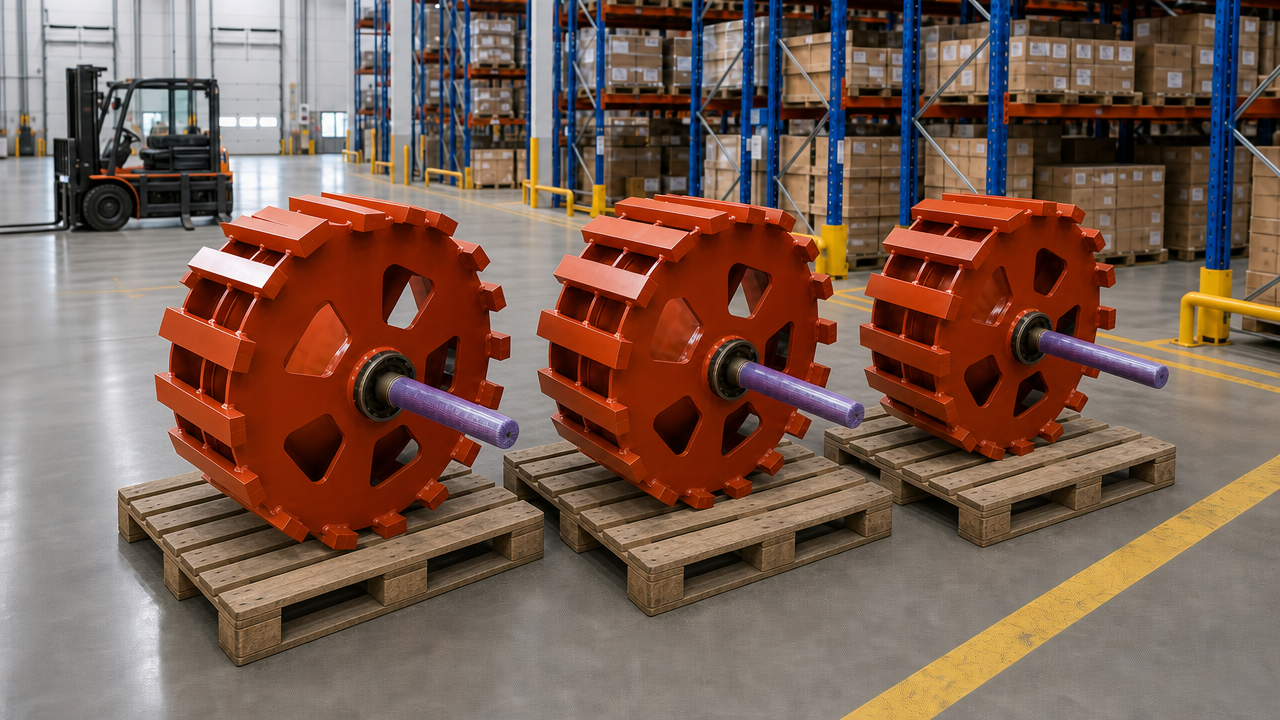
Hallamshire Engineering Services has manufactured 630mm-diameter slatted pulley drums for Rema Tip Top as part of a conveyor system engineered for a glass-handling plant. The open drum construction is designed to allow fine glass particles, cullet, labels, packaging debris, and dust to fall through the pulley instead of accumulating between the belt and drum surface.
The drums have a 360mm face length and were designed to the end user’s specification as part of an established supply relationship between the two companies. Hallamshire has manufactured pulley drums for Rema Tip Top branches and their customers for more than 20 years, with previous projects spanning a range of material-handling applications.
The glass installation illustrates how a relatively simple mechanical interface can determine the reliability of a much larger conveyor system. Fine and fragmented material does not always remain on the intended transport path. Once glass particles enter the contact area between a conventional solid pulley and the belt, they can create localised abrasion, cuts, tracking problems, and accelerated wear.
A slatted pulley changes that interface by giving loose material a path away from the belt. Rather than remaining trapped and being carried repeatedly around the pulley circumference, debris can pass through the open construction. The benefit is not an increase in nominal conveyor speed but a reduction in the conditions that contribute to belt damage, slip, mis-tracking, bearing wear, cleaning, and unplanned intervention.
Neil Bettley of Hallamshire Engineering Services said: “This project is a result of the excellent working relationship we have enjoyed with Rema Tip Top for over two decades, producing pulley drums for end-user customer applications across a range of industries. This project relied on our ability to manufacture slatted drums to an exact end-user specification and is testament to our collaborative relationship with Rema Tip Top.”
Those end-user requirements matter because pulley drums are often treated as standard conveyor hardware despite operating in markedly different environments. Belt tension, product loading, abrasiveness, moisture, contamination, operating speed, shaft arrangement, bearing selection, access, and cleaning requirements can all influence the final design. A component suitable for packaged goods may be poorly suited to loose cullet or abrasive mineral material.
Hallamshire manufactures solid, spiral, and slatted pulley designs, allowing the geometry to be matched to the behaviour of the material being conveyed. Its slatted arrangement is intended for applications where debris clearance and self-cleaning behaviour are important, but where the process does not call for a conventional solid drum.
For the glass-handling plant, the maintenance implications are as important as belt protection. Debris accumulating around pulleys has to be removed, creating recurring cleaning work and requiring access to equipment that may otherwise have remained in service. Reducing that accumulation can shorten or remove some interventions while lowering the chance that trapped fragments trigger an unscheduled shutdown.
The cost of a conveyor problem is rarely confined to the failed component. A damaged belt may stop upstream processing, interrupt downstream handling, or leave material stranded between stages. Maintenance staff then have to make the system safe, remove damaged components, clean the area, complete the repair, and verify tracking before production resumes.
Steve Halliday, Eastern Regional Manager at Rema Tip Top, said: “This is just the latest in a series of high-value engineering solutions where we have partnered with Hallamshire Engineering Services over the years. The pulley drums were an essential part of a complete conveyor system we designed and built to meet the customer’s exact requirements.”
Rema Tip Top provides conveying, wear-protection, and materials-processing systems, while Hallamshire’s contribution centres on the pulley hardware. The division of work reflects the way bespoke conveying projects are commonly delivered: the system integrator defines the performance and end-user requirements, while specialist manufacturers engineer individual components around those conditions.
Hallamshire operates as part of Group Rhodes and has more than 50 years of experience in conveyor drums and rollers. Its application base includes mineral processing, aggregates, quarrying, recycling, agriculture, and manufacturing, all sectors where contamination and abrasive materials can shorten component life if equipment geometry does not suit the product being handled.
The company can supply pulley drums individually or as part of larger handling systems, and its experience across harsher materials applications is relevant to glass because fragments combine high abrasion with irregular particle sizes. That makes debris management a mechanical-design problem rather than simply a housekeeping issue.
The contract is modest beside a complete production line, but the same engineering principle applies: plant availability often depends on components whose cost is small compared with the process they support. A pulley that keeps contamination away from the belt can prevent a minor accumulation problem from developing into a larger maintenance event.
For this installation, the design response is deliberately uncomplicated. The 630mm drum does not attempt to stop glass debris reaching the conveyor; it gives that material somewhere to go once it does. In a handling system where abrasive fragments can otherwise remain trapped at the belt interface, that change in geometry is intended to protect uptime as much as the pulley itself.