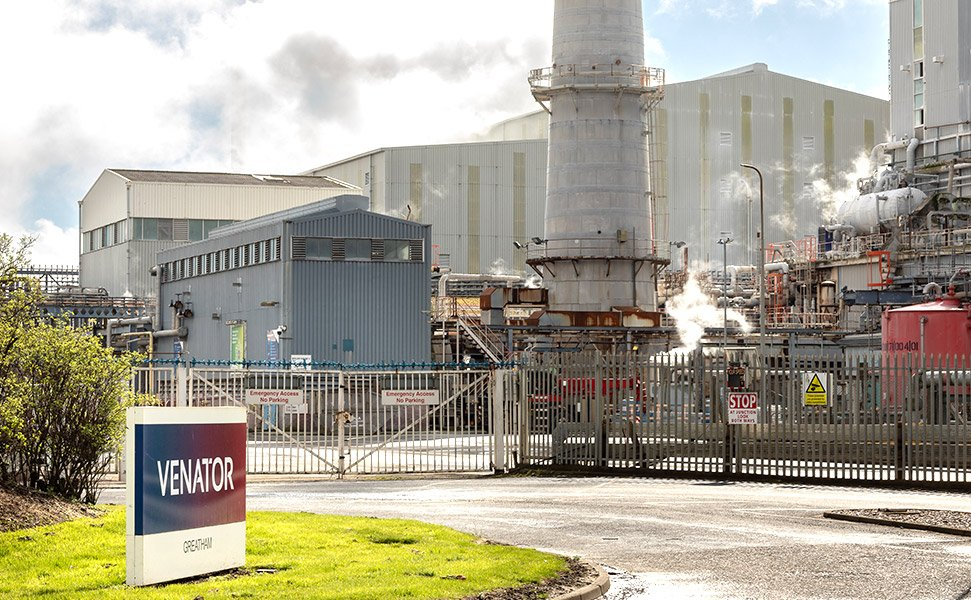
Tioxide Materials has restarted titanium dioxide pigment production at its Greatham facility in Hartlepool, returning the long-established chemical site to commercial operation following LB Group’s acquisition of the plant earlier this year. Single-stream production is under way, with TIOXIDE and DELTIO pigments beginning to return to market while the site progresses through a phased ramp-up.
The restart follows around four months of commissioning, maintenance, and testing by engineering, operations, and technical teams. Full operational capacity is targeted for early 2027 rather than immediately, reflecting the work required to stabilise continuous chemical processing after an extended shutdown. The Greatham facility has stated nameplate capacity of 150,000 tonnes of titanium dioxide pigment a year.
Recommissioning a process plant involves far more than restoring utilities and starting feed flow. Mechanical integrity, instrumentation, process safety systems, control loops, pumps, valves, heat-transfer equipment, and environmental controls all have to perform together before operators can increase throughput with confidence. Product quality must also remain within specification as operating rates rise, making a controlled production ramp more useful than an aggressive return to full load followed by repeated interruptions.
The plant had been idled in the fourth quarter of 2025 before LB Group completed the acquisition of the Greatham facility and associated titanium dioxide assets from Venator Materials UK on 27 April 2026. The transaction created the new Tioxide business and gave LB Group a UK manufacturing base with more than half a century of pigment-production history in the North East.
Greatham began production in 1971 as the UK’s first commercial chloride-process titanium dioxide pigment plant. The site subsequently developed and adopted Integrated Chlorination and Oxidation technology, while ownership passed through ICI, Huntsman, and Venator before the latest acquisition. Expansions in 2002 and 2008 increased a production base whose industrial value is partly defined by the capital, permitting, process knowledge, and operating experience needed to reproduce comparable chemical capacity.
Titanium dioxide is a high-volume white pigment valued for opacity, brightness, and durability, with applications across coatings, plastics, inks, and other manufactured products. Production at Greatham therefore feeds a broader materials chain in which pigment consistency affects colour, coverage, formulation, processing behaviour, and finished-product performance for downstream manufacturers.
Chloride-route pigment manufacture is also closely tied to plant-specific process knowledge. Feed preparation, chlorination, oxidation, solids handling, finishing, and quality control have to operate within tightly managed conditions if the final pigment is to meet customer specifications consistently. Restarting capacity therefore requires experienced operators and technical teams as well as functioning hardware, particularly after a prolonged period without normal production.
European chemical production has faced sustained pressure from energy costs, global competition, and uneven industrial demand, leaving older assets under particular scrutiny where utilisation or margins deteriorate. Reopening a 150,000-tonne plant does not remove those structural pressures, but it restores a sizeable UK source of a widely used industrial material and gives customers another regional supply option.
Capacity figures alone will not determine the plant’s contribution. The practical measure is how much of the nominal output can be converted into stable, saleable production while maintaining equipment reliability, process yields, quality, and environmental performance. Continuous plants can lose significant output through relatively short interruptions, so sustained availability over months matters more than reaching a headline rate during a brief production run.
The manufacturing base is supported by Tioxide’s research and development operation at Wynyard, with commercial and business functions in Stockton-on-Tees. Retaining technical capability alongside production gives the company resources for process optimisation, product development, troubleshooting, and customer qualification rather than leaving Greatham as a standalone manufacturing asset.
LB Group’s ownership also places the plant within a larger international titanium-materials business. Access to a broader supply network can support feedstock, technical knowledge, and market reach, although the success of the restart will still be determined locally by operating discipline and customer demand. Equipment condition, staffing, maintenance planning, and product consistency have to support the staged increase in output through the remainder of 2026.
Older chemical plants rarely return to full commercial service through a single ceremonial restart. Production rates have to increase, maintenance regimes must settle, and operators need evidence that quality can be repeated across longer campaigns. Greatham has crossed the more fundamental threshold of producing pigment again; the next milestone is sustained operation at progressively higher throughput as Tioxide works towards full capacity in early 2027.