MatAlytics has secured £619,000 of Innovate UK funding to develop and industrially validate physics-based artificial intelligence for steel production. The Midlands technology company will apply its CITRUS software to modelling the thermomechanical behaviour and microstructure of steel, targeting calculations that have traditionally depended on computationally intensive finite-element simulation.
The award builds on £100,000 of earlier Innovate UK support and moves a proof-of-concept technology into a steel-manufacturing application. MatAlytics emerged from research originating at the University of Nottingham and has developed CITRUS around neural networks trained using the outputs of finite-element models. The objective is to retain useful physics-based understanding while reducing the computation time needed to produce operating insight.
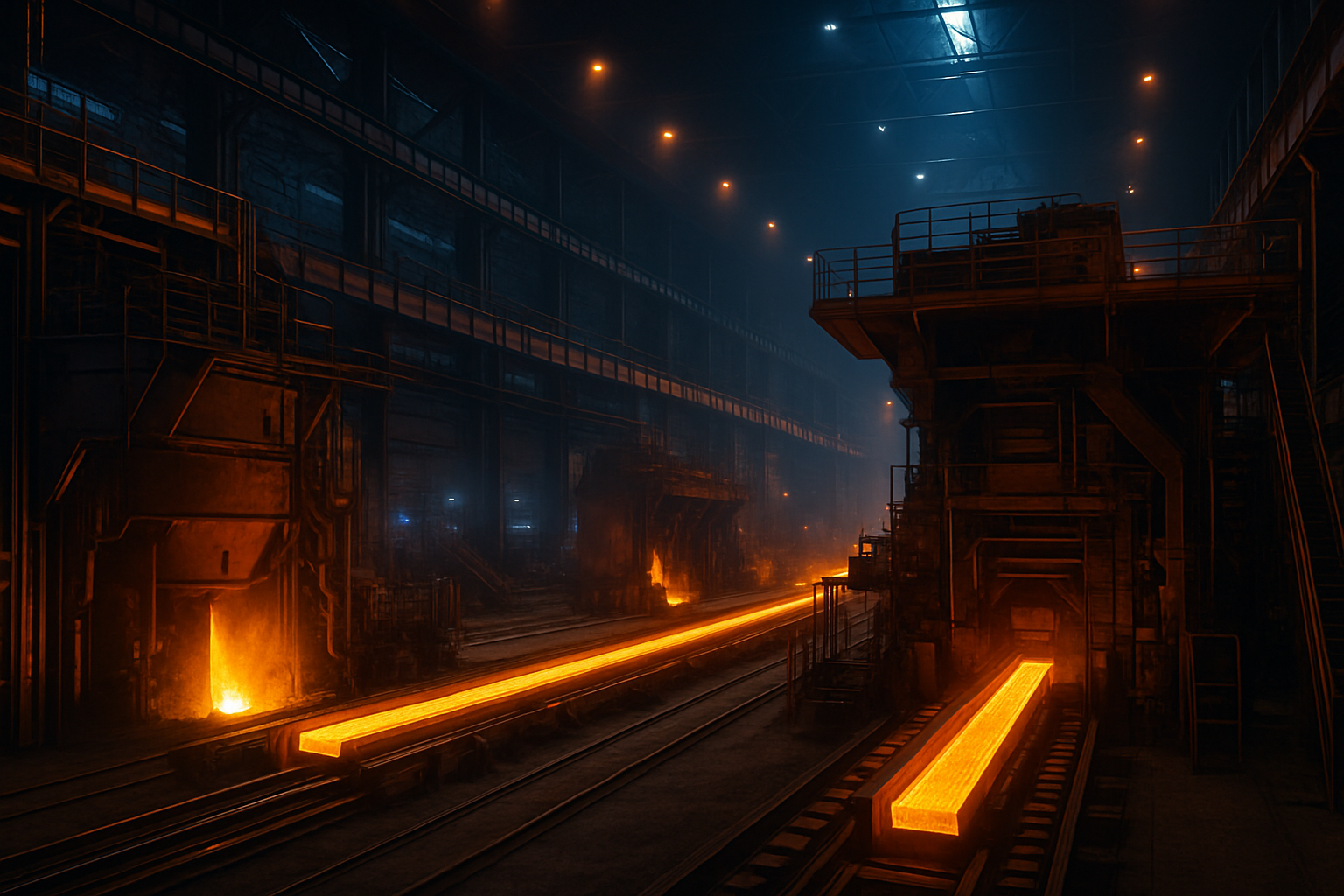
The steel project focuses particularly on reheating, where slabs or other products are brought to controlled temperatures before rolling or heat treatment. Furnace operation affects throughput, fuel consumption, temperature uniformity, material behaviour, and the microstructure that eventually contributes to mechanical properties. The process consequently offers a direct connection between modelling accuracy and operating cost.
Leaving a slab in a gas-fired furnace longer than necessary consumes additional energy and can constrain production flow. Removing it too early, or allowing temperature profiles to become insufficiently uniform, can create problems during downstream rolling or treatment. Optimisation therefore requires more than simply shortening residence time: the process still has to produce the required internal material condition consistently.
Traditional finite-element modelling can provide detailed estimates of temperature, stress, deformation, damage, and other parameters, but high-fidelity simulations may require substantial computing resource and time. That is manageable for offline engineering studies but less useful where plant decisions need to respond quickly to changing material, furnace, or production conditions.
MatAlytics’ approach is to train neural networks on finite-element simulation results so that the resulting model can reproduce relevant predictions far more quickly when new data is supplied. The company says CITRUS can turn calculations that might otherwise require hours or days into results available in seconds. That speed claim remains a company-reported capability and will now have to be demonstrated within the steel application rather than treated as an independently proven production result.
The distinction between physics-based AI and a purely statistical factory model is important. Steel behaviour is governed by thermal and mechanical processes that engineers already model mathematically. Training on simulation results gives the neural network a relationship with those known physical behaviours rather than asking it to infer every operating rule from historical plant data alone.
That does not make the output automatically trustworthy. Neural networks remain bounded by their training data, material properties, sensor inputs, operating range, and validation. A steel grade, geometry, furnace condition, or process route that differs substantially from the cases used to build the model may require further training or engineering verification before the prediction can safely influence production.
The latest funding is therefore intended to move CITRUS beyond proof of concept towards industrial validation, where simulation speed matters less than whether the model remains accurate under real operating conditions. Plant engineers need to understand not only the prediction but also when that prediction is sufficiently reliable to influence furnace control, production scheduling, or material processing.
MatAlytics sees reheating optimisation as an opportunity to reduce natural-gas consumption, energy cost, and associated carbon emissions while increasing throughput. Faster modelling could allow operating teams to adjust reheating cycles more closely to the actual material and process requirements rather than relying solely on fixed schedules with larger safety margins. Any resulting saving will depend on how much flexibility the furnace, production plan, and downstream mill provide.
The company also intends the system to predict microstructure evolution and final mechanical properties. That widens the potential value because steel quality depends not only on chemistry but on the thermal and mechanical history imposed during production. Better prediction of those relationships could support process development, new grades, troubleshooting, and quality control alongside energy optimisation.
Real-time use would create integration requirements of its own. Sensor data has to be sufficiently accurate, contextualised, and available to the model, while outputs need to enter operating workflows without becoming another isolated dashboard. If recommendations are to influence furnace settings or scheduling, responsibility for reviewing and acting on them also has to be clear, particularly where production quality or equipment safety could be affected.
The same modelling approach has potential outside steel. MatAlytics identifies power generation, nuclear and fusion systems, hydrogen infrastructure, aerospace, defence, automotive, and other asset-intensive industries as possible markets for physics-informed AI. Those applications share a requirement to understand how structures and materials behave under thermal or mechanical loads without waiting for lengthy conventional simulations every time new operating data arrives.
Steel provides a demanding place to demonstrate whether the concept works industrially. Material variability, furnace behaviour, thermal gradients, production pressure, and product-quality requirements make the gap between an impressive software demonstration and a trusted plant tool unusually visible. Engineers do not need an AI system merely to tell them that lower gas consumption would be desirable; they need evidence that a faster model can identify where energy can be removed without creating a quality or throughput problem elsewhere.
The £619,000 award gives MatAlytics funding to produce that evidence. CITRUS already has a defined technical basis, but commercial adoption will depend on accuracy, integration, validation, and whether seconds-fast predictions produce measurable operating gains on the mill floor. In steel manufacturing, computational speed is useful; reliable process decisions are what ultimately carry a value.