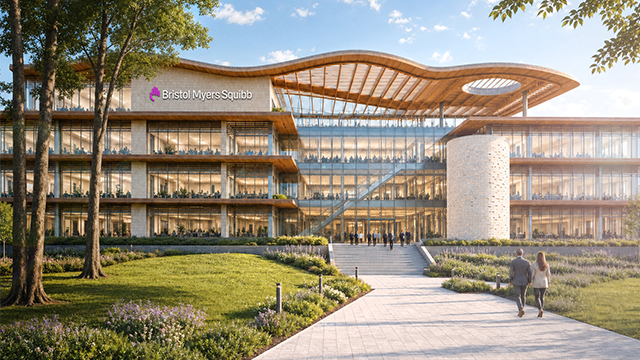
Bristol Myers Squibb has selected Generation Park in Houston, Texas, for a new $2.3 billion manufacturing campus designed to support several pharmaceutical production modalities, creating nearly 500 skilled jobs and extending the company’s five-year US investment programme.
Bristol Myers Squibb says the approximately 600,000 square foot campus will be modular and multi-modal, with capabilities covering small molecules, biologics and antibody-drug conjugates. The site is also intended to support drug product and finished-goods manufacturing from late development through commercial launch, allowing several stages of the manufacturing chain to be handled on one campus.
The design is intended to let BMS add or reconfigure manufacturing capacity as its pipeline changes. That flexibility is important in pharmaceuticals because a plant built around one product or modality can become difficult to adapt when a company’s development portfolio shifts. Small molecules, biologics and antibody-drug conjugates use different process equipment, containment strategies, cleaning regimes and analytical controls, so a multi-modal campus has to accommodate variation without weakening the discipline required for regulated production.
The Houston investment forms part of BMS’s $40 billion commitment to US research, development, technology and domestic manufacturing over five years. The company says the new site is intended to increase domestic manufacturing capability while giving it more capacity to move products from development towards launch.
Generation Park was selected after BMS evaluated several locations in the central and eastern United States. The company cited the region’s life-sciences workforce, available incentives, utilities, transport infrastructure and business environment among the factors behind the decision. For a pharmaceutical manufacturing campus, those utilities are not a minor consideration: production depends on reliable power, controlled environments, process water, clean utilities and support systems that have to operate consistently enough for manufacturing processes to be validated.
BMS expects the site initially to employ nearly 500 people across operations, production, maintenance, engineering, quality control, quality assurance, site leadership and administration. It also expects around 2,000 construction and other indirect jobs between 2027 and 2030 as the campus is built and brought online.
A project of this scale will involve considerably more than constructing the building shell. Manufacturing equipment, utilities, automation, laboratories and digital systems must be installed, commissioned and qualified before they can support regulated production. In pharmaceuticals, mechanical completion does not make a line ready for commercial output; the manufacturer must demonstrate that the process operates within defined conditions and produces material consistently with the required quality and traceability.
The modular approach is intended to shorten part of that journey when new capacity is required. If process blocks, utility connections and digital interfaces can be standardised, later additions can be integrated more quickly than a completely new factory. The engineering difficulty is to preserve enough flexibility for future products without creating layouts or utilities that are inefficient for the processes actually installed.
Digital integration is another part of the plan. BMS describes the site as digitally advanced and designed to accommodate future automation. Better process data, electronic records and automated material tracking can improve visibility and reduce manual handling, but systems that affect regulated manufacturing also become part of the site’s validation and cybersecurity burden. Software, interfaces and data flows have to be controlled with the same seriousness as physical production equipment.
The decision to combine small-molecule, biologic and antibody-drug conjugate capability also reflects the changing composition of pharmaceutical pipelines. Companies increasingly need manufacturing networks capable of supporting products with very different production routes rather than relying only on large single-purpose plants. That creates an advantage for sites that can add specialised capability without rebuilding the complete infrastructure around them.
Antibody-drug conjugates illustrate the point. They combine a biological targeting component with a potent small-molecule payload, creating manufacturing and containment requirements that cross conventional boundaries between biologics and chemical processing. A campus able to support several modalities can potentially reduce the organisational and logistical distance between those activities, although BMS has not yet disclosed the detailed process configuration planned for Houston.
The location also gives the company room to expand beyond the opening configuration. BMS says the architecture is intended to allow new manufacturing capabilities to be brought online as pipeline and commercial needs evolve, with the site growing in scale, capability and workforce over time. Early decisions about utility capacity, material flows, laboratories, warehouses and data architecture will therefore influence how easily later phases can be added.
The employment profile reinforces the long-term operating commitment. Maintenance and engineering roles will be required to keep complex utilities and production equipment available, while quality organisations will be responsible for controlling the processes and records that allow products to be released. Those functions are less visible than a new production line, but they determine whether a pharmaceutical site can operate reliably after the construction phase is finished.
BMS has attached a substantial capital figure to the Houston plan, but the industrial test will come through execution. Equipment has to arrive on time, specialised contractors and validation resources have to be coordinated, and the site has to move from construction through commissioning into regulated production without compromising quality.
The $2.3 billion investment gives the project scale, while the modular concept gives it a promise of adaptability. Whether Houston delivers that flexibility will become clear when BMS starts adding and changing production capabilities around a live manufacturing campus rather than an empty site plan.