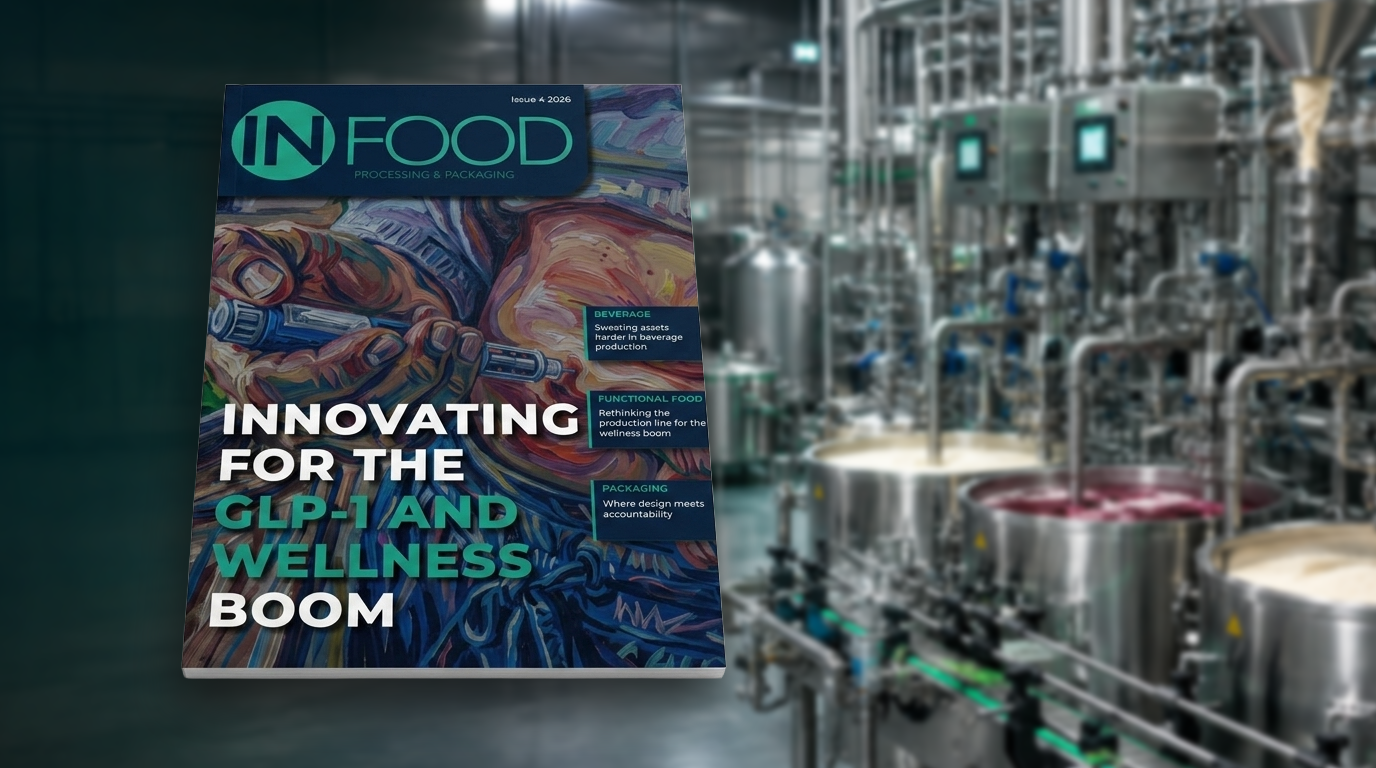
Food manufacturing has always balanced consumer demand against engineering reality, but the timescale mismatch is becoming harder to ignore. Eating habits can shift in months; filling lines, utilities, inspection systems, and packaging assets are expected to remain productive for years.
The July/August edition of IN Food examines that tension through the practical decisions now reaching factory floors. GLP-1 therapies and broader wellness demand are changing the product brief, with smaller portions expected to carry greater nutritional density, protein, fibre, and functional value. That moves the challenge beyond formulation because sensitive ingredients can require different thermal treatments, mixing, segregation, hygiene, traceability, and quality assurance.
Capital pressure is moving in the opposite direction. With manufacturers scrutinising expenditure, the issue also makes the case for extracting more from installed equipment. One beverage example reports a 10% capacity increase from a redesigned PET blowing block alongside reduced compressed-air consumption, illustrating why targeted brownfield engineering can outperform reflexive replacement when the constraint is understood properly.
The same systems thinking extends into inspection and packaging. Conductive dairy products can complicate metal detection through product effect, while packaging design is increasingly being pulled upstream by recyclability infrastructure, lifecycle data, pEPR, PPWR, logistics, and material choices. A pack that looks compliant in isolation can still fail when the surrounding system cannot process it as intended.
Across these subjects, the industrial problem is remarkably consistent: manufacturers are being asked to create more adaptable products while running assets that cannot be redesigned every time consumer behaviour changes. Flexibility, therefore, is becoming an engineering requirement rather than a convenient option — in process design, automation, utilities, quality systems, and packaging development.
The faster the market moves, the more expensive rigid production becomes. Issue 4 shows why the advantage may lie less in predicting demand than in designing operations that absorb it.