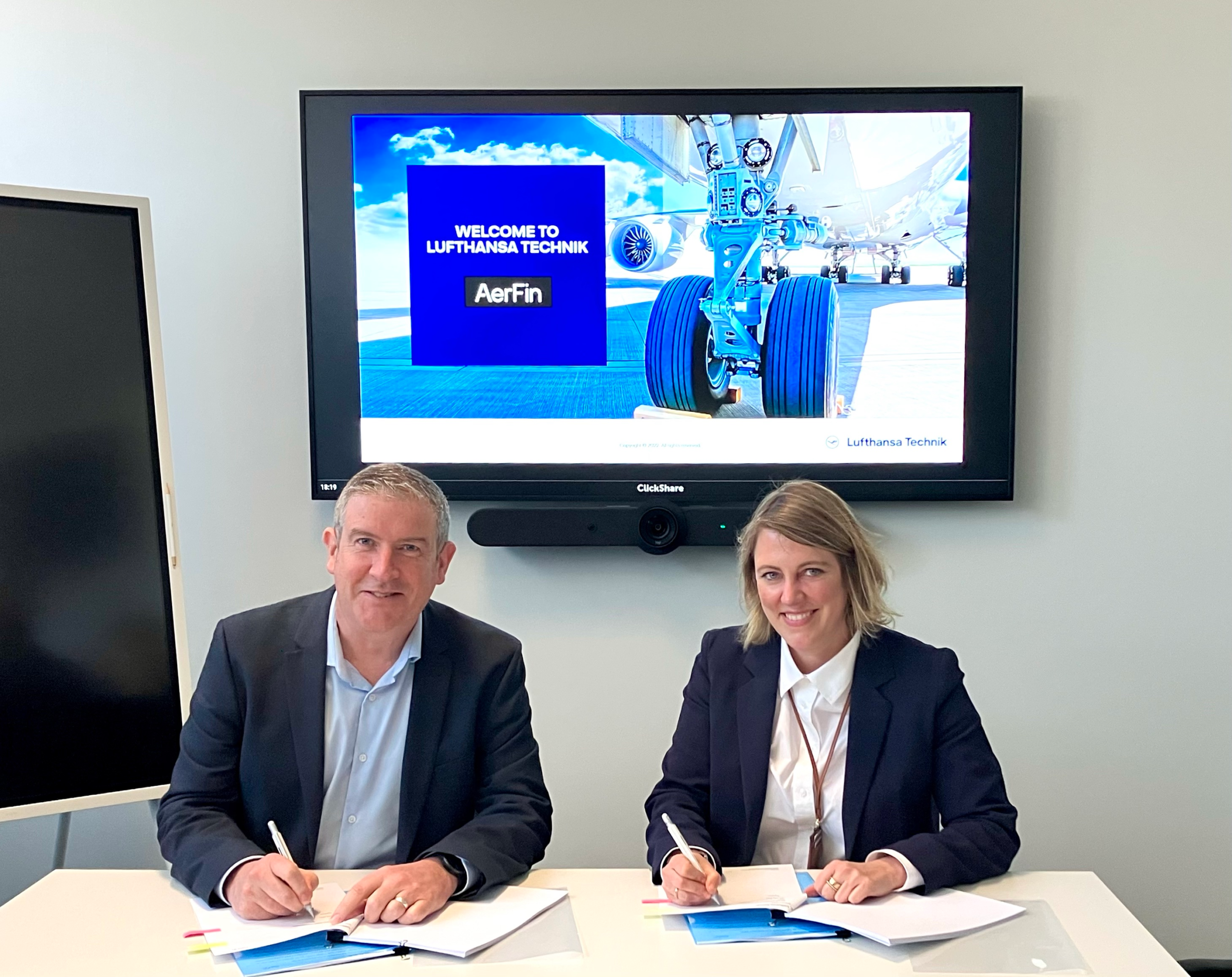
AerFin has signed a multi-platform component consignment agreement with Lufthansa Technik, extending the German MRO group’s access to serviceable material across six major Airbus and Boeing aircraft families as the aviation aftermarket continues to work through uneven parts availability and repair capacity.
The agreement with AerFin covers the Airbus A320ceo, A320neo and A330 families, together with the Boeing 737NG, 737 MAX and 777. AerFin will make serviceable material available within Lufthansa Technik’s component support network, giving the MRO provider another route to source parts for planned maintenance and unplanned aircraft-on-ground requirements.
No contract value, duration or inventory volume has been disclosed. The industrial value of the arrangement lies instead in how component stock is positioned and released into the aftermarket, where a missing rotable can keep an otherwise serviceable aircraft on the ground and where lead times for new or repaired parts can vary considerably between component types.
Component consignment provides a way of widening material availability without requiring Lufthansa Technik to purchase every unit placed into the supply channel. The model allows an asset owner to retain an economic interest in stock while another organisation makes that stock available to customers through an established sales, exchange or support network. For aircraft operators, the distinction matters less than whether a certified component can be supplied at the required location and time.
Berit Plewinsky, Vice President Aircraft Component Services at Lufthansa Technik, said the company is seeking partners able to improve component availability across its customer base.
“We believe innovation thrives through collaboration. That’s why we’re seeking trusted partners to develop creative solutions that improve availability and create seamless flight operations for our customers.”
Lufthansa Technik already operates a substantial component material business. Its published service information says the company supports more than 5,000 aircraft, delivers around 300,000 parts each year and holds material worth about US$2.3 billion in its own pool. Adding AerFin stock does not replace that network; it increases the range of assets that can be drawn into it when customer demand and repair-cycle timing do not line up neatly.
That mismatch has become an important feature of the aviation aftermarket. Airlines are operating mixed fleets for longer, while newer-generation aircraft have entered service alongside large populations of older A320ceo, 737NG, A330 and 777 aircraft. The result is continuing demand for mature-platform components at the same time as A320neo and 737 MAX fleets generate their own requirements.
Simply buying more stock is an expensive response. Rotable components can carry high individual values, and demand for a particular part may be irregular. Inventory that sits unused ties up capital, yet insufficient stock creates exposure when a repair is delayed or an aircraft needs a replacement immediately. Consignment and used serviceable material provide ways of spreading that risk across a wider asset base.
The engineering burden does not disappear when a component is sourced from the aftermarket. Every unit still requires acceptable traceability, configuration and condition records, while repaired or used material has to meet the certification requirements applicable to the aircraft and operator. A component with incomplete documentation is not equivalent to one that can move directly into an approved maintenance process.
James Bennett, Chief Commercial Officer at AerFin, said the agreement extends access across several of the most widely operated narrowbody and widebody platforms.
“This agreement reflects the strength of our relationship with Lufthansa Technik and our shared focus on delivering practical, high-quality solutions to the market.
“By expanding access across multiple key platforms to our customers, we’re better placed to support with the material they need, when they need it – while continuing to drive value from assets in a disciplined and efficient way.”
AerFin’s business spans aircraft and engine trading, component supply, leasing and engine MRO services, which gives it access to material arising from several points in an aircraft’s lifecycle. Teardown activity can return serviceable components to circulation, while asset purchases and portfolio management can create stock that is useful to operators long after the original aircraft has left passenger service.
The agreement also arrives shortly after ORIX Aviation agreed to acquire AerFin, subject to regulatory approvals, with completion targeted before the end of 2026. That transaction is separate from the Lufthansa Technik deal, but it underlines the strategic value being attached to aftermarket platforms capable of combining aircraft assets, parts, repair capability and distribution.
For Lufthansa Technik, the immediate requirement is more prosaic: keeping aircraft material available across a fleet mix that will remain diverse for years. A320ceo and 737NG aircraft are not disappearing as their successors grow, and A330 and 777 fleets continue to generate demand for components with long operating histories. The aftermarket therefore has to support several technology generations simultaneously.
That makes inventory discipline as important as headline stock value. Material has to be located, documented and released quickly enough to solve an operational problem, while owners need enough utilisation to justify holding the asset. The new agreement gives AerFin another route into Lufthansa Technik’s support network; its performance will be visible in whether that extra stock shortens the wait for the parts that actually stop aircraft flying.