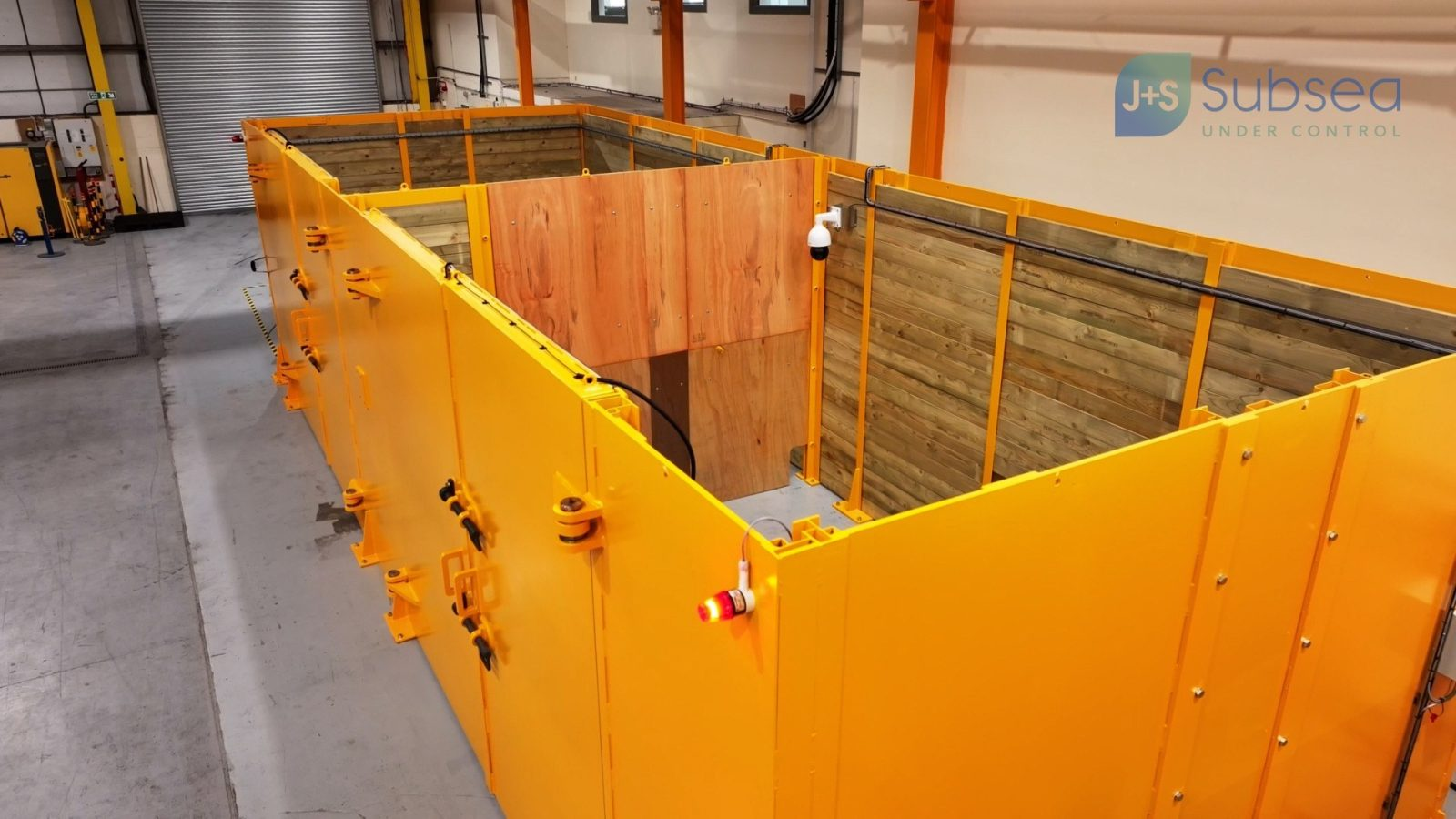
J+S Subsea has installed two pressure testing bays rated to 30,000psi at its Aberdeen headquarters, increasing its capacity to manufacture, qualify, and validate electrical and hydraulic connection systems in-house.
Backed by an investment of almost £140,000 and support from Energy Transition Zone Ltd, the bays were initially developed around a fast-mate connection system for renewable energy applications. The facilities can also support equipment used in offshore oil and gas production, decommissioning, carbon capture and storage, and late life asset projects.
High pressure testing allows individual components and complete assemblies to be assessed against conditions they may encounter during installation and service. Sealing performance, mechanical integrity, electrical continuity, hydraulic behaviour, and repeated connection cycles can be monitored before equipment is committed to an offshore campaign.
Following the company’s move to larger premises in Dyce during late 2024, the additional infrastructure increases the proportion of design, manufacture, refurbishment, and testing work that can be completed within one operation. External test facilities will still be required for some specialist qualifications, although routine development and customer testing can now be managed locally.
When a component fails during a pressure cycle, engineers can inspect the result, revise materials or geometry, alter assembly procedures, and repeat the test without transporting equipment between several organisations. The shorter feedback loop is especially useful for bespoke systems, where each revision may otherwise add days or weeks to an offshore schedule.
Qualification expands across offshore markets
North Sea engineering companies increasingly serve a mixture of conventional energy, decommissioning, carbon storage, and renewable projects. Although each market presents distinct operating requirements, they share demanding conditions around pressure, corrosion, remote installation, long service intervals, and limited access for repair.
Connection systems used for late life asset support may have to interface with equipment installed decades earlier, where original drawings, spare parts, or manufacturer support are incomplete. Refurbishment and reverse engineering consequently need to be supported by testing that demonstrates compatibility with ageing infrastructure rather than relying solely on the original design specification.
Decommissioning work creates different loading and duty patterns. Equipment may be connected temporarily during flushing, cutting, lifting, monitoring, or well intervention, and reliability remains critical even where the operating period is comparatively short. A failed connector can delay a vessel, interrupt a tightly sequenced campaign, or require another mobilisation.
Carbon capture and storage introduces material conditions that cannot be assumed to match conventional hydrocarbon service. Carbon dioxide streams may contain water and other impurities, creating corrosion, sealing, and compatibility risks that depend on pressure, temperature, and composition. Test procedures must reproduce credible service conditions rather than borrowing acceptance limits from unrelated applications.
Offshore renewables add requirements around electrical distribution, monitoring, repeated mechanical loads, and prolonged exposure to seawater. Floating systems can subject connections to movement and cyclic loading, while fast installation must be balanced against the need for dependable sealing and electrical performance over an extended operating life.
The wider offshore project pipeline is sustaining demand for specialist connection and control equipment. Installation work for the Neptun Deep gas development in the Black Sea has shown how fabrication, marine construction, control systems, and subsea integration must converge before a new field can begin production.
Greater in-house test capacity can also change a supplier’s role within a project. A company that provides documented validation alongside design and manufacture can accept responsibility for a finished assembly rather than delivering an individual part whose performance must be demonstrated elsewhere.
That responsibility requires controlled procedures, calibrated instrumentation, competent operators, and traceable records. Pressure systems contain substantial stored energy, while a test result has little value unless specimen preparation, environmental conditions, measurement accuracy, and acceptance criteria are defined before the cycle begins.
Digital records can capture complete pressure profiles, leakage rates, temperature, and failure events, providing evidence for customers and future design work. Those files must remain linked to the exact materials, components, assembly records, and instrument calibrations used for the test if they are to support formal qualification.
Local capacity may also reduce the scheduling risk created by competition for shared test facilities. Offshore projects frequently depend on a narrow window for vessel mobilisation or installation, and a comparatively small item can hold the entire sequence if its documentation or qualification remains incomplete.
J+S Subsea expects the bays to support further growth as it develops equipment for several offshore sectors. Their value will be measured through turnaround, repeatability, and accepted customer test evidence, with each successful qualification reducing one of the many small uncertainties that accumulate before equipment reaches the seabed.