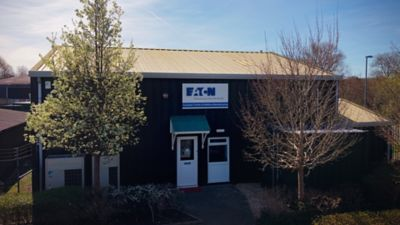
Eaton has opened a European aerospace additive manufacturing centre at its Wimborne operation in Dorset, combining component design, process engineering, metal printing, validation, and production preparation within a single facility.
As Eaton’s third additive manufacturing site worldwide and its second dedicated to aerospace, the centre will support commercial aviation, defence, and aftermarket programmes. Work is expected to cover both redesigned legacy parts and components developed specifically around the geometric and material capabilities of additive production.
Installed at the Wimborne aerospace campus, the centre includes Eaton’s largest metal additive manufacturing system, which the company says can deliver up to twice the productivity of its earlier equipment. Titanium processing and electron beam additive manufacturing are also planned, extending the range of materials, component sizes, and performance requirements available to engineering teams.
Progress towards AS9100 certification will determine when the centre can move qualified components into controlled aerospace supply chains. Customers require traceable materials, approved machine parameters, stable post-processing, inspection records, and repeatable mechanical performance before printed parts can progress beyond prototypes and development batches.
By locating additive engineering alongside an established aerospace manufacturing operation, Eaton can connect designers more directly with the specialists responsible for build preparation, powder management, heat treatment, machining, surface finishing, inspection, and validation. Problems identified after printing can consequently be traced back through a shorter and more closely controlled process chain.
Printing becomes one stage of production
Metal additive manufacturing offers substantial design freedom, particularly where several components can be consolidated into one part or where internal flow passages cannot be produced through conventional machining. Aerospace engineers can also reduce mass, remove joints, and place material more selectively around mechanical and thermal loads.
Those advantages are only useful when the complete manufacturing route produces a stable result. Printed aerospace components rarely leave the machine ready for installation, and the subsequent operations can account for a large share of cost, lead time, and technical risk. Support removal, thermal treatment, machining, surface finishing, cleaning, and non-destructive inspection must all be designed around the printed geometry.
Powder condition introduces another source of variation. Particle size, shape, chemistry, moisture, contamination, storage, reuse, and handling can influence layer deposition and final material properties, while changes between powder batches must be understood before they affect production yield. Controlled storage and documented reuse strategies are therefore as important as the printer itself.
The aerospace industry is increasingly applying additive processes to components whose conventional supply routes are expensive or vulnerable. GKN Aerospace has been developing an additive production route for structural parts within the F135 engine programme, demonstrating how qualification work is moving into demanding applications where repeatability carries more weight than novelty.
Aftermarket production presents a separate opportunity. Aircraft can remain in service for decades, while demand for individual replacement parts may fall below the level required to maintain tooling, casting patterns, or dedicated production lines. A qualified digital route can support smaller batches, provided that the source design, software, machine configuration, materials, and inspection methods remain under revision control.
Regional production can reduce dependence on lengthy international logistics for some specialised components, although additive manufacturing retains its own concentrated supply risks. Metal powders, lasers, electron beam systems, vacuum equipment, software, sensors, and replacement machine parts are supplied by a relatively small group of manufacturers and must remain available throughout long aerospace programmes.
Inspection becomes more difficult as designers introduce internal channels, thin walls, lattice structures, and consolidated geometries. Conventional dimensional tools may be unable to reach critical surfaces, requiring computed tomography, process monitoring, destructive sample testing, or indirect verification through flow and pressure measurements.
Machine monitoring can generate extensive data on melt pool behaviour, layer condition, temperature, and build environment, but production teams must establish which signals reliably indicate a defect. Collecting information without connecting it to material performance or inspection outcomes adds storage and analysis costs without improving acceptance decisions.
Design remains the first filter for commercial viability. Parts copied directly from machined or cast designs may become more expensive when printed, particularly once post-processing is included. The strongest applications tend to emerge when the design is reworked to reduce assembly, improve performance, or remove a recurring supply constraint.
Wimborne’s combined engineering and production capability gives Eaton a route for testing those decisions before transferring parts into serial manufacture. The centre’s output will depend on the number of complete production routes it can qualify, rather than the number of geometries its machines can print.
Further material capability and completion of the site’s quality approvals will widen the range of programmes it can support. Each qualified part will still require a controlled link between design intent, machine process, post-processing, inspection, and customer acceptance — the disciplines that separate aerospace manufacturing from an impressive demonstration build.