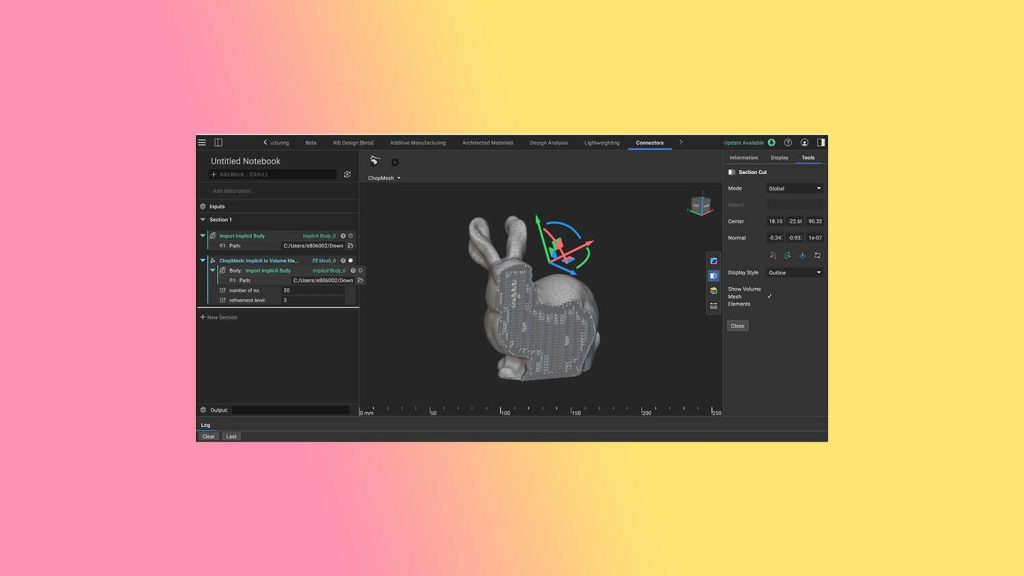
Voxshell has secured £800,000 in seed investment to accelerate development of ChopMesh, its automated meshing platform for complex engineering simulation.
The Cranfield University spinout will use the funding to expand its engineering team, develop workflow orchestration, and support wider commercial deployment. DSW Ventures led the round, which also received support connected with Innovate UK.
ChopMesh addresses the preparation stage between a digital design and computational analysis. Before engineers can perform finite element analysis or computational fluid dynamics, geometry normally has to be divided into smaller elements or cells that numerical solvers can process.
Producing a usable mesh can require extensive clean-up, simplification, defeaturing, and repeated quality checks, particularly when a design contains complex surfaces, internal structures, or detailed manufacturing features. Voxshell estimates that geometry preparation and meshing account for as much as 80% of some simulation workflows.
The company’s software is intended to process conventional CAD alongside implicit and volumetric geometries. Implicit design methods are increasingly used for lattice structures, topology-optimised parts, heat exchangers, porous materials, and components created through computational design.
Such geometries can be difficult to represent using the boundary surfaces and file formats associated with established CAD systems. Conversion into an intermediate model may remove detail, introduce defects, or generate data sets that are too large to manage efficiently.
Voxshell says ChopMesh can work natively with implicit geometry while preserving the design intent required for downstream simulation. Artificial intelligence accelerates parts of the preparation process and automates decisions that would otherwise require manual intervention by an analyst.
Founded in April 2024, the company has already secured paying customers and pilot projects with tier-one aerospace manufacturers. A higher-performance version intended for automated batch processing is scheduled for release later in 2026.
Simulation capacity is outgrowing preparation methods
Engineering organisations are being asked to evaluate more design alternatives within shorter development programmes. Electrification, thermal management, lightweighting, additive manufacturing, and stricter certification requirements have increased both the number and complexity of simulations required before physical testing.
Solver performance has improved substantially, while cloud computing and high-performance hardware have made additional processing capacity available. Geometry preparation remains comparatively labour-intensive, leaving expensive computing resources waiting for models that still require manual repair or adjustment.
Automating the meshing stage could redirect experienced analysts towards selecting boundary conditions, validating assumptions, interpreting results, and improving designs. Those activities rely more heavily on engineering judgement than the repetitive clean-up of geometry.
Confidence in automated output will determine the pace of adoption. A mesh that appears visually acceptable may still produce inaccurate or unstable results when elements are distorted, insufficiently refined, or poorly aligned with the physical behaviour being modelled.
Engineering teams will consequently need evidence that ChopMesh produces repeatable results across their own geometry and simulation classes. Early deployment is likely to involve controlled workflows where automated meshes can be compared with established methods before use on safety-critical or certification work.
Integration presents another technical test because simulation departments rarely depend on a single design tool, solver, or data format. ChopMesh must fit around existing CAD, product lifecycle management, optimisation, and high-performance computing systems without creating another isolated transfer stage.
Batch processing could be particularly useful in design optimisation. Generative and topology optimisation methods may produce hundreds or thousands of candidate geometries, making manual preparation impractical even when only a fraction of those candidates proceed to detailed analysis.
An automated pipeline can reject unsuitable designs, mesh viable candidates, run simulations, and feed the results into a subsequent optimisation cycle. The approach allows computational design to examine a wider solution space without creating an equivalent increase in manual preparation.
Additive manufacturing presents a related opportunity. Lattice structures and internal channels can deliver useful combinations of weight, stiffness, heat transfer, and fluid performance, but their geometric complexity can overwhelm conventional preparation methods.
Faster meshing would allow more of those structures to be evaluated before manufacturers commit to expensive builds. It could also support process simulations examining distortion, heat flow, residual stress, and support strategies within additively manufactured parts.
Aerospace pilots provide a demanding validation environment because aircraft and propulsion programmes require controlled simulation methods and clear evidence linking digital predictions with physical testing. Success there could support adoption in automotive, energy, medical devices, and advanced machinery.
Voxshell is entering a market where established CAD and simulation suppliers are already investing in automated preparation and artificial intelligence. Its position rests on solving a specialised problem across multiple toolchains rather than attempting to replace the wider engineering software environment.
The seed round is modest beside the development budgets of the largest software groups, although focused products can gain traction when they remove significant engineering labour or shorten programme schedules. Commercial progress will depend on measured performance with production geometry rather than demonstrations using simplified examples.
As simulation becomes central to reducing prototypes and controlling development risk, the work required before a solver begins is attracting greater attention. Automating that preparation could determine how widely advanced geometry and optimisation are used beyond specialist analysis teams.