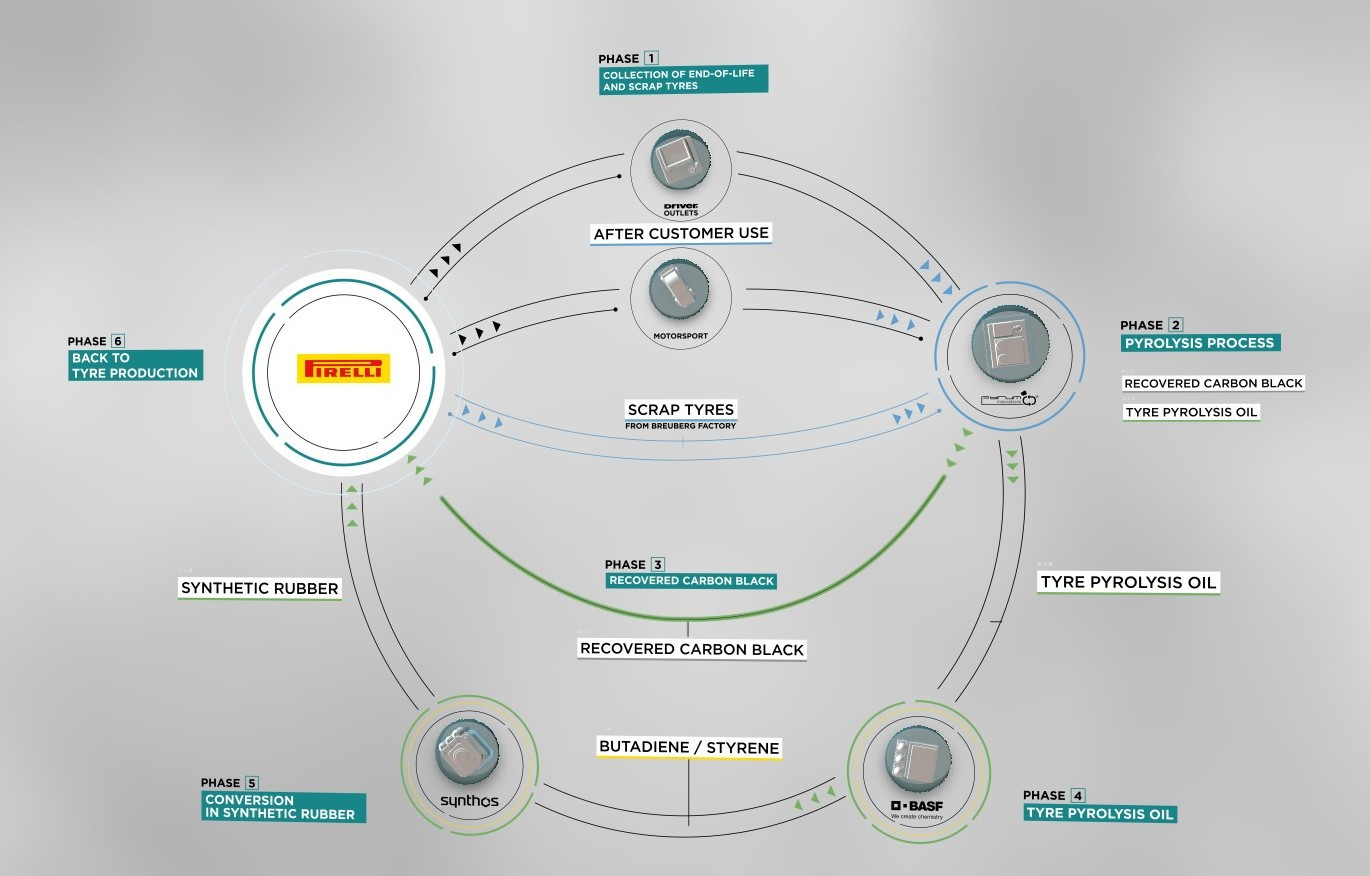
Pirelli, Pyrum Innovations, BASF, and Synthos have established a European production chain intended to return materials recovered from end-of-life and manufacturing-scrap tyres to new tyre production.
The collaboration connects tyre collection, thermolysis, recovered carbon black processing, chemical production, synthetic rubber manufacture, and final tyre compounding. By linking each stage with a defined downstream customer, the partners aim to keep recovered material within comparable industrial applications rather than directing it towards lower-value uses.
End-of-life tyres will be collected in Germany through selected Driver retail outlets, while material from Pirelli’s Breuberg factory and motorsport activity will also enter the system. Pyrum Innovations will process the tyres using its thermolysis technology.
Heating the tyre material in a controlled low-oxygen environment separates it into recovered carbon black, tyre pyrolysis oil, steel, and other outputs. Upgraded recovered carbon black will be supplied directly to Pirelli’s European plants, where it can replace part of the virgin carbon black used within new rubber compounds.
Pyrum will also supply tyre pyrolysis oil to BASF as a chemical feedstock. BASF intends to co-process the recovered oil with conventional raw materials, producing chemicals including butadiene and styrene for subsequent polymer manufacture.
Synthos will use certified circular feedstock to make synthetic rubber carrying ISCC Plus certification, which Pirelli will then use in high-performance tyres. The arrangement creates two return routes from old tyres: recovered carbon black entering compounds directly and hydrocarbon feedstock passing through chemical production before returning as new rubber.
Chemical feedstock will be attributed through mass-balance accounting, allowing a documented proportion of circular raw material to be allocated to products from an integrated manufacturing system where recycled and conventional inputs are mixed. The approach avoids the expense of building separate pipelines, storage, and processing equipment for comparatively small initial volumes.
Certification and chain-of-custody records must remain robust because the allocated circular content cannot be identified molecule by molecule within the finished tyre. Each company will need auditable information covering input volumes, process losses, product allocation, and transfers between sites.
Material consistency controls closed-loop production
Tyres are difficult to recycle because they combine synthetic and natural rubber, carbon black, silica, steel, textile reinforcement, oils, additives, and cured cross-linked polymers. Mechanical shredding can recover steel and produce rubber granulate, but it does not recreate all the raw materials needed for an equivalent new tyre.
Thermochemical treatment breaks down the rubber and produces oil and carbon-rich solids, although industrial performance depends on energy consumption, plant availability, emissions control, product yield, and the consistency of feedstock arriving from different tyre types and operating histories.
Recovered carbon black must satisfy demanding specifications before it can enter high-performance compounds. Particle structure, ash content, surface chemistry, contamination, moisture, and batch consistency affect reinforcement, mixing, curing, rolling resistance, grip, wear, and appearance.
Direct substitution on a weight-for-weight basis is therefore unlikely across every compound. Pirelli will need to determine where recovered grades can replace virgin material without weakening tyre performance, factory stability, or regulatory compliance.
Pyrolysis oil follows a different qualification route, since its composition and impurities must remain compatible with downstream chemical equipment. Stable volumes are also required before logistics, processing, and certification can operate economically at a large scale.
The involvement of BASF and Synthos connects recycling output with established chemical and polymer plants. Circular materials often struggle to progress beyond demonstration scale when the recycler lacks a committed route into qualified manufacturing, leaving recovered products exposed to uncertain demand and price.
Long-term purchase arrangements can provide greater confidence for investment in collection, processing, and upgrading capacity. Tyre manufacturers gain a more dependable source of lower-impact material, while recyclers obtain customers capable of absorbing industrial volumes.
Circular inputs must still compete with virgin carbon black and synthetic rubber on price, performance, and availability. Conventional feedstock costs move with oil, energy, transport, and global production capacity, so the recovered alternatives need to remain viable through periods when virgin materials become cheaper.
European regulation is increasing the requirement to document product carbon, recycled content, waste treatment, and supply chain impacts. A certified closed-loop arrangement provides a stronger evidence base, although the environmental result depends on actual displacement of virgin material, process energy, transport distances, and recovery yield.
Factory scrap and motorsport tyres can provide comparatively controlled feedstock, while mixed end-of-life tyres introduce variation in composition, contamination, and condition. Expanding the programme will require collection and sorting systems capable of delivering suitable material at a scale matched to the thermolysis and downstream chemical plants.
Production scheduling must also align across four industrial businesses. A disruption at the thermolysis plant, chemical operation, polymer facility, or tyre factory can interrupt the chain, while inventory and storage limits may restrict how long intermediate materials can absorb differences in output.
Process data will be needed to improve yield and control variation as volumes increase. Information on tyre source, material composition, operating conditions, recovered product quality, and compound performance can help the partners identify which feedstocks create the most consistent results.
The initial German collection network provides a manageable route for establishing that control before a wider European rollout. Industrial progress will be measured through tonnes returned to tyre production, the proportion of virgin material displaced, consistent tyre performance, and the ability to reproduce the route across additional plants and markets.