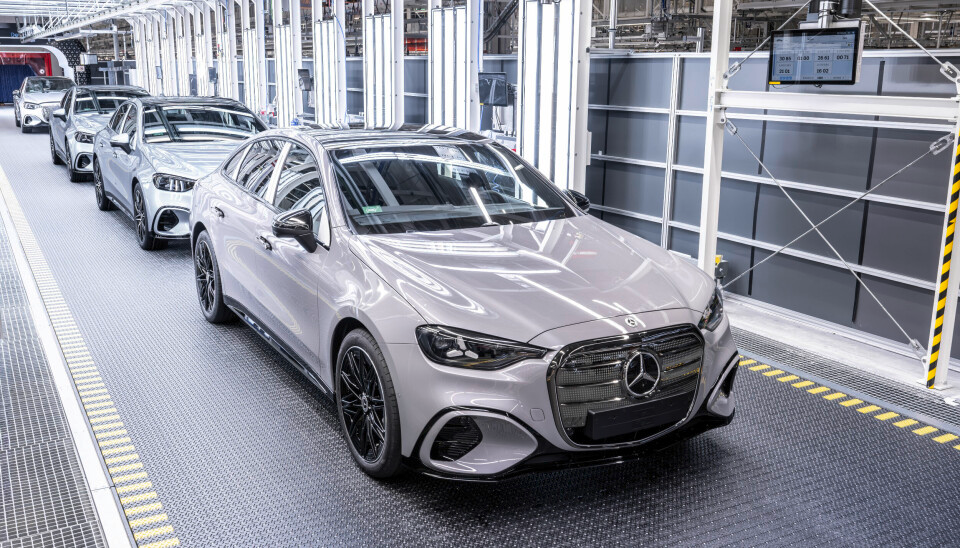
Mercedes-Benz has begun electric C-Class production at Kecskemét following a €1bn expansion that more than doubles the physical footprint and manufacturing scope of its Hungarian operation.
The site has grown from 200 hectares to 440 hectares, with new body and assembly halls, a second press shop, an additional paint operation, and battery assembly capacity. More than 5,000 people now work across stamping, body construction, painting, battery handling, final assembly, logistics, quality, maintenance, and production engineering.
As the first battery electric core model to enter production at Kecskemét, the electric C-Class establishes the plant as a central part of Mercedes-Benz’s European electrification programme. Preparations are also under way for the compact electric G-Class, while the expanded operation retains flexibility to accommodate further models.
Body components and drive batteries for the electric C-Class and GLB can now be produced on site, shortening internal supply routes and giving the plant greater control over critical production stages. The existing assembly hall can manufacture combustion and electric models, whereas the new hall has been developed around battery electric production.
Mercedes used a digital twin of the assembly operation through its MO360 production environment and Nvidia Omniverse, allowing manufacturing teams to test layouts, equipment positions, workflows, and interfaces before physical installation. Potential clashes and access constraints could therefore be examined before commissioning work reached the factory floor.
Digital planning is particularly useful when several products and powertrain types must share infrastructure. Material routes, operator movements, automation envelopes, maintenance access, and production sequencing can be modelled together, although the accuracy of the result depends on keeping the virtual environment aligned with engineering changes made during installation.
The expanded plant includes 42.3MWp of solar generation, which Mercedes expects to supply around a quarter of annual electricity consumption. Its new paint shop has been designed to consume approximately 20% less energy and produce around 80% less carbon dioxide than the existing paint operation.
Painting remains one of the most energy-intensive stages of vehicle production because bodies pass through cleaning, pretreatment, coating, curing, ventilation, filtration, and controlled environmental zones. Lower-temperature processes, improved airflow, heat recovery, and more efficient ovens can therefore reduce a substantial part of the plant’s operating demand.
The Kecskemét project also reflects a broader move away from factories dedicated to one model or powertrain. Electric-vehicle adoption continues to vary by region, taxation, fleet policy, charging infrastructure, and customer demand, leaving manufacturers with less certainty over the mix required across a long investment cycle.
Flexible production provides some protection against those changes, but it increases operational complexity. Battery electric and combustion vehicles require different powertrain handling, test routines, safety arrangements, and component flows, while shared assembly lines must maintain stable sequencing and avoid introducing unnecessary variant-driven disruption.
Battery integration adds requirements around high-voltage safety, traceability, fire protection, thermal management, and end-of-line testing. Packs and modules must arrive in the correct configuration, with manufacturing records linked to the completed vehicle and retained for service, quality, and warranty analysis.
Mercedes has been industrialising electric powertrain technologies elsewhere in Europe, including axial-flux motor production in Berlin. The transition reaches beyond final assembly into winding, joining, electronics, precision manufacture, automated inspection, and new supplier relationships.
Hungary already sits within a dense Central European automotive network of vehicle plants, battery projects, component manufacturers, and logistics operations. Additional capacity can attract further suppliers, although it also intensifies competition for technicians, maintenance engineers, production specialists, and skilled operators.
Energy infrastructure will influence how fully the new operation can be used. On-site solar reduces purchased electricity and some exposure to price volatility, yet vehicle and battery production still require dependable grid capacity across shifts, seasons, and periods of low renewable generation.
Storage, demand management, and long-term energy procurement can support that requirement, although none removes the need for a resilient electrical connection. The balance between production scheduling and available power will become more important as additional process heat, charging, and battery operations are electrified.
Mercedes can also move capacity between plants as demand changes, provided quality systems, tooling, components, and workforce readiness remain aligned. Such flexibility carries capital cost, but it gives the manufacturer more options than a network built around rigid, single-model facilities.
The €1bn investment has created a deeper manufacturing operation rather than simply another final assembly line. Its performance will be measured through launch quality, utilisation, cost, energy intensity, and the ability to adjust product mix without destabilising output as the European vehicle market continues to change.