Mercedes-Benz has started large-scale production of electric axial flux motors at its Berlin-Marienfelde plant, turning a high-performance motor architecture into an automotive-scale manufacturing programme.
The production launch places the company’s oldest manufacturing site at the centre of a new electric drive system. Berlin-Marienfelde, which has more than 120 years of manufacturing history, is now operating as a centre of excellence for high-performance electric motors.
The axial flux motor will make its production vehicle debut in the new Mercedes-AMG GT 4-Door Coupe. Unlike a conventional radial flux motor, where electromagnetic flux runs perpendicular to the axis of rotation, an axial flux design routes flux parallel to the axis, allowing a flatter disc-shaped motor with high power and torque density.
The manufacturing challenge is substantial. Mercedes-Benz has said axial flux motor production involves 98 process steps, including 65 being used by the company for the first time and 35 that are new in industrial terms. More than 30 patent applications are linked to the technologies developed for production.
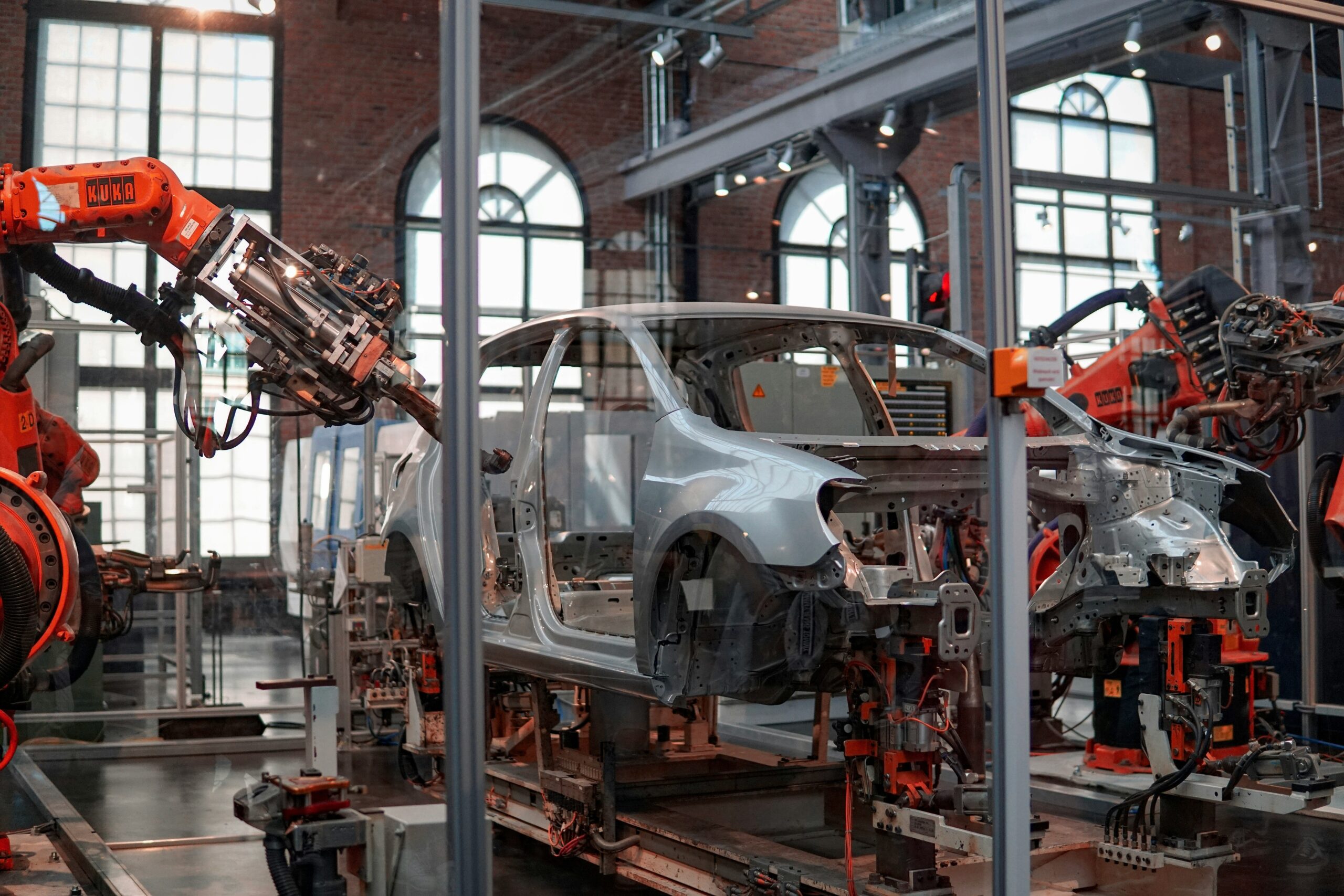
Production at Berlin-Marienfelde covers roughly 30,000 square metres across three halls and seven production lines. The operation combines highly automated processes, laser technology, intelligent control systems, AI-based quality control, and skilled assembly work, reflecting the precision required to manufacture compact high-performance drive units at scale.
Motor design becomes manufacturing discipline
Axial flux motors have long attracted attention because of their compact form factor and high power density. Those characteristics are particularly attractive in performance electric vehicles, where mass, packaging, thermal behaviour, and continuous power delivery all influence the finished product. Industrialising the architecture is the harder part.
A motor that performs well in prototype form does not automatically become a manufacturable product. Winding formation, insulation protection, thermal control, magnet handling, joining, dimensional control, and end-of-line testing all have to be resolved for production speed and repeatability. The tighter the package, the less room there is for process variation.
Mercedes-Benz acquired British axial flux motor specialist YASA in 2021, and the Berlin programme shows how that technology is being absorbed into a larger industrial system. The value now sits not only in the motor architecture, but in the ability to manufacture it repeatedly, inspect it reliably, and integrate it into a performance vehicle platform.
Electric vehicle manufacturing is changing quickly as assembly plants are reworked around electrified platforms, battery systems, power electronics, software-defined functions, and more automated production flows. That transition is visible in projects such as the reconfiguration of Martorell for Cupra Raval production, where electric vehicle output has driven major changes to robotics and plant layout.
Motor manufacturing also sits closer to the design engineering frontier than many traditional drivetrain processes. Electromagnetic design, mechanical envelope, cooling strategy, winding process, joining method, and quality control all interact. A small manufacturing variation can affect efficiency, noise, thermal performance, or durability.
AI-based quality control has practical value in this context because high-performance electric drives generate large quantities of process and inspection data. Identifying the signals that correlate with long-term performance requires more than conventional sampling. Models trained on production and test data can help detect drift, classify defects, and improve control strategies, provided they remain tied to engineering judgement.
Europe’s automotive sector is under pressure from lower-cost EV competition, battery supply uncertainty, and the high capital cost of factory transition. Retaining capability in high-value components such as motors, power electronics, and control systems gives manufacturers a stronger basis for differentiation than final assembly alone.
Berlin-Marienfelde’s transformation shows how a legacy powertrain site can be retooled around a more specialised electrification role, where process development, automation, and design engineering are tightly coupled. The next test is whether axial flux production can move from a performance flagship into broader vehicle architectures without losing the manufacturing discipline that made scale possible.